
Mercedes-Benz officially revealed the 2027 C-Class Electric today, confirming a dual-motor C400 4Matic with 482 horsepower, a 94.5 kWh battery, and up to 473 miles of WLTP range. Translated to the U.S. EPA standard, that figure lands closer to 380 to 400 miles, still enough to make this the longest-range C-Class ever built. Motor1’s full reveal story confirms the car arrives at U.S. dealers in the first half of 2027.
The car is a sedan only, built on the same 800-volt MB.EA platform as the electric GLC that debuted at Munich last September. The wheelbase grows 3.8 inches over the combustion C-Class, the drag coefficient drops to 0.22, and the dashboard is dominated by an optional 39.1-inch Hyperscreen. There is no wagon. Designer Robert Lesnik told Autocar that an estate body style is not planned because “nobody is buying them” in the U.S. or China.
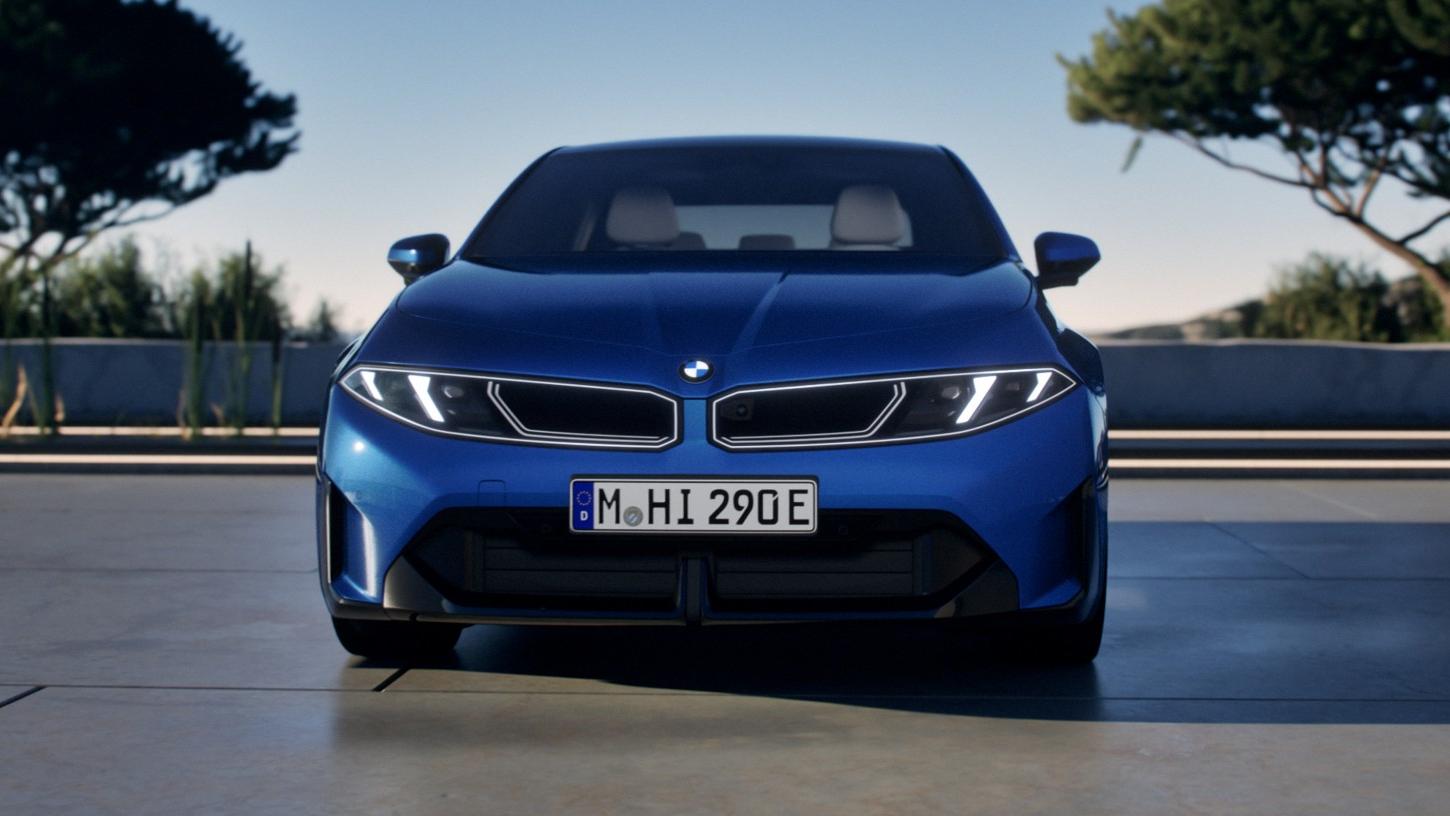
This is also the car Mercedes is leaning on to answer the newly revealed BMW i3, which lands in U.S. showrooms around the same time with 463 hp and a preliminary 440 miles of EPA range. The gap between the two is narrower than the press materials suggest.

The C400 4Matic Delivers 482 HP And A 3.9-Second 0-60
The launch variant uses dual permanent-magnet motors producing a combined 482 hp and 590 lb-ft of torque, fed by a 94.5 kWh (net) lithium-ion pack. Mercedes quotes a 3.9-second 0-60 mph run and an electronically limited 130 mph top speed. The rear motor carries a two-speed transmission, with first gear tuned for acceleration and second for highway efficiency, while the front motor decouples when traction and power are not required.
A rear-wheel-drive single-motor variant follows later with a claimed 497 miles WLTP, or roughly 400 to 420 miles EPA. That version gets the bigger headlines in Europe. In the U.S., the AWD C400 4Matic arrives first.
Peak DC Charging Hits 330 kW, Adding 202 Miles In 10 Minutes
Mercedes quotes a peak DC fast-charging rate of 330 kW, which the company says adds up to 202 miles (325 km) of WLTP range in 10 minutes on a compatible station. That is the peak figure, not sustained. Under U.S. testing conditions, the real added range in the same 10-minute window lands closer to 160 to 170 miles. The BMW i3 50 xDrive claims 400 kW peak on its Neue Klasse platform, so BMW wins the spec-sheet comparison here, though how many U.S. stations can actually deliver 400 kW today is a different conversation.

The Interior Is All Screens With Some Physical Buttons Restored
The cabin is largely carried over from the GLC, which we covered in detail when the C-Class EQ interior teaser dropped earlier this month. The top-trim Hyperscreen measures 39.1 inches and houses the driver cluster, central infotainment, and a passenger display under a single glass panel. Lower trims get a Superscreen with a 10.3-inch driver cluster and dual 14-inch touchscreens. The base configuration swaps the passenger touchscreen for a digitally animated trim panel, which is a digital photo frame by another name.
Mercedes reinstated physical controls on the steering wheel and center console after the haptic-slider experiment on the combustion C-Class and CLA drew sustained criticism. Good. The panoramic glass roof gets 162 optional illuminated stars, and the grille houses up to 1,050 backlit pixels.
Rear-Wheel Steering And Predictive Air Suspension Target S-Class Ride Quality
The C-Class Electric can be optioned with rear-axle steering that turns up to 4.5 degrees opposite the fronts below 43 mph, cutting the turning circle to 36.7 feet (11.2 meters). Above that speed, the rear wheels turn up to 2.5 degrees with the fronts for stability. Optional adaptive air suspension reads the road ahead using Google Maps topology data and cloud inputs, preloading damper settings for upcoming pavement imperfections.
Mercedes claims the car is “as smooth as an S-Class on long journeys.” That is a bold line to print in a press kit, and the claim I am most skeptical of. The current EQE and EQS sedans on the older EVA2 platform do not ride with S-Class composure over broken expansion joints, and MB.EA is a new architecture with no independent long-distance review miles on it yet. If predictive damping delivers on even half of what Mercedes is claiming, that is a real step forward for the segment.

Pricing Is Not Confirmed, But $60,000 Looks Likely
Mercedes has not released U.S. pricing. Jalopnik’s estimate is roughly $60,000 for the C400 4Matic, slotting between the $51,000 combustion C300 and the $66,300 EQE 320 sedan. The federal EV tax credit is gone, and the C-Class Electric will be built in Germany, not Alabama. Buyers pay the tariff-era sticker without offset.
EVXL’s Take
This is the car Mercedes should have built instead of the EQS. The bulbous jellybean styling that defined the EQ era is gone, the MBUX software keeps physical controls where they matter, and the proportions finally read as a compact executive sedan instead of an airport shuttle. Three years late to its own positioning, but directionally right.
The industry delta: Mercedes is no longer competing with Tesla. It is competing with BMW. The i3’s 400 kW charging and 440-mile EPA figure set the bar for any premium German EV sedan launching in 2027, and the C400’s 330 kW peak and roughly 390-mile EPA estimate do not quite clear it. Where Mercedes wins is ride quality and interior materials. Where BMW wins is charging speed and, probably, handling. Both will fight over the same buyer who wants a $60,000 German EV sedan that is not a Tesla.
The bigger risk is demand. Mercedes paused EQE and EQS production for U.S. orders last summer after the federal tax credit was signed away, and the product blitz laid out by CEO Ola Källenius in August 2025 assumed an EV adoption curve that has since flattened. The C-Class Electric launches into a U.S. market that is skeptical of $60,000 German EVs without a credit to soften the bill.
Prediction: the C-Class Electric will undersell the combustion C-Class by at least 3 to 1 in its first full U.S. sales year, and Mercedes will quietly discount it by $5,000 to $7,000 within 18 months of launch. The product is sound. The pricing structure is the problem, and it is not one the engineering team can fix.
EVXL uses automated tools to support research and source retrieval. All reporting and editorial perspectives are by Haye Kesteloo.