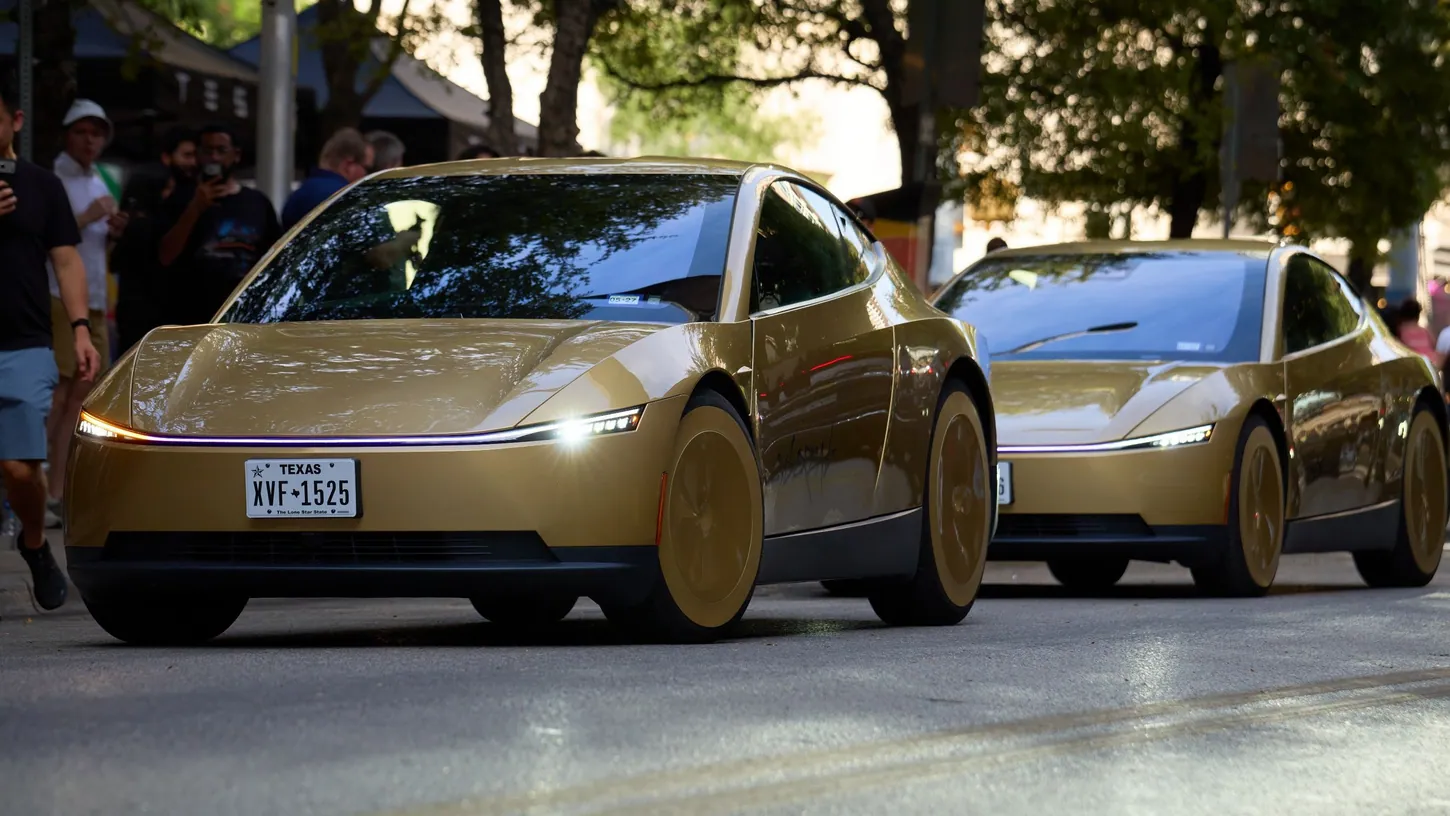

A team led by Dan Burkland posted on X early Sunday that they completed a Cannonball Run from the Red Ball Garage in Manhattan to the Portofino Hotel in Redondo Beach in 49 hours and 55 minutes, with their Tesla Model 3 running Full Self-Driving (FSD) v14.3.2 the entire way and zero driver disengagements. If verified, the run beats the January 22, 2026 zero-intervention FSD Cannonball mark of 58 hours 22 minutes, set by Alex Roy and his team in a Tesla Model S, by 8 hours and 27 minutes.
Burkland traveled with co-drivers posting under the X handles @BLKMDL3 and @AaronS5_. He said FSD handled every mile, including parking at each Supercharger stop. Telemetry and a full video are still pending, which puts the time in the same category Roy’s run held in its first 48 hours: a self-reported claim awaiting independent verification.
The comparison to Roy’s record is not apples to apples.
The Burkland Run Differs From Roy’s On Direction, Season, And Software
Roy’s January 22, 2026 zero-intervention run covered 3,081 miles eastbound from Redondo Beach to midtown Manhattan in mid-winter conditions of snow, ice, and slush, on a 2024 Tesla Model S equipped with HW4 hardware running FSD v14.2.2.3, the version that shipped to most v14-eligible owners that month. Burkland’s run went the opposite direction, westbound from New York to Los Angeles, in early May 2026, on a refreshed Model 3 running FSD v14.3.2.
The traditional NY-to-LA Cannonball route runs about 2,800 to 2,900 miles depending on which interstates a team picks, roughly 200 miles shorter than the 3,081-mile route Roy’s team logged. That distance differential alone, at typical Cannonball average speeds of 60 to 65 mph, accounts for somewhere around three to four hours of the eight-hour delta before software is even factored in.
Software is the next variable. v14.3.2 inherits the AI compiler rewrite from v14.3, which Tesla shipped in early April with a claimed 20% reaction-time improvement built on a ground-up MLIR (Multi-Level Intermediate Representation) rebuild. EVXL covered that release in detail when v14.3 began rolling out in April. v14.3.2 is two point revisions past v14.3, and Tesla’s 20% reaction-time figure has not been independently benchmarked. Roy ran v14.2.2.3 in winter weather. Burkland’s claim runs v14.3.2 in May, with no precipitation reported.
The Parking Bar Just Got Higher
Burkland framed the run on X as zero disengagements across the entire trip, “including parking at every charging stop”, a phrasing that explicitly folds Supercharger lot maneuvering into the autonomy claim, where prior FSD Cannonball attempts treated parking lots as a known soft spot the driver took over for. That distinction tightens the autonomy bar in a way the headline number does not.

A December 2024 Roy attempt required 32 interventions, most of them in charger lots and surface streets. A subsequent Roy run in early 2025 cut total human input to 5 minutes 20 seconds, again concentrated around charging stops. v14.3 explicitly listed improved parking pin prediction and increased decisiveness in parking spot selection in its release notes. If Burkland’s promised video confirms zero parking interventions across roughly 20 to 25 charging stops, that is the technical headline beneath the time.

Verification Is The Open Question
The X post includes timestamped clocks at the Portofino finish-line monument, a Red Ball Garage selfie at the start, and exterior shots of the Model 3 at both ends, but it does not yet include continuous GPS logs or a timestamped charge-session record with entry and exit times for every Supercharger stop. Roy’s January 22 run published telemetry within days, and reception stayed cautious until The Drive and Autoblog independently spoke with the team.
Until Burkland’s promised data drops, the 49:55 number sits where Roy’s run sat for its first 48 hours: claimed, plausible, unverified.

EVXL’s Take
The cadence is the story. Roy’s record landed January 22, 2026. Tesla shipped v14.3 with the MLIR compiler rewrite in early April. Six weeks later, a separate team is claiming a faster zero-intervention run on the newer software. That tracks the same arc that pushed FSD from 32 interventions in December 2024 to none in January 2026, and it lines up with what we flagged when v14.3 release notes hit: this is infrastructure work that pays off across many subsequent releases, not a single-update bump.
The skeptical read: Tesla has every reason to amplify a public zero-intervention third-party run while an active NHTSA investigation into 2.88 million FSD-equipped vehicles remains open, and while the company has retired the $8,000 FSD purchase option in favor of subscription-only access at $99 a month. A clean Cannonball claim is good marketing for that subscription. None of that disproves the claim. The verification bar should be high.
Burkland’s telemetry will land within 10 days, the run will hold up on GPS and video review, and another team will post a sub-48-hour westbound zero-intervention attempt before Q3 2026 closes.
Source: Dan Burkland on X.
EVXL uses automated tools to support research and source retrieval. All reporting and editorial perspectives are by Haye Kesteloo.