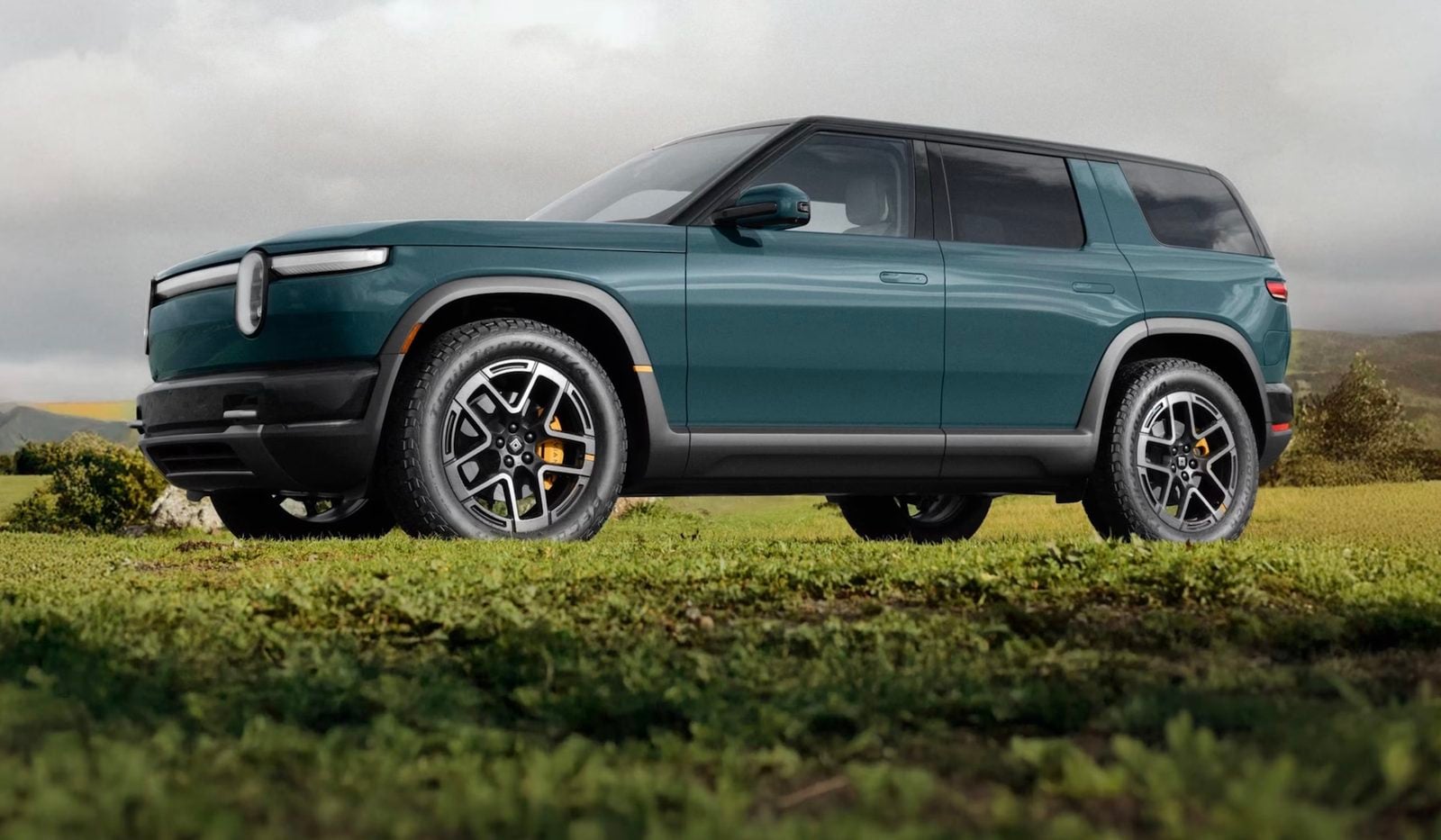
EPA certification documents for the Rivian R2 have leaked via Rivian Forums, and the range numbers beat the company’s own projections. The Performance trim on 21-inch all-season tires earned an EPA-estimated 335 miles of range, five miles more than the 330-mile figure Rivian published at the March SXSW launch. Jonathan M. Gitlin at Ars Technica first reported the certification details on April 7, 2026. Employee deliveries are scheduled to begin this month at Rivian’s Normal, Illinois plant, with customer deliveries following as production ramps up.
The numbers look good on paper. In practice, a few details in these same documents warrant attention before R2 reservation holders start planning cross-country trips.
The R2 Performance Beats Its Own Estimated Range on Both Tire Setups
The EPA tested two configurations of the Performance AWD variant. On 21-inch all-season tires, the R2 earned 335 miles, the figure that will appear on the window sticker. Swap to 20-inch all-terrain tires and range drops to 314 miles EPA estimated, still five miles above Rivian’s preliminary 307-mile estimate for that setup. Both results come from actual EPA test cycles conducted at FEV Michigan and the EPA’s Ann Arbor laboratory between February and early March 2026, per a detailed EPA filing breakdown published by EV.com.
The tire result tells an interesting story. Conventional wisdom says smaller wheels improve EV range because smaller, narrower tires displace less air. Here the opposite holds: the 20-inch wheels are fitted with knobby all-terrain rubber, and the aerodynamic drag from that tread pattern costs 21 miles of range compared to the 21-inch all-season setup. If you’re configuring an R2 for off-road weekends, that’s a real-world number to factor in before checkout.
The usable battery capacity in the EPA documents is listed at 86.8 kWh, slightly below the 87.9 kWh Rivian has cited in its own specifications. The difference is minor and typical of how automakers describe rated versus usable capacity, but it’s worth noting that the marketed number and the tested number don’t match.
The Efficiency Claim Deserves Skepticism
The EPA documents show a combined efficiency of 144 MPGe for the Performance trim on 21-inch wheels. That figure would place the R2 as the second most efficient production EV available in the United States, trailing only the Lucid Air Pure at 146 MPGe, and ahead of the Tesla Model Y at 138 MPGe. The R2 weighs 4,998 pounds on that configuration, nearly 800 pounds more than the Model Y Performance at 4,466 pounds. A boxy, nearly 5,000-pound SUV outperforming a sleek, lighter sedan on efficiency is not impossible, but it strains credibility.
The likely explanation: the EPA gives manufacturers flexibility in testing procedures. Some automakers use more conservative protocols; others choose more lenient ones. EV startups have historically tended toward the lenient end. That doesn’t mean 335 miles is fiction. It means the real-world number will almost certainly land lower for most drivers, and the gap between window-sticker range and actual range may be wider than what Model Y or Ioniq 6 owners typically experience. Rivian has not confirmed which testing option it selected.
Peak Charging Is 210 kW — But the Average Rate Tells a Different Story
The EPA certification lists peak DC fast charging at 210 kW with Level 2 AC charging at 11.5 kW (48 amps at 240 volts). The R2 uses a NACS connector positioned at the rear left corner, compatible with Tesla Superchargers and the Rivian Adventure Network.
Here is the number that matters more than the peak: Rivian says the R2 charges from 10 to 80 percent in 29 minutes. Do the math on 86.8 kWh and that works out to an average charge rate somewhere between 107 and 126 kW, depending on how much of that capacity is accessible across the tested window. Either figure is roughly on par with the R1’s average, and well below the 210 kW peak. That peak applies only at low state of charge and only briefly. Anyone planning a road trip around peak charge rates will be disappointed at a charging stop.
For context, the Hyundai Ioniq 6 on an 800V architecture charges at a sustained rate that keeps it near its 240 kW peak for far longer than typical 400V vehicles can maintain their peak. The R2 is a 400V platform. That’s not a disqualifying fact, but it shapes what fast charging actually looks like in practice.
The Heat Pump Wrinkle
One line in the EPA certification documents created confusion: the tested vehicle was described as using a conventional air conditioning system, not a heat pump. Rivian has since confirmed to multiple outlets, including Rivian Trackr and InsideEVs, that all production R2 units, including the Launch Edition, will ship with a redesigned heat pump system. The EPA note reflects how the test vehicle was configured, not what customers will receive.
That clarification matters for cold-weather performance. A heat pump recovers waste heat from the battery and powertrain to warm the cabin, consuming less energy than a resistive heater. Rivian’s own documentation states that real-world range should improve over the EPA-tested baseline when the temperature drops below roughly 20°C (68°F). The 335-mile figure, in other words, was earned without the benefit of the production car’s heat pump. In typical winter conditions, the R2 should do better than competitors tested under the same constraints, though real-world winter range will still be lower than the 335-mile EPA figure regardless.
The R2 battery uses nickel cobalt aluminium (NCA) chemistry. A separate label in the January EPA filing referenced lithium iron phosphate (LFP) chemistry, suggesting a second battery variant may be planned, potentially for the lower-cost Standard trim with a smaller pack arriving in late 2027.
EVXL’s Take
The R2 EPA result is genuinely good news for Rivian. Beating a manufacturer’s own range estimate out of the gate is the right way to start a launch, and it stands in contrast to the industry norm of certified numbers that land below internal projections. When we covered the R2’s SXSW debut, the charging spec was already the weak point — 29 minutes to 80 percent matched a Model Y, not a class leader. Nothing in the EPA documents changes that. The range headline will dominate coverage this week; the average charge rate is the number that will shape how R2 owners actually feel about the vehicle on road trips six months after delivery.
I haven’t driven the R2 yet. First customer deliveries haven’t started. What I’d want to check before forming a firm view on that efficiency claim: what test procedure option Rivian selected, and whether early owners’ real-world numbers on a full highway run match the EPA figure or come in closer to 280–300 miles, which is where Rivian’s own efficiency physics suggest a 5,000-pound boxy SUV should land. The Lucid Air comparison alone — a car designed from the ground up around aerodynamic efficiency — should give any observer pause. The counter-case is real: the R2 is roughly 1,300 pounds lighter than the R1S on a purpose-built platform, and weight reduction at that scale does move efficiency dramatically. It’s possible the number holds. First-owner highway data will tell.
As I noted in our Q4 earnings coverage, Rivian projected more than 22,000 R2 deliveries in 2026. The company needs that volume to close its cash burn. A 335-mile EPA sticker makes the R2 easier to sell against a Model Y Long Range RWD at 357 miles; a 300-mile real-world result on the highway would not. First-owner data will settle this debate by summer. If the R2’s real-world range on a 70 mph highway drive with climate control running lands consistently above 290 miles, Rivian has a genuine Model Y challenger. If it falls short of that, the efficiency story unravels publicly — at the worst possible moment in the launch cycle.
Frequently Asked Questions
What is the Rivian R2’s official EPA range?
The R2 Performance on 21-inch all-season tires is EPA-rated at 335 miles. With 20-inch all-terrain tires, range drops to 314 miles EPA estimated. Both figures apply to the dual-motor Performance trim and were certified ahead of spring 2026 deliveries.
How fast does the R2 charge?
Peak DC fast charging is rated at 210 kW. Level 2 AC charging tops out at 11.5 kW (48 amps). Rivian says 10 to 80 percent takes 29 minutes, implying an average charge rate of roughly 107–126 kW depending on available capacity across that window. Peak rates apply only briefly at low battery levels; real-world sustained charging will be lower.
Does the R2 come with a heat pump?
Yes. All production R2 units, including Launch Edition vehicles, will ship with a redesigned heat pump system that integrates valves, sensors, heat exchangers, and the refrigerant bottle into a single compact assembly. The EPA test vehicle used conventional air conditioning, so cold-weather range on production cars should be better than the certified figure suggests.
What battery chemistry does the R2 use?
The Performance trim uses nickel cobalt aluminium (NCA) chemistry in a three-module pack with 86.8 kWh of usable capacity. A separate EPA filing referenced lithium iron phosphate (LFP) chemistry, suggesting a possible second battery variant for future lower-cost trims.
How does R2 range compare to Tesla Model Y?
The R2 Performance at 335 miles EPA beats the Model Y Performance at 306 miles EPA. The Model Y Long Range RWD, however, holds the edge at 357 miles EPA. The R2 is also nearly 800 pounds heavier than the Model Y Performance, which makes its efficiency numbers, if accurate, a notable engineering achievement worth tracking in real-world owner data.
EVXL uses automated tools to support research and source retrieval. All reporting and editorial perspectives are by Haye Kesteloo.
Discover more from EVXL.co
Subscribe to get the latest posts sent to your email.