One day after reporting Q4 earnings that beat revenue estimates, Lucid Group filed a WARN notice with California’s Employment Development Department disclosing 319 job eliminations at its Newark headquarters, effective April 21, according to the Mercury News. That’s the third consecutive year Lucid has filed layoff notices at the same address: 123 workers cut in 2023, 258 in 2024, and now 319 in 2026.
The Newark cuts are part of a broader 12% global workforce reduction Lucid announced February 20, confirmed by an internal memo obtained by TechCrunch. Based on the company’s 6,800 reported headcount at end of 2024, the 12% figure puts total cuts somewhere between 750 and 800 positions.
- The Cut: 319 permanent eliminations at Lucid’s Newark, California HQ, effective April 21, 2026, per California WARN Act filing.
- The Scope: Part of a company-wide 12% reduction affecting salaried workers across battery testing, R&D, simulation, functional safety, and talent acquisition. Hourly manufacturing workers in Arizona are not affected.
- The Context: Lucid lost $2.7 billion on a GAAP basis in 2025 on $1.35 billion in revenue. That’s roughly $3 spent for every $1 earned.
- The Buyer Question: If you’re considering a Gravity or Air purchase, here’s what Lucid’s financial runway actually means for your warranty.
Lucid’s Newark Layoff Pattern Shows No Sign of Stabilizing
Lucid’s Newark facilities are its engineering and corporate nerve center. The 319 positions cut this April add to 381 eliminated at the same location over the prior two years. None of the affected workers have bumping rights to displace less-senior employees, and none are union-represented, according to the WARN letter signed by associate general counsel Russell Jones.
Interim CEO Marc Winterhoff framed the cuts in the standard language: improve operational effectiveness, optimize resources, continue the path toward profitability. The company said its core priorities are unchanged, with Gravity SUV production and the upcoming midsize platform still on track.
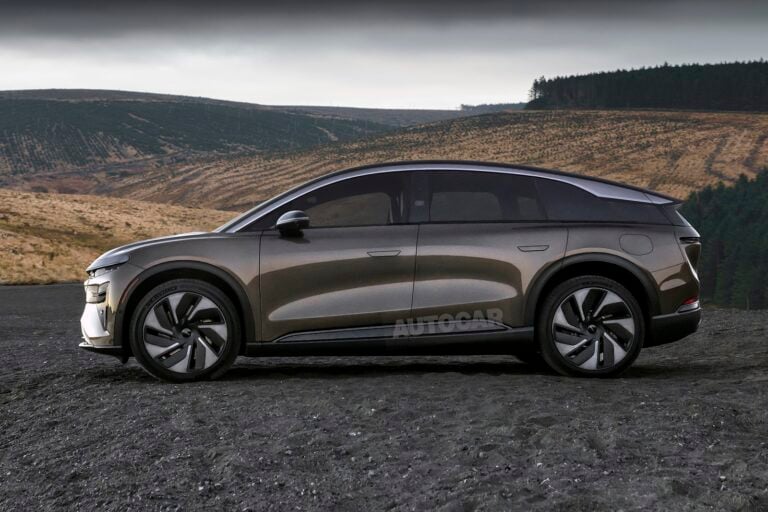
That midsize platform is the vehicle Lucid actually needs. The Lucid Air starts at $70,900. The Lucid Gravity Touring starts at $79,900. Despite sitting under the old $80,000 MSRP cap, neither vehicle qualified for the $7,500 federal EV tax credit under the battery sourcing rules — and that credit expired entirely on September 30, 2025. The planned midsize crossover, targeting around $50,000, would put Lucid directly against the Tesla Model Y for the first time. Production is expected to begin in Saudi Arabia in late 2026 or early 2027.
The Financial Hole Keeps Getting Wider
Lucid’s Q4 2025 results, reported just one day before the WARN notice surfaced, showed the scale of the problem. Q4 revenue of $522.7 million beat estimates by 14%. But adjusted loss per share came in at $3.08 versus the $2.63 consensus. Free cash flow burned $1.24 billion in Q4 alone, and $3.8 billion across the full year. CFO Taoufiq Boussaid said total liquidity of $4.6 billion funds operations into the first half of 2027.
That’s the runway. Saudi Arabia’s Public Investment Fund, which owns a majority stake, has expanded credit facilities repeatedly and shows no sign of walking away from its Vision 2030 industrial showcase. But the PIF’s willingness to backstop Lucid doesn’t change what the income statement says: the company loses money on nearly every vehicle it sells.
As we analyzed in December, the question for Gravity and Air buyers isn’t whether Saudi Arabia can keep Lucid solvent. It’s whether the company can fix its quality and software track record before it needs to raise capital again. The 2026 UX 3.0 software overhaul and cup holder redesign we covered in our January software roadmap piece are real improvements. Whether they arrive on schedule is a different matter.
EVXL’s Take
Three years. Three WARN notices. Same address. That’s the pattern Lucid can’t seem to escape in Newark.
The 12% global cut makes operational sense. Lucid produced 17,840 vehicles in 2025 and is guiding 25,000-27,000 for 2026. You don’t need a headcount built for a 100,000-unit company when you’re still at 18,000. But cutting R&D and functional safety staff while racing to launch a new midsize platform is a tightrope walk that Lucid has stumbled on before. Earlier this year, the company quietly revised its preliminary 2025 production count down by 538 vehicles after units failed internal validation. That’s the kind of quality control gap that tends to appear when organizations are stressed.
The post-tax-credit market is brutal for anyone selling $80,000 EVs. Morgan Stanley projected U.S. EV volumes falling 20% in 2026 when they downgraded Lucid to Sell in December. That call looks increasingly accurate. Lucid’s Q4 revenue beat was real, but it was driven by Gravity deliveries to a backlog that was already built. The question now is whether they can sell 25,000 units into a market that lost its biggest demand driver five months ago.
My call: Lucid reaches its 2026 production guidance of 25,000-27,000 vehicles, but misses on the delivery side by at least 15% as post-incentive demand proves softer than management expects. Expect another restructuring announcement in Q3 2026 once the midsize platform launch slips past year-end.
Editorial Note: AI tools were used to assist with research and archive retrieval for this article. All reporting, analysis, and editorial perspectives are by Haye Kesteloo.
Discover more from EVXL.co
Subscribe to get the latest posts sent to your email.