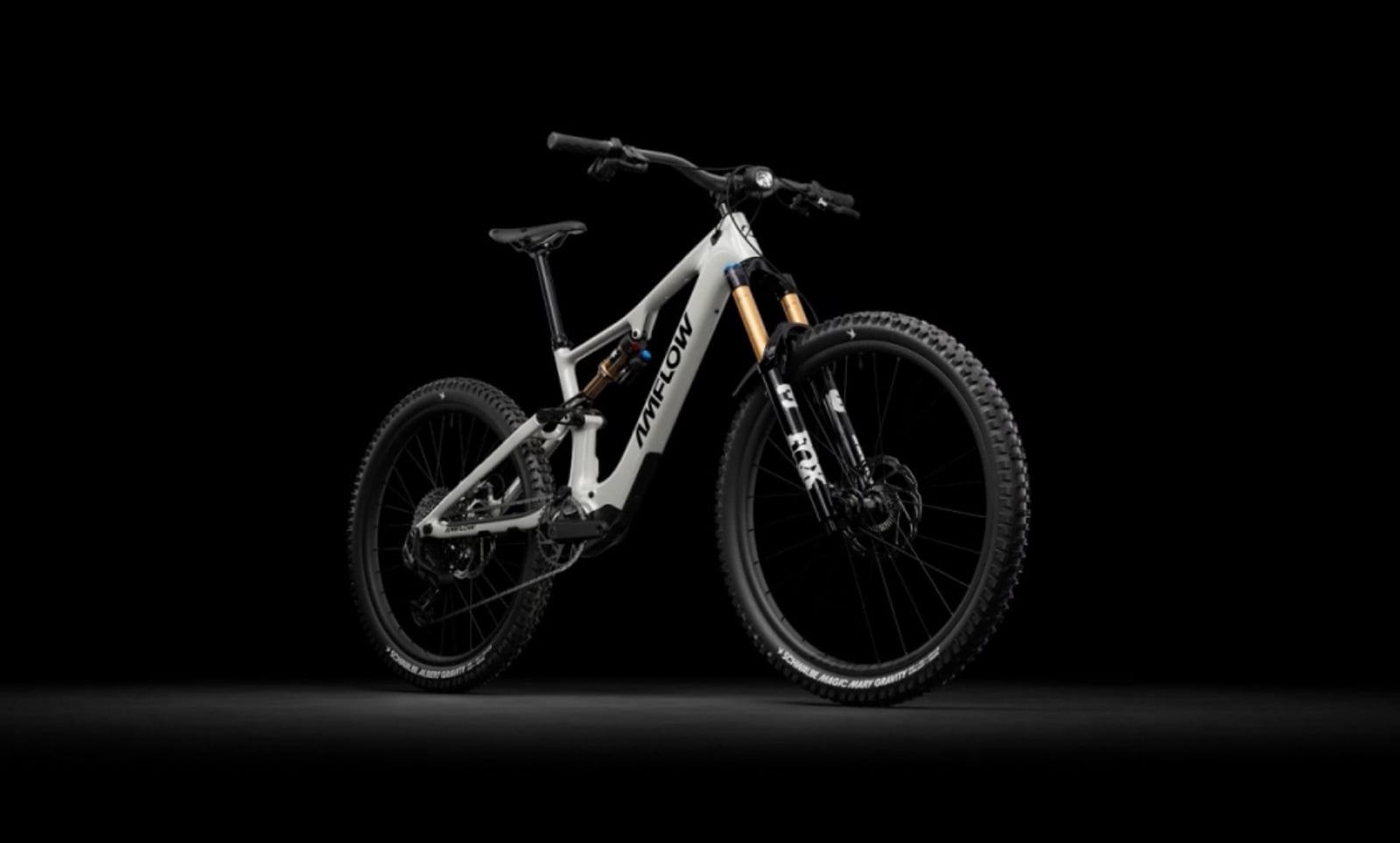
Avinox, the e-bike drive system brand whose motors power DJI‘s Amflow bikes, launched its next-generation M2S and M2 drive units on April 9, 2026. The official announcement from Shenzhen puts the M2S at 1,500W peak power and 150 Nm of peak torque — numbers well above the 85 Nm, 600W ceiling that Bosch and Shimano have held for years. The M2 sits below it at 1,100W and 125 Nm. Both units weigh approximately 2.6 kg, nearly identical to the outgoing M1, meaning Avinox achieved the power jump through density improvements rather than added size. Over 60 OEM partners have already committed to the new systems, including Canyon, Pivot, Mondraker, and Commencal.
M2S and M2 Specs Put Bosch and Shimano Further Behind
The Avinox M2S delivers 1,500W peak power and 150 Nm peak torque, with 130 Nm available continuously — figures that were not part of the mid-drive conversation even two years ago. When we covered the Amflow PL Carbon’s U.S. launch in July 2025, the M1’s 105 Nm and 1,000W Boost figure already looked extreme next to Bosch’s 85 Nm and 600W. The M2S makes the M1 look conservative.
According to Avinox’s press release, the M2S achieves a 45% increase in power density and a 21.6% increase in torque density compared to the M1, while the M2 adds a 4.6% power density gain. The weight change is minimal: the M2S comes in at 2.59 kg, the M2 at 2.65 kg, against the M1’s 2.52 kg. That’s an engineering achievement worth taking at face value — though Avinox notes all figures are from controlled test conditions and actual results may vary.
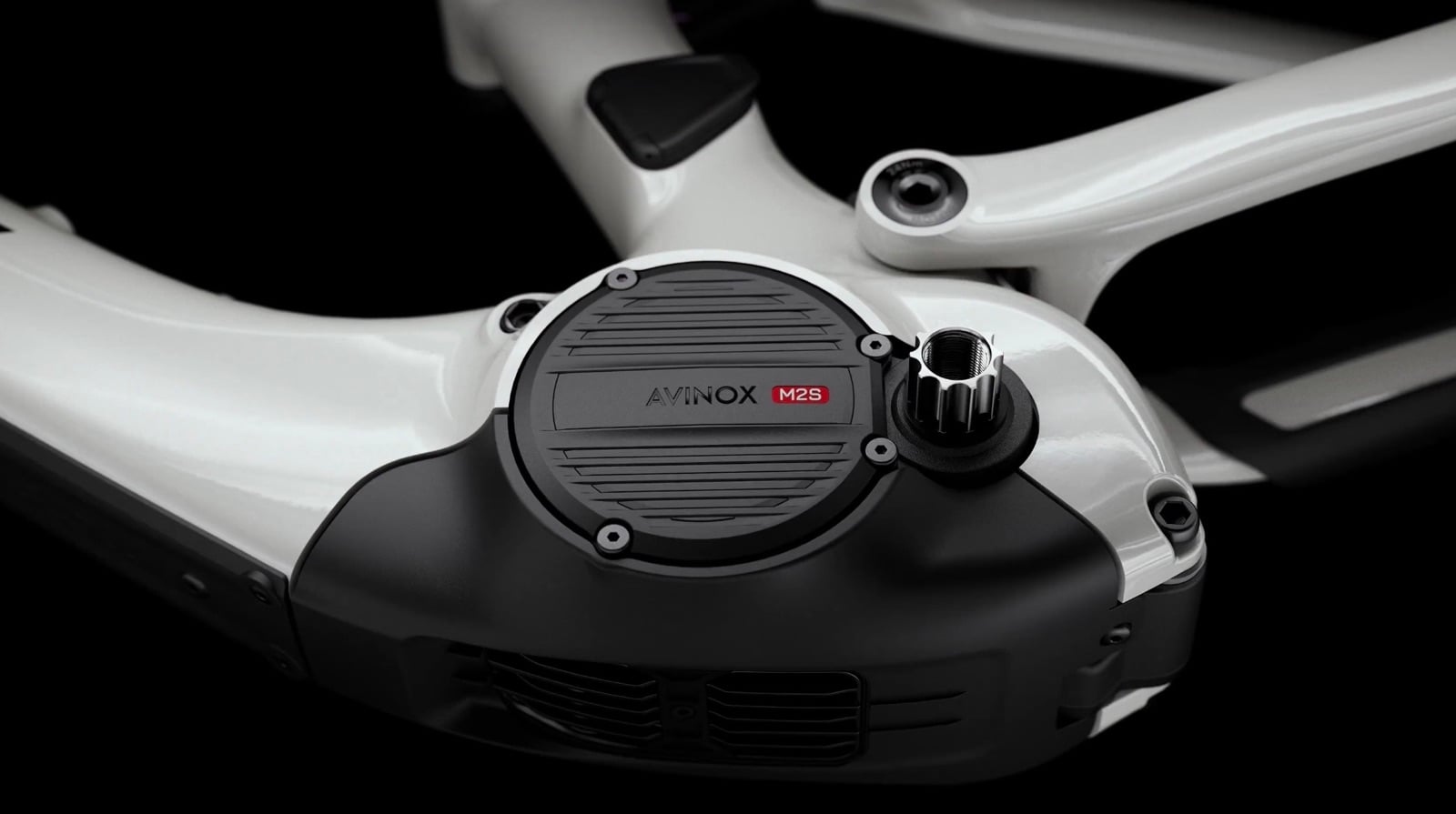
Noise held steady despite the power increase. Both units operate at or below 45 dBA. The M2S uses a dual-gear meshing design to eliminate gear play and pedal kickback. The M2 uses helical gears to cut knocking and rattling on rough terrain. The M2S also gains new cooling fins, flat wire windings, and an integrated temperature sensor to sustain high output without thermal throttling during long climbs.
RS800 and RS600 Are Avinox’s First Removable Batteries
Avinox is shipping its first removable battery options alongside the new motors. The RS800 delivers 800 Wh at roughly 4 kg with an energy density of 200 Wh/kg. The RS600 offers 600 Wh at approximately 2.96 kg and can also mount externally on a frame as a second battery, extending range for longer rides. Both units release with a quick-release mechanism, so riders can charge without moving the entire bike to an outlet.
The integrated FP700 battery — fixed in the frame — rounds out the lineup at 700 Wh, weighing 3.18 kg at an energy density of 220 Wh/kg. Using a GaN 3x fast charger, it goes from 0% to 80% in 1 hour and 16 minutes. Removable batteries have been standard on commuter and city e-bikes for years, so their arrival here is overdue rather than surprising — but for apartment riders and anyone without a charging point near bike storage, it removes a real friction point.
New Displays Bring Heart Rate Assist and Apple Find My
Avinox is releasing two new 2-inch OLED full-color displays: the DP100-F and the DPC100. Both handle turn-by-turn navigation via imported routes from third-party planning apps, displayed directly on the screen. The heart rate-based assist control is worth singling out: pair a monitor, set a target heart rate zone, and the motor increases assist when your heart rate climbs above it and reduces output when you drop below. It’s a more rider-aware auto mode than the terrain-sensing systems most competitors currently offer.
Apple Find My integration is available on the DPC100, letting riders check bike location and battery level or trigger a sound alert through the Find My app. Abnormal movement alerts via Bluetooth and full parameter customization through the Avinox Ride app — assist levels, start assist, max torque — round out the software side. All new M2S and M2 components are also backward compatible with M1-generation hardware, a cross-compatibility commitment Bosch has not offered across its own system generations.
The Legal Line Both Motors Cross
Both the M2S and M2 exceed the power limits that define a legal e-bike in most major markets. In the United States, Class 1, 2, and 3 e-bikes are capped at 750W. The European Union caps pedelecs at 250W continuous. A motor rated at 1,500W peak or 1,100W peak places any bike it powers outside those classifications on public roads and shared paths in virtually every jurisdiction where Avinox operates.
Avinox does not address this in the announcement. Compliance is left to individual brands and riders. That’s the same approach DJI’s Amflow took with the M1, which also exceeded legal boost-mode limits. In practice, most of these bikes will be ridden on private trails where road classifications don’t apply. But Canyon and Pivot also sell e-MTBs that end up on public multi-use paths, and the regulatory question isn’t going away. Regulators in both the U.S. and EU are already debating where to draw the line on higher-power e-bikes, and the OEM brands taking on these motors carry the liability exposure Avinox’s announcement sidesteps.
60 OEM Partners Signal a Platform Shift
When Avinox launched the M1 in 2024, the brand was largely known as the motor inside DJI’s Amflow bikes. Sixty-plus OEM partners — spanning Canyon, Pivot, Mondraker, Commencal, Atherton, Propain, Whyte, and Forbidden — changes that picture. Avinox notes the partner list is partial. Having brands commit to a drive system is not the same as shipping bikes in volume, and some of these partnerships may be early-stage. Still, the coverage is broad enough to place Avinox across multiple tiers of the premium e-MTB market simultaneously, which the M1 launch never achieved.
The broader e-bike market is pulling serious investment from technology companies alongside traditional cycling brands. Rivian’s micromobility spinoff Also entered the space in October 2025, and Rivian later spun both its e-bike and AI divisions out as separately funded startups. The motor supply race is the infrastructure layer underneath all of it — and it’s genuinely open right now in a way it wasn’t three years ago when Bosch was the default choice for any serious brand.
EVXL’s Take
I rode an Amflow PL Carbon on a proper trail session in Westchester, NY, and the M1 already felt like too much motor in Boost mode — the surge off the pedal stroke was unmistakably electric motorcycle, not bicycle. Trail mode was manageable, but the moment you hit Boost on a steep climb, the assist came in harder and faster than any Bosch or Shimano system I’ve ridden. The M2S with 130 Nm continuous torque and 1,500W peak won’t be subtler. For experienced riders on private terrain, that’s an argument for buying one. For anyone trying to stay legal on public multi-use trails, the spec sheet creates more questions than it answers.
The raw power numbers are the headline, but the partner count is the actual story. During its Black Friday sale, the Amflow PL Carbon came in at $6,499 against the Specialized Levo’s $7,299 — at full MSRP the Amflow sits $200 above the Levo, so the price advantage isn’t permanent, but the performance case is. Canyon and Pivot adopting the M2S means it will appear in bikes that reach riders who would never consider a brand tied to DJI. That’s the moment a motor supplier stops being a challenger and starts being the default. Bosch’s reply to the M2S, whenever it arrives, will determine whether it can hold the premium trail segment or concedes it.
With 60 brands committed by April 2026, Avinox-powered bikes will dominate at least a tier of major e-MTB releases before the year ends. If Bosch doesn’t respond with a credible performance answer by Eurobike 2026, its share of the high-performance trail segment will be measurably smaller — count the new OEM platform announcements at that show and the answer will be visible — by the time 2027 model-year bikes arrive.
EVXL uses automated tools to support research and source retrieval. All reporting and editorial perspectives are by Haye Kesteloo.
Discover more from EVXL.co
Subscribe to get the latest posts sent to your email.