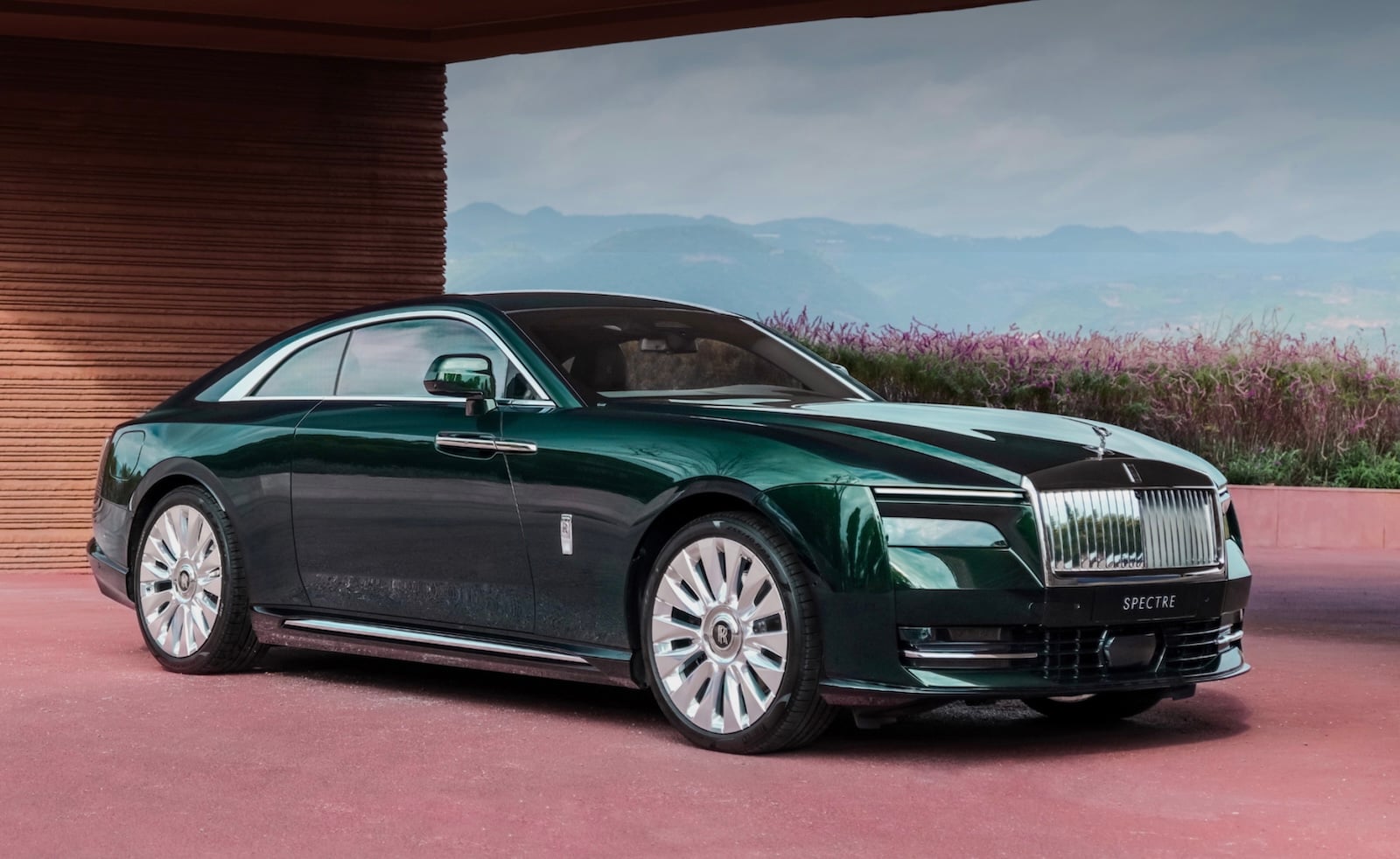
Rolls-Royce has abandoned its goal to sell only electric vehicles by 2030, with CEO Chris Brownridge confirming on March 18, 2026, that the company will continue producing V12 combustion-engine cars for the foreseeable future. The announcement, reported by The Guardian, reverses a pledge made under former CEO Torsten Müller-Ötvös, who set the all-electric target in 2021 and reaffirmed it at the reveal of the Spectre, the company’s first battery-electric vehicle, in 2022. Deliveries of the Spectre began in late 2023.
The numbers behind the decision are not ambiguous. According to BMW Group’s annual report, Spectre deliveries fell to 1,002 units in 2025, down 47 percent from 1,890 in 2024. The EV’s share of Rolls-Royce’s total sales collapsed from 33 percent in 2024 to 17.7 percent last year. Against a target of 70 percent EV share by 2028, the actual trajectory is moving in the opposite direction.
Brownridge Cites Changing Legislation and Divided Buyer Demand
CEO Chris Brownridge, who took over from Müller-Ötvös in December 2023, framed the reversal as a response to market reality rather than a repudiation of electric vehicles. “For every client that loves an electric vehicle, there is one who does not,” he said, according to The Guardian. “We recognise some clients would rather have a V12 engine. The V12 is part of our history.”
Brownridge did not offer a replacement electrification timeline or new EV sales targets. He declined to disclose what share of current sales comes from the Spectre. His defense of the previous commitment, “that prediction was based on a different set of circumstances”, covers two shifts: governments across Europe and the US have softened their EV mandate timelines, and the luxury buyer demand the original strategy assumed has not materialized at the volume needed.
Rolls-Royce Motor Cars is headquartered in Goodwood, West Sussex, and is owned by German automaker BMW. The company builds roughly 5,600 vehicles per year and is currently expanding its Goodwood plant in a £300 million project focused on bespoke and coachbuilt capacity, not additional EV production.
The Spectre’s Sales Collapse Explains the Strategy Shift
The Spectre is the clearest data point in this story. The two-door electric grand tourer carries an EPA-estimated range of 277 miles, charges at up to 195 kW peak, and starts at approximately $420,000 before Rolls-Royce’s extensive bespoke options. It accelerates from 0–60 mph in 4.4 seconds, brisk, but not the primary reason anyone buys a Rolls-Royce.
The launch wave was real: the Spectre accounted for 33 percent of all Rolls-Royce deliveries in its first full year on sale in 2024, and in Europe it outsold even the Cullinan SUV. What followed was a sharp correction. By 2025, deliveries had fallen nearly in half. Pre-owned Spectres are appearing at dealerships with six-figure discounts below original MSRP, not the behavior of a model holding its value in a healthy market.
Brownridge compared the trajectory to past Rolls-Royce models like the Wraith and Dawn, suggesting the initial surge was launch demand rather than structural appetite. That framing is plausible but does not fully account for the steepness of the drop or the fact that no comparable V12 model suffered a similar decline over the same period.
Luxury Automakers Are Retreating From Their EV Timelines
Rolls-Royce is not alone. Bentley, also UK-founded and German-owned (by Volkswagen), pushed its all-electric deadline from 2030 to 2035 in 2024, then dropped its fixed phase-out date entirely by September 2025. Porsche has since announced new internal combustion engine models after scrapping its own EV share targets. At the macro level, Honda told investors last week it expects a $15.7 billion restructuring hit tied to its EV strategy, and Stellantis booked more than €22 billion in charges largely connected to reversing course on electric vehicle commitments.
The EU’s effective relaxation of its 2035 combustion-engine phase-out, and the US federal government’s retreat from EV support under President Donald Trump, removed two of the regulatory pillars that justified aggressive 2030 targets in the first place. For manufacturers that set those targets in 2021 and 2022, the calculation has genuinely changed.
EVXL’s Take
What makes the Rolls-Royce reversal worth examining carefully is that this should have been the easiest electrification case in the entire industry. The objections that genuinely slow EV adoption at mass-market price points, charging infrastructure anxiety, purchase price premium, range limitations for long-distance commuters, are irrelevant to a Rolls-Royce buyer. Rolls-Royce owners drive their cars an average of roughly 3,700 miles per year, per Bloomberg. That’s about eleven full charges on the Spectre’s 277-mile EPA range, annually. Range anxiety is not the issue.
I haven’t driven the Spectre, and I’ll say so plainly. But the data tells a story that doesn’t require a test drive to interpret: the Spectre is technically excellent, Edmunds called it genuinely enjoyable to drive, and it still fell off a cliff after its first-year novelty wore off. That points to something cultural rather than engineering. The V12 isn’t just a powertrain for this buyer. It’s the product. The sound, the mechanical weight, the sense that something large and expensive is happening under the bonnet, these are features, not bugs to be designed away.
The devil’s advocate position: Brownridge may be right that this is a launch-curve normalization rather than category rejection. First-mover buyers bought Spectres as a statement. The repeat buyers, the ones who’d replace a Ghost or Phantom with a Spectre, haven’t converted. If the next Cullinan offers an electric option and it lands well, the EV share could recover without any target in place. Flexibility isn’t inherently cowardice.
But the pattern across luxury automakers tells a harder story. When Bentley pushed back its EV target in late 2024, it was framed as strategic prudence. Within a year, the fixed date was gone entirely. Rolls-Royce has now taken the same path, just faster. The luxury segment has collectively decided that EV adoption will be demand-led rather than timeline-driven, and the demand, at the ultra-high end, appears softer than any 2021 forecast anticipated. My expectation: Rolls-Royce will not announce a new all-electric target date before 2030. The V12 stays in production through at least the end of this decade.
EVXL uses automated tools to support research and source retrieval. All reporting and editorial perspectives are by Haye Kesteloo.
Discover more from EVXL.co
Subscribe to get the latest posts sent to your email.