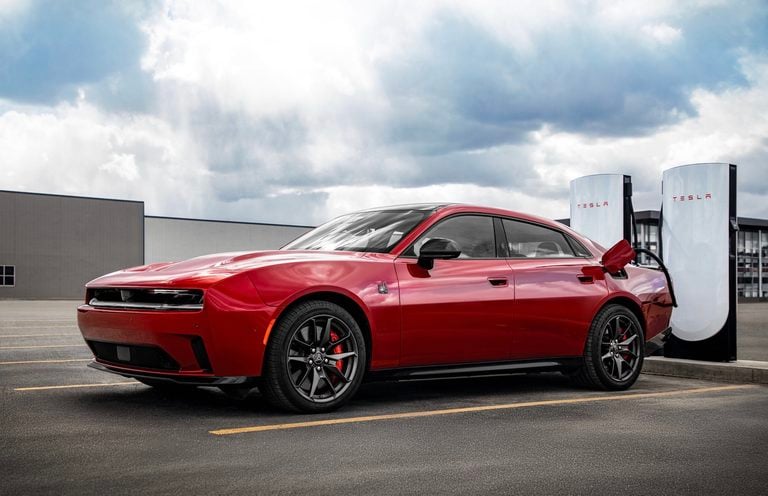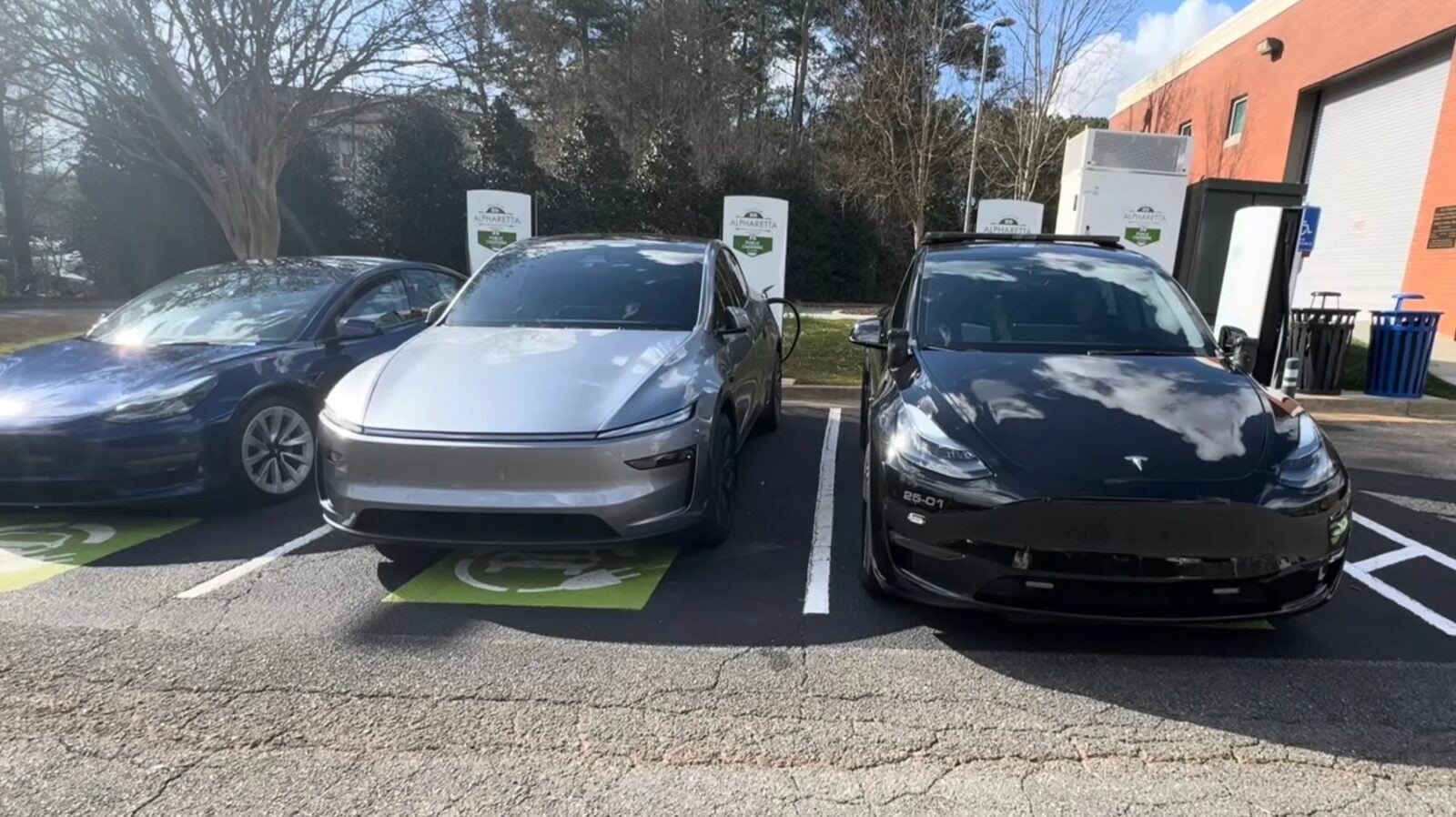
Four V3.5 Supercharger stalls are now live at the Alpharetta Department of Public Safety in Georgia, and the city owns them. Installed through Tesla’s Supercharger for Business program, this is believed to be the first time a municipality has deployed a city-branded Supercharging station on public property.
- The Fact: Alpharetta, Georgia, has deployed four city-branded Tesla Supercharger stalls at a public safety facility, believed to be the first U.S. city to own and operate a Supercharging station under Tesla’s Supercharger for Business program.
- The Delta: The stalls use V3.5 hardware, meaning V4 dispensers paired with a V3 power electronics cabinet, delivering up to 325 kW peak output at $0.35/kWh for all EVs, not just Teslas.
- The Setup: Primary purpose is charging electric police vehicles, but the station is open to the public and may generate modest revenue for the city.
- The Signal: Other municipalities are watching closely. The Supercharger for Business program is the lowest-friction path to deploying branded DC fast charging without building an independent network.
Alpharetta’s Supercharger Station: What’s Actually There
The Alpharetta City Supercharger sits at the city’s Department of Public Safety and consists of four V3.5 stalls, a configuration where V4-style dispensers draw from a V3 power electronics cabinet, topping out at 325 kW peak. The stalls are labeled “The City of Alpharetta, Georgia – public charging station,” which is a first for a Tesla-networked site. Pricing is $0.35/kWh flat for every EV that plugs in.
The primary driver was the city’s fleet of electric police vehicles, including Tesla Model Y patrol cars. We’ve covered the economics of police EV adoption in depth: a Missouri police department testing Model Ys found charging cost roughly $2.30 per full charge versus $24 for a tank of gas. For a department running vehicles around the clock, on-site charging infrastructure makes operational sense. Owning the charger and collecting $0.35/kWh from the public turns a fleet expense into something closer to a utility asset.
The Supercharger for Business Program Adds Another Category
Tesla’s Supercharger for Business program lets companies, operators, and now municipalities deploy Supercharger hardware under their own branding with their own pricing. Tesla handles the backend: network connectivity, software, and maintenance. The operator handles the site and collects the revenue. It’s the same approach Tesla announced at Power2Drive in Munich when it brought white-label Supercharger hardware to Europe: brand the station yourself, set your own rate, skip building your own network from scratch.
The program already includes commercial operators like Francis Energy, Suncoast Charging, and Wawa, plus smaller one-off deployments like the Pie Safe in Deary, Idaho. Alpharetta adds a new category entirely: a local government using the program to solve a fleet charging problem while keeping the infrastructure open to the public.
That’s a meaningful distinction. Most business Supercharger deployments are driven by commercial incentives, including customer dwell time, retail traffic, and brand visibility. A city has different motivations: fleet readiness, public infrastructure, and potentially a small income stream to offset costs. The $0.35/kWh rate is competitive with many third-party DC fast chargers and below what Tesla charges at many of its own Supercharger sites.
Police EV Fleets Are Building Their Own Charging Logic
The pattern of police departments adopting Teslas has been accelerating. West Iceland Police hit one million kilometers in their all-Tesla patrol fleet, reporting an 85% cut in emissions and compelling operational savings. In the U.S., departments from Missouri to California have been adding Model Ys to test the total cost of ownership against traditional patrol vehicles.
The charging side of that equation has been the variable most departments can’t fully control. Relying on public charging networks or home charging solutions for patrol vehicles creates scheduling friction. Owning the hardware and having it on-site at a public safety facility removes that friction entirely. Alpharetta appears to have solved this through the Supercharger for Business program rather than a custom infrastructure buildout.
Tesla’s Supercharger Network Continues Expanding Into New Contexts
The Alpharetta deployment comes as Tesla’s Supercharger network grows in ways that go well beyond Tesla-owned locations. The world’s largest Supercharger reached full operation in Lost Hills, California with 164 solar-powered stalls in November. Live Supercharger availability data now flows into Google Maps for all EV drivers. And the Business program keeps adding operators who want the network’s reliability without building independently.
V3.5 hardware, the configuration Alpharetta uses, is worth noting. V4 dispenser aesthetics on V3 power electronics gives the station a modern look while keeping costs within range for a city procurement budget. The 325 kW peak is more than enough for the Model Y’s actual charging curve, which plateaus well before that ceiling.
EVXL’s Take
This is the Supercharger for Business program doing something Tesla probably anticipated but hasn’t had a clear example of yet: a government entity using it to solve a real infrastructure problem and then opening the asset to the public. That’s a different value proposition than a Wawa or a hotel deploying stalls to attract customers.
Cities are slow procurement machines. If Alpharetta got four 325 kW stalls installed through a Tesla program with manageable upfront costs and Tesla handling the network backend, that’s a template other municipalities can follow without reinventing anything. The $0.35/kWh rate suggests the city isn’t subsidizing public charging. Whether it actually breaks even depends on Alpharetta’s utility rate and whatever program fees Tesla charges, neither of which is public. But the structure is right: a self-sustaining model matters enormously for cities that can’t justify charging infrastructure as a pure public expense.
The next test is replication. If ten cities have city-branded Supercharger stations by the end of 2025, the program’s municipal chapter is real. If Alpharetta stays a one-off, it’s a good story that didn’t scale. My read: at least a handful of other cities are already in conversations with Tesla after seeing this, and we’ll see a second city-owned Supercharger station before Q3 2026.
Source: EVChargingStations.com
Editorial Note: AI tools were used to assist with research and archive retrieval for this article. All reporting, analysis, and editorial perspectives are by Haye Kesteloo.
Discover more from EVXL.co
Subscribe to get the latest posts sent to your email.