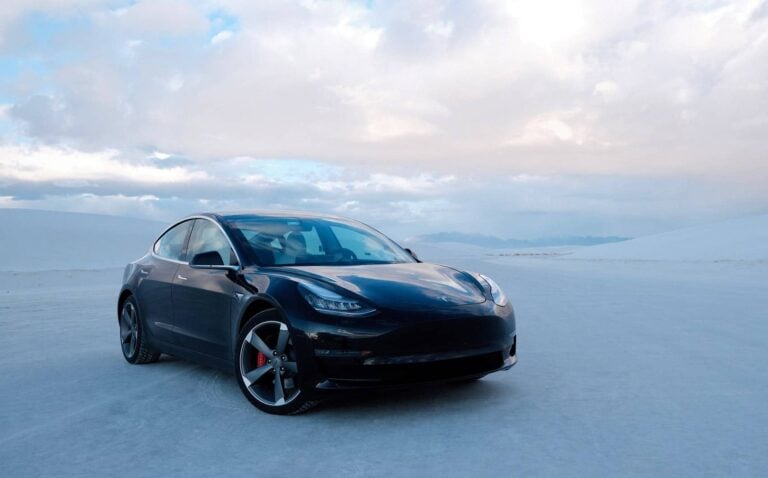
The Tesla app’s “Share Destination” feature was never designed for medical emergencies. But on November 15, 2025, at 3:50 AM on a dark stretch of I-20 in Georgia, that’s exactly how Jack Brandt’s family used it. His father was behind the wheel of a 2026 Model Y Launch Edition running FSD v14.1.3 when a massive heart attack hit. He couldn’t control the vehicle. He could barely stay conscious. FSD kept driving.
What happened next is the most detailed, verifiable account of FSD operating during a genuine life-threatening emergency that we’ve seen. And the details matter more than the headline.
- The Fact: A Tesla owner suffering a STEMI heart attack on I-20 was driven to Tanner Medical Center in Carrollton, GA by FSD v14.1.3 after his son remotely changed the vehicle’s navigation through the Tesla app from miles away.
- The Detail Nobody’s Covering: The car had already passed the Carrollton exit. FSD took the next exit, turned around, re-entered I-20 East, exited again, and navigated unfamiliar local roads directly to the Emergency Room entrance.
- The Medical Reality: Doctors at Tanner Medical Center told the family that if the father had pulled over and waited for an ambulance, or continued driving to Birmingham, he would not have survived. Three arteries required immediate intervention.
The Timeline: From Chest Pain to Emergency Room in Under an Hour
Jack Brandt’s father left Atlanta heading west on I-20 toward Birmingham, Alabama to help care for his mother. The 2026 Model Y had just received the FSD v14.1.3 update, which Tesla released on October 20, 2025 as part of its HW4-only v14 rollout. FSD was engaged for the highway drive.
At approximately 3:50 AM, Jack’s phone rang. His father was experiencing severe chest pain and couldn’t safely control the car. FSD was still engaged and still driving. Jack immediately conferenced in his grandfather, and the family had seconds to make a decision.
Jack’s grandfather contacted an uncle in Douglasville, GA, who knew about Tanner Medical Center in Carrollton, not far from the father’s location on I-20. Jack pulled up the hospital on Google Maps and shared the destination to his father’s Tesla through the app. As an authorized driver on his father’s Tesla account, he was able to remotely change the Juniper’s FSD navigation. He did this from his own 2014 Model S.
Then something happened that made the difference between life and death.
FSD v14.1.3 Executed a Highway Turnaround to Reach the Hospital
The Model Y had already passed the Carrollton exit on I-20 West. When the new destination came through, FSD immediately took the next exit, turned around, re-entered I-20 heading East, and drove back to the Carrollton exit. From there, it navigated local roads it had never driven before and pulled directly in front of the Tanner Medical Center Emergency Room entrance.
The father, fighting for consciousness, managed to switch the FSD speed profile to Mad Max to get there as fast as possible. The family called ahead, and ER staff were ready and waiting when the car arrived.
That speed profile choice is worth noting. NHTSA opened an investigation into Mad Max mode in October 2025 after reports of routine speeding and aggressive lane changes. Tesla reintroduced the mode with FSD v14.1.2, and it operates at speeds up to 85 mph on highways. In this case, the aggressive speed that regulators flagged as a safety concern may have been exactly what saved a man’s life.

A STEMI Heart Attack Leaves Zero Room for Delay
Brandt’s father was diagnosed with a massive STEMI heart attack, the most dangerous type of cardiac event. Three arteries required immediate intervention. Doctors told the family afterward that if he had pulled over and waited for an ambulance on a rural stretch of I-20 at 4 AM, or if he had tried to continue the remaining distance to Birmingham, he would not have made it.
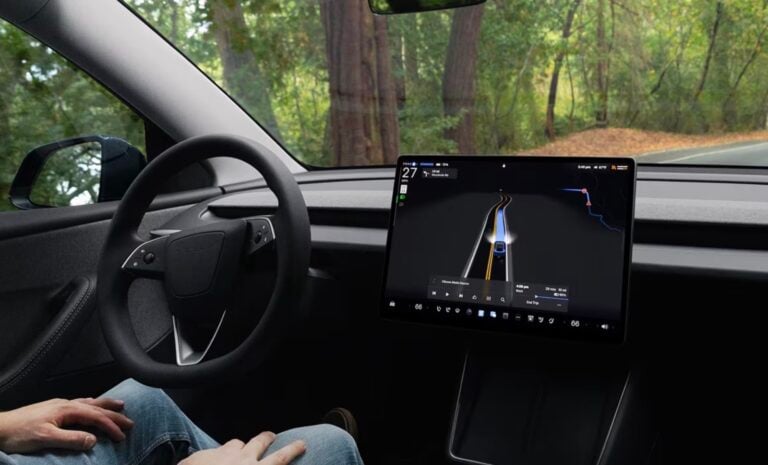
What the family didn’t know at the time: Tanner Medical Center in Carrollton specializes in cardiac care through its Adams Heart Center. The hospital has interventional cardiologists on call 24/7, ready to treat heart attacks the moment a patient arrives. The navigation screenshot shared by Brandt shows the car 9.4 miles away from the hospital at 4:31 AM, with 38% battery remaining.
Brandt’s father survived. A photo shared on X shows him sitting up in a hospital bed, giving a thumbs up while holding a “Get Well Soon” card. He’s alive and recovering.
This Is the Second Major FSD Medical Emergency Case, but the First With Remote Navigation
In April 2024, a North Carolina-based producer named MaxPaul Franklin used FSD v12 to drive himself 13 miles to a VA Emergency Room after his insulin pump malfunctioned, causing severe dehydration and a blood glucose level of 670. He suffered a mild heart attack but was able to engage FSD himself before losing the ability to drive.
The Brandt case is different in several ways. The heart attack was far more severe (STEMI requiring triple-artery intervention versus a mild cardiac event). The driver was on a highway between cities, not driving to a nearby hospital he already knew. And the navigation was changed remotely by a family member who wasn’t in the car. That remote capability turned the Tesla app into something closer to a remote emergency dispatch system.
In January 2026, a Cybertruck owner in New Mexico also credited FSD with avoiding a head-on collision on a two-lane highway when an oncoming pickup truck crossed the center line at 75 mph. That case was about collision avoidance. The Brandt case is about sustained autonomous navigation during a medical crisis where the driver was physically incapacitated.
The 2026 Model Y’s Radar Can Detect Heartbeats. It Can’t Act on Them Yet
There’s a detail in EVXL’s coverage of the 2026 Model Y Juniper refresh that becomes sharply relevant here. Tesla enthusiast Sawyer Merritt noted during his detailed walkthrough that the Juniper’s new radar system “can detect heartbeats and breathing patterns,” and that “Tesla hopes that at some point the technology will be able to detect life-threatening events such as a heart attack.”
The hardware is already in the car. The software to act on that data is not. If the 2026 Model Y Juniper could detect a cardiac event and automatically route to the nearest hospital without waiting for a family member to manually share a destination through the app, the time between heart attack onset and hospital arrival would shrink further. That’s the gap between where Tesla is now and where this technology could go.
FSD Is Still a Level 2 System. That Legal Reality Didn’t Change
Every story about FSD performing well in an emergency has to include this context: Tesla’s Full Self-Driving is classified as an SAE Level 2 driver-assistance system. It requires constant driver supervision. Using FSD while physically incapacitated is, strictly speaking, not how the system is intended to operate. Tesla’s own documentation states that drivers must remain attentive and ready to intervene at all times.
Musk himself has blurred these lines, telling a Tesla owner in December 2025 that FSD v14.2.1 permits extended phone use “depending on context of surrounding traffic.” NHTSA is investigating 2.88 million Tesla vehicles for FSD-related traffic violations, including 14 crashes that caused 23 injuries.
The Brandt case sits in a gray area that regulators haven’t addressed. Nobody would argue the father should have pulled over on I-20 at 4 AM during a STEMI heart attack and waited for an ambulance. The doctors said he’d be dead. But the system that kept him alive is the same system that NHTSA is investigating for running red lights.
The Post Went Viral. The Engagement Numbers Tell Their Own Story
Jack Brandt’s post on X has already accumulated 1,700 likes, 396 reposts, and 282 bookmarks within hours of publication. Tesla influencer Sawyer Merritt amplified it, calling it “probably the most incredible example yet of FSD saving a life.” His repost generated 666 likes and 34,000 views.
The timing matters. Tesla is weeks away from killing the FSD purchase option entirely on February 14, moving to subscription-only at $99/month. Stories like Brandt’s are the strongest marketing Tesla could ask for as it tries to convert 1.5 million free trial users into paying subscribers. CFO Vaibhav Taneja revealed in October 2025 that only 12% of the Tesla fleet has paid for FSD. A life-saving anecdote is worth more than any advertising campaign for closing that gap.
EVXL’s Take
I’ve covered FSD’s controversies extensively. The broken $100,000 appreciation promise. The NHTSA investigation into Mad Max mode. The glacial pace of European regulatory approval. All of that reporting stands.
But I won’t pretend this story doesn’t matter. A man is alive because FSD v14.1.3 kept a 2026 Model Y on the road at 4 AM on a Georgia interstate while he was having a heart attack. His son remotely rerouted the car to a hospital. The car turned around on the highway, navigated unfamiliar local roads, and delivered him to an ER with interventional cardiologists ready to save his life.
No other production vehicle on sale today can do what that Model Y did on November 15. Not a BMW. Not a Mercedes. Not a BYD. The combination of FSD’s autonomous navigation, the Tesla app’s remote destination sharing, and the authorized driver feature created a chain of capability that didn’t exist in any car five years ago.
That doesn’t erase FSD’s documented problems. It doesn’t make the NHTSA investigation less valid. It doesn’t change the fact that Tesla has spent years overpromising on autonomous timelines while collecting billions in prepayments for a feature that will never hit the $100,000 valuation Musk promised.
Both things are true at once. FSD is an imperfect Level 2 system under federal investigation. And on one night in November, it was the difference between a man living and dying.
Here’s what I’m watching: Tesla’s 2026 Model Y Juniper already has radar capable of detecting heartbeats and breathing patterns. The moment Tesla connects that detection capability to automatic emergency routing, FSD becomes a fundamentally different product. Not a driver-assistance feature. A medical safety net. Expect Tesla to announce cardiac detection as a software feature before the end of 2026. It’s too good a story for Musk not to ship it.
Editorial Note: AI tools were used to assist with research and archive retrieval for this article. All reporting, analysis, and editorial perspectives are by Haye Kesteloo.
Discover more from EVXL.co
Subscribe to get the latest posts sent to your email.