Tesla announced on March 20, 2026, that it has completed the final vehicle testing phase for Full Self-Driving (Supervised) in the Netherlands alongside the RDW (Rijksdienst voor het Wegverkeer, the Dutch vehicle authority), submitting all documentation required for UN R-171 approval and Article 39 exemptions. The RDW has communicated an expected approval date of April 10 — a three-week slip from the March 20 target that Elon Musk cited at Giga Berlin earlier this month. If that date holds, the Netherlands would become the first European market to greenlight FSD (Supervised), and Tesla says EU-wide recognition could follow during summer 2026. Tesla Europe’s official Middle East & Africa account posted the announcement on March 20.
This is the most concrete regulatory progress Tesla has produced in 18 months of documented friction with European authorities. Whether April 10 holds is a different question entirely.
Tesla and the RDW Have Completed Final Testing — Now the Review Begins
Tesla says it has wrapped the final vehicle testing phase for FSD (Supervised) together with the RDW and submitted a full documentation package covering UN R-171 requirements and Article 39 exemptions — the specific EU legal instruments Tesla is using to seek approval for a system that falls outside standard type-approval boundaries. The RDW is now reviewing that package internally before issuing any formal decision.
According to Tesla, the 18-month approval process included:
- 1,600,000+ km of FSD (Supervised) testing on EU roads
- 13,000+ customer ride-alongs
- 4,500+ track test scenario executions
- Thousands of pages of written documentation covering 400+ compliance requirements
- Dozens of research studies into safety performance
Those are Tesla’s own figures, unverified by any independent party. The March 1 EVXL article on this approval process noted that Tesla’s safety data is self-reported and that the RDW will want to verify it. That said, 1.6 million km of EU road testing, if accurate, represents a substantial dataset. The question is whether the RDW’s internal review finds it sufficient — particularly around scenarios involving dense scooter and cyclist traffic, which European roads generate at a frequency that U.S.-derived training data does not fully reflect.
The Date Slipped Once Already
April 10 is not the original target. When Musk spoke at Giga Berlin earlier this month — appearing there for a worker event ahead of the IG Metall union vote, not a product launch — he cited March 20 as the date the RDW had communicated, and hedged it twice in the same breath with “what I was told” and “hopefully that date remains the same.” It didn’t remain the same.
Tesla’s European FSD timeline has a consistent pattern. In November 2025, the RDW publicly denied Tesla’s claim of a committed approval and asked Tesla fans to stop calling their offices. Supervised road testing only began in early 2026, after months of regulatory friction. The shift from March 20 to April 10 is a three-week slip, not a catastrophic one — but it is a slip, and it comes in a process where Tesla has not yet hit a single self-announced European FSD deadline.
Tesla Europe’s own statement is appropriately careful: the RDW “has communicated the expected approval for Netherlands date of 4/10.” Expected. Not confirmed. Not signed.
The Regulatory Framework That Makes This Possible
The clearest path-opener here is the UN’s updated autonomous driving framework approved in draft in January 2026, which replaced prescriptive hardware and sensor requirements with an outcome-based “Safety Case” approach. Tesla’s neural-network vision system was never designed to satisfy the old rule structure. The new framework lets the RDW evaluate FSD on the basis of its own safety evidence rather than forcing it through specifications written for deterministic, sensor-fusion-based systems. Without that change, April 10 wouldn’t even be on the table.
Tesla is seeking approval under UN R-171 — the regulation it has cited in its own filings — combined with Article 39 of the European type-approval framework (Regulation EU 2018/858), which allows regulators to grant exemptions for vehicles using technologies not yet covered by existing rules. Together, these instruments give the RDW a legal basis to approve FSD as a novel system rather than try to classify it under categories written before supervised autonomy existed.
What Approval Actually Means for European Tesla Owners
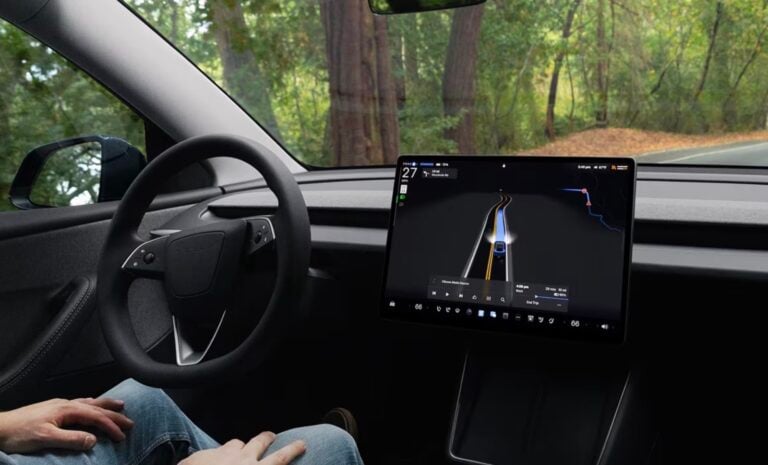
Netherlands approval covers FSD (Supervised). Drivers must remain attentive and keep hands available to intervene. This is a Level 2+ system, not unsupervised autonomy. It handles navigation, lane changes, traffic lights, roundabouts, and most urban driving scenarios — but the legal and operational responsibility stays with the driver.
For context: Mercedes received Level 3 approval in Germany in 2022 for Drive Pilot, which legally allows hands-off and eyes-off operation. Drive Pilot operates only below 60 km/h on mapped motorways in good weather. FSD (Supervised) requires continuous driver attention but operates across a far wider range of speeds and road types. Netherlands approval in April would greenlight a system that carries less legal autonomy than what German Mercedes drivers have had for four years — even though its real-world operational envelope is considerably broader.
The jump in capability for existing European Tesla owners would still be substantial. Tesla owners with AI4 hardware are currently limited to Autopilot in Europe; Netherlands approval would move them to FSD V14 overnight. I’ve used FSD V14 extensively on U.S. roads, and the gap between Enhanced Autopilot and FSD on a complex urban route is large enough that European owners genuinely haven’t experienced what their hardware is capable of. Whether V14’s behavior translates cleanly to Amsterdam or Brussels — with tram tracks, unmarked bike lanes, and right-of-way rules that differ materially from U.S. defaults — is something only post-approval real-world data will answer.
Netherlands approval does not automatically extend to Germany, France, Spain, or any other EU member state. Each country conducts its own certification process, though Tesla says it anticipates national EU recognition following the Netherlands decision, with a possible bloc-wide approval during summer 2026. That timeline is Tesla’s projection, not the European Commission’s.
EVXL’s Take
I’ve been tracking this saga since at least November 2025, when the RDW publicly contradicted Tesla’s own social media account. What’s different now is the substance: the final testing phase is actually complete, documentation has been submitted, and the RDW has communicated a specific date rather than a general timeframe. That is meaningfully further along than where we stood in March, when Musk was citing a third-party date with two caveats attached.
A regulator that reviewed 1.6 million km of road data and 4,500 track scenarios — even granting that those are Tesla’s own figures — and then communicated April 10 is not a regulator playing for time. The documentation is in. The review has started. That’s a different posture than the RDW denying everything in November.
The NHTSA unintended acceleration investigation that once loomed as the main wildcard has been resolved in Tesla’s favor — the agency found no evidence of a defect across 2.2 million vehicles. That removes one lever European regulators might have leaned on to justify a pause. The active FSD probe remains a separate matter, but with the SUA petition closed, the RDW’s path to sign-off before April 10 looks notably clearer.”
April 10 Netherlands approval is more likely than not at this point — roughly 65%. Full EU-wide availability by summer 2026 is Tesla’s most optimistic read. A more realistic outcome is two or three major EU markets following the Netherlands by year-end, with Germany and France taking until at least Q1 2027. Chinese competitors including Xpeng and BYD, which also benefit from the new UNECE framework, will be pushing for their own European supervised autonomy approvals on the same timeline. Tesla won’t have the European autonomous driving market to itself for long.
EVXL uses automated tools to support research and source retrieval. All reporting and editorial perspectives are by Haye Kesteloo.
Discover more from EVXL.co
Subscribe to get the latest posts sent to your email.