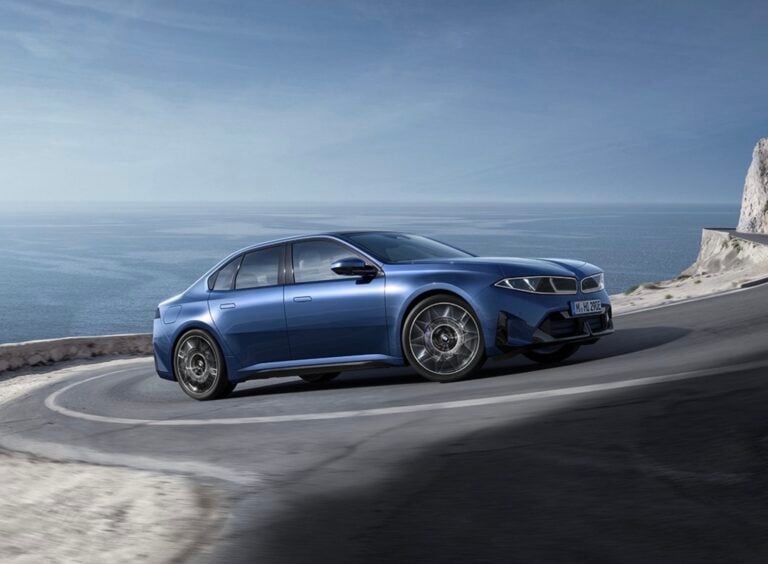
Porsche sold just 16,339 Taycans globally in 2025. That’s down from a peak of 41,296 in 2021 — a 60 percent collapse in four years. Those are the numbers sitting on incoming CEO Michael Leiters’ desk as he reportedly weighs whether to fold the Taycan and Panamera into a single unified model line.
- The Report: British magazine Autocar claims Leiters is considering merging the Taycan and Panamera nameplates to cut engineering and development costs.
- The Delta: Previous Porsche leadership had publicly said both models could coexist. That position appears to have changed with the leadership change.
- The Sales Reality: Taycan global volume dropped from 40,629 units in 2023 to 16,339 in 2025, its worst year on record.
- The Buyer Impact: If Porsche consolidates the two lines, Taycan buyers could find themselves on a discontinued nameplate within this decade.
Leiters Arrives at a Brand Under Financial Pressure
Michael Leiters, the former McLaren CEO, takes over Porsche at a moment when the brand is running out of runway for its original EV-first vision. Year-over-year sales fell 10 percent in 2025, following a three percent drop in 2024. China, historically one of Porsche’s most profitable markets, has seen demand decline by double digits for three consecutive years. Porsche posted its first-ever quarterly operating loss in Q3 2025 — a €967 million wipeout — which set the tone for the cost-cutting agenda Leiters now inherits.
The full-year 2025 picture is even more stark. According to Volkswagen Group’s earnings report released today, Porsche’s operating profit collapsed 98 percent for the full year — from €5.3 billion in 2024 down to just €90 million in 2025 — after the company booked €4.7 billion in writedowns tied to its retreat from its original EV roadmap. The charges include a €2.7 billion goodwill impairment reflecting the deflated value of Porsche’s EV ambitions on Volkswagen’s balance sheet. Porsche’s own full-year press conference, with Leiters and CFO Jochen Breckner presenting, is scheduled for tomorrow, March 11.
Engineering a wide portfolio of new models while revenue shrinks is expensive. Merging the Panamera and Taycan into a single platform and nameplate would eliminate duplicate development costs for two cars that occupy the same segment and target overlapping customers. According to Autocar, that logic is what’s driving the conversation.

Porsche’s Taycan Collapse Reflects a Broader EV Rethink
The Taycan’s sales trajectory tells the clearest story of any premium EV on the market: a model that launched with serious momentum, peaked at over 40,000 units annually, and has since lost more than half its volume in two years. The primary culprit is China, where domestic automakers now offer tech-loaded luxury EVs at prices Porsche cannot match without gutting its margins.
Porsche announced the shutdown of its proprietary China charging network last December, with stations going dark starting March 2026 — a move that strips away one of the few tangible premium differentiators the Taycan had over local rivals. European luxury brands broadly are losing ground in China as buyers shift to homegrown products, and Porsche is among the hardest hit. The brand name carries weight, but it no longer justifies a significant price premium over a comparably equipped Chinese EV for an increasing share of Chinese consumers.
This isn’t isolated to China. Porsche formally abandoned its goal of reaching 80 percent EV sales by 2030, and the 718 EV program collapsed so badly that Porsche is reverse-engineering the PPE Sport platform it spent billions developing to also accommodate combustion engines. The dual-strategy pivot — keeping gas and EV versions of the same model — is now standard practice at the brand.

Which Name Survives a Merger: Panamera or Taycan?
If Porsche does consolidate, the Panamera name is almost certainly the one that survives. The Panamera has been in production since 2009, carries more than 15 years of brand equity, and is familiar to buyers who have no intention of going fully electric. The Taycan, despite its engineering quality, has been on sale since late 2019 and is now associated with declining demand.
A unified model under the Panamera badge could follow the same dual-powertrain template Porsche is applying elsewhere: a gas or hybrid Panamera sitting alongside an electric version on a shared platform. That approach is already the plan for the Macan, Boxster, and Cayman. Extending it to the sedan segment is a logical step. The electric Cayenne, which just launched, uses tech developed through Porsche’s Formula E program — proof the brand can still produce capable EVs when the business case holds up.
Porsche has also confirmed the V8 engine will stay in the Panamera into the 2030s, which signals the ICE version isn’t going anywhere soon regardless of what happens to the Taycan.
EVXL’s Take
This is the third significant course correction Porsche has made to its EV lineup in under two years, and each one points in the same direction: the original all-electric roadmap was built on demand assumptions that didn’t hold. The Taycan was supposed to prove that Porsche could own the premium EV segment. Instead, it’s become a case study in how quickly volume evaporates when Chinese competitors close the technology gap at a fraction of the price.
I’ve been watching Porsche’s China position deteriorate through multiple data points — the charging network shutdown, the 718 reversal, the Q3 2025 quarterly loss — and a Panamera/Taycan merger fits the same pattern. It’s not a strategic vision. It’s triage.
The Taycan is a genuinely good car. The Sport Turismo in particular is one of the best-driving EVs I’ve sat in, with steering weight and pedal response that still outclass most of the segment. But good driving dynamics don’t win a market where specs-per-dollar is the primary battleground. That’s the problem Leiters can’t engineer his way out of without a fundamentally cheaper platform.
My expectation: Porsche confirms the Taycan nameplate is retired by 2027, with a next-generation electric Panamera — built on a shared gas/EV architecture — arriving in production form by 2028. Used Taycan prices are already soft relative to original transaction prices, and once a retirement announcement lands, expect another 10 to 15 percent drop on top of that.
Source: Motor1 — Porsche Might Unify Taycan And Panamera To Cut Costs
Editorial Note: AI tools were used to assist with research and archive retrieval for this article. All reporting, analysis, and editorial perspectives are by Haye Kesteloo.
Discover more from EVXL.co
Subscribe to get the latest posts sent to your email.