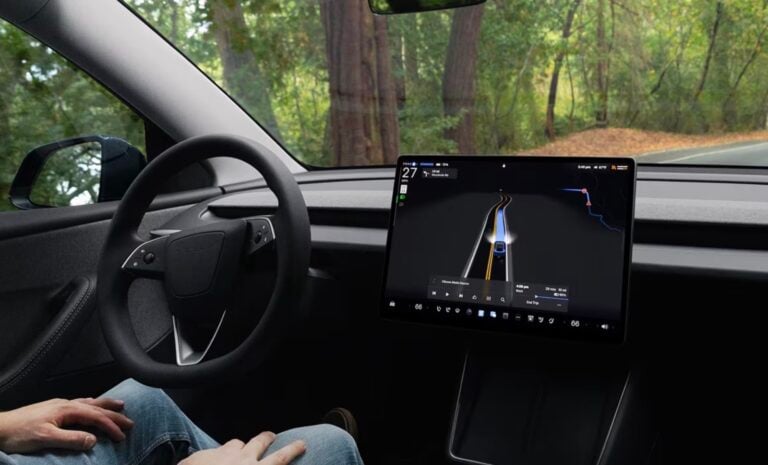
The Dutch vehicle authority RDW has apparently told Tesla that March 20 is the target date for regulatory approval of FSD (Supervised) in the Netherlands. That came straight from Elon Musk, who mentioned it during an interview at Giga Berlin. If it holds, the Netherlands would become the first European market to greenlight Tesla’s latest supervised autonomy software.
The word “if” is doing a lot of work in that sentence.
- The Fact: Musk said Dutch authorities told him FSD (Supervised) approval is expected on March 20, 2026, making the Netherlands potentially the first EU market to clear the software.
- The Delta: Musk qualified the statement twice in the same breath: “what I was told” and “hopefully, that date remains the same” — the date came from regulators, not from a signed approval.
- The Buyer Impact: European Tesla owners who already paid for FSD should not rebook their calendars yet. One date from one regulator is not an approval certificate.
Musk’s Giga Berlin Quote, Parsed
Speaking at Giga Berlin, Musk told his audience that Tesla has “the most advanced real-world AI” and that European approval is close. On the Netherlands specifically, he said: “We’re told by the authorities that March 20th, it’ll be approved in the Netherlands (what I was told).”
He followed that with a second statement: “Hopefully, that date remains the same. But I think people in Europe are going to be pretty blown away by how good the Tesla car AI is in being able to drive.”
That framing matters. The date did not come from an internal Tesla milestone. It came from a third party, the RDW, and Musk hedged it immediately. This is not a product launch announcement. It is a CEO repeating a date he was given by a regulator, with caveats attached.
The context at Giga Berlin also adds nuance. Musk was there as part of an event for workers ahead of the IG Metall union vote, not a product event. The FSD comment was part of a broader pitch about Tesla’s AI and technology ambitions for Europe.
The Safety Data Tesla Is Citing
Tesla’s internal safety report shows FSD (Supervised) has accumulated 8.3 billion miles of real-world driving data. Vehicles with FSD Supervised engaged recorded one major collision every 5,300,676 miles. By comparison, Teslas driven manually with Active Safety systems recorded one every 2,175,763 miles, and Teslas without Active Safety recorded one every 855,132 miles. The U.S. national average during the same period was one major collision every 660,164 miles.
Those numbers are significant. They are also self-reported. The RDW will want to verify performance against European road conditions, European traffic patterns, and European edge cases, including the motorcycle and scooter density that U.S. training data doesn’t fully capture. We noted this specific gap when FSD testing began in Europe in February.
The Road to This Point Has Been Messy
The history of Tesla’s European FSD push is not a clean story. In November 2025, Tesla’s European social media account claimed the RDW had “committed” to Netherlands approval. RDW publicly denied it and asked Tesla fans to stop calling their offices. Supervised testing only began in February 2026 after months of friction between the company and the regulator.
The new UNECE autonomous driving framework adopted in January 2026 helped create a clearer regulatory path by replacing prescriptive rules with an outcome-based “Safety Case” approach. Tesla’s neural network system was never going to fit cleanly into the old deterministic European rule structure. That regulatory shift is genuinely good news for Tesla’s approval timeline, and it means the RDW can assess FSD on the basis of Tesla’s own safety data rather than requiring it to conform to rules written for older, sensor-fusion-based systems.
NHTSA opened an active investigation into 2.9 million Tesla vehicles equipped with FSD in October 2025, following 58 reports of traffic safety violations and 14 crashes. European regulators have every reason to watch that investigation closely before signing off on their own markets. Tesla also logged zero autonomous test miles in California over six years, a data point that surfaced in a Reuters investigation and complicates the “most advanced real-world AI” framing.
On the legal side, Tesla is currently suing the California DMV over the regulator’s finding that “Full Self-Driving” constitutes false advertising. That lawsuit is unresolved. For European regulators deciding whether a product marketed as “FSD” meets their approval standards, it is an uncomfortable backdrop.
Tesla owners globally who paid up to $15,000 for FSD capability, including European buyers who prepaid for a feature they still cannot use, have also been watching Tesla quietly kill the outright purchase option. The $8,000 purchase option died in February 2026, a quiet admission that the software’s future value story was not playing out as Musk had promised.
The FSD system itself has proven its value in specific circumstances. FSD v14 drove a man suffering a STEMI heart attack to the ER in November 2025, with his son controlling the destination remotely via the Tesla app. That story is real, and it reflects genuine capability. It is also one data point. Regulators need millions of them, across European road conditions, before approval.
Netherlands Approval Would Not Extend Automatically to Other EU Markets
If March 20 holds, the Netherlands approval covers FSD (Supervised), meaning drivers must remain attentive with hands available. This is not unsupervised autonomy. It is a software mode that handles most driving tasks while requiring the human to stay ready to intervene.
Netherlands approval does not automatically extend to Germany, France, Spain, or any other EU member state. Each country conducts its own certification process. The Netherlands result could accelerate those reviews, or other regulators could wait for more miles of European-specific data before acting. Either outcome is plausible.
For context: Mercedes received Level 3 approval in Germany in 2022. At Level 3, the driver can legally take eyes off the road within defined conditions. In practice, Mercedes Drive Pilot operates only below 60 km/h on mapped motorways in good weather, a narrow envelope. FSD (Supervised) is legally Level 2+, requiring continuous driver attention but operating across a far wider range of speeds and road types. The Netherlands approval, when it comes, will greenlight a system that carries less legal autonomy than what Mercedes drivers in Germany have had for four years, even if its real-world operating range is considerably broader.
EVXL’s Take
I’ve been tracking Tesla’s European FSD saga since at least November 2025, when the RDW publicly contradicted Tesla’s own social media account. The pattern since then has been consistent: Tesla pushes a timeline, the regulator pushes back, testing proceeds cautiously, and the actual approval date moves.
March 20 could be real. The RDW gave Musk a specific date, which suggests internal progress. The new UNECE framework does give European regulators a cleaner path to approve vision-based AI systems like FSD. The supervised testing that ran through February appears to have gone well enough that a March target is at least credible.
But Musk hedged it twice in a single statement. That’s not pessimism on my part, that’s reading his own words. “What I was told” and “hopefully that date remains the same” are not the language of a CEO who has approval locked. They’re the language of a CEO who received a date from a third party and is passing it along with appropriate uncertainty.
The NHTSA investigation is still active and unresolved. The California false advertising lawsuit is still in court. The motorcyclist detection issue in European traffic hasn’t been publicly addressed. Taken together, these give European regulators documented, specific reasons to take their time, and any one of them could justify a slip past March 20.
My prediction: March 20 approval in the Netherlands is possible, but I’d put the odds at around 50/50. Tesla has received a specific date from a specific regulator, which is further along than we’ve been before; but Tesla has also missed or moved every European FSD target to date, and the RDW has shown it won’t be rushed. If March slips, look for a Q2 target. Full availability across major EU markets, Germany, France, Spain, won’t happen before 2027. And by the time it does, Chinese competitors with comparable supervised autonomy features will be in those markets at significantly lower price points.
Source: Teslarati
Editorial Note: AI tools were used to assist with research and archive retrieval for this article. All reporting, analysis, and editorial perspectives are by Haye Kesteloo.
Discover more from EVXL.co
Subscribe to get the latest posts sent to your email.