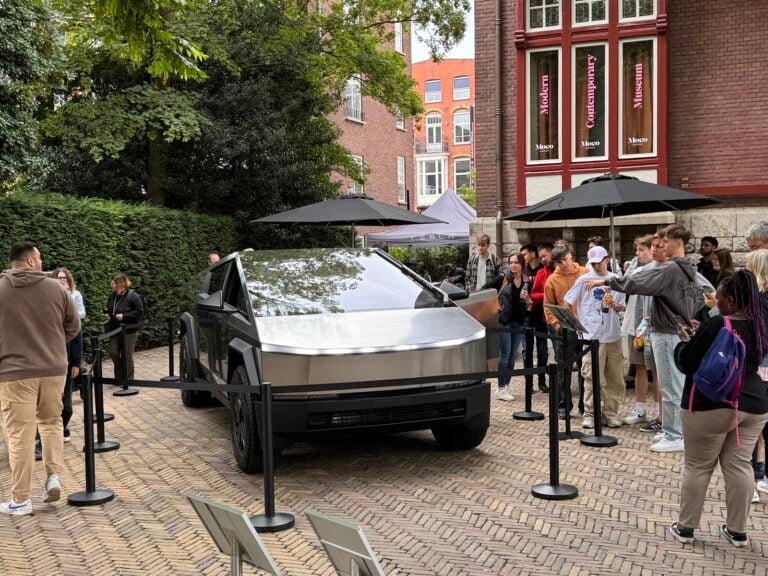
California’s clean-truck voucher program just handed Tesla roughly $165 million in reserved funding for a truck that has delivered exactly five units to paying customers. A Los Angeles Times investigation published today exposes how the state’s Hybrid and Zero-Emission Truck and Bus Voucher Incentive Project (HVIP) allocated nearly 1,000 vouchers to subsidize the Tesla Semi while competitors with production-ready electric trucks watched the funding disappear in days.
- The numbers: Tesla secured about 30% of all HVIP voucher funding from 2025 through early February 2026. The next-largest recipient, Canadian bus maker New Flyer, got $67.9 million. BYD received $67.2 million.
- The problem: The 2024 Tesla Semi was listed as HVIP-eligible by CARB despite not having powertrain certification registered on CARB’s own website.
- The impact: Competitors with trucks in stock say the reservation locked them out, distorting the heavy-duty EV market at the worst possible time.
CARB reserved $165 million for a truck that barely exists in customer hands
HVIP has distributed over $1.6 billion since 2009, helping commercial fleets buy zero-emission trucks and buses. The program operates first-come, first-served. During the September 9, 2025 funding cycle, 68% of $335.6 million was claimed in 48 hours. Tesla captured nearly 1,000 of those vouchers for a vehicle Elon Musk first unveiled as a prototype in November 2017. Production was originally scheduled for 2019. Eight years later, the Semi still has no publicly advertised retail price.
State documents show the Semi sells for approximately $260,000 (300-mile range) and $300,000 (500-mile range), well below the $435,000 average cost of a zero-emission Class 8 truck in 2024. The voucher program can cover up to 90% of list price for private fleet operators. But competitive pricing only matters if you can deliver the truck. State data confirms Tesla has collected payment for just five Semi units, all delivered last July to Nevoya Transportation LLC.
Tesla’s Semi may not have met HVIP certification requirements
HVIP requires a zero-emission powertrain certification from CARB, written approval for each model year, and listing in the HVIP catalog. The Times found the 2024 Tesla Semi was listed as eligible despite missing powertrain certification on CARB’s website. No subsequent model years appeared as eligible before Tesla applied for incentives.
A senior official at a competing EV manufacturer told the Times: “I still haven’t seen any proof that Tesla has been able to satisfy the requirements. That is really concerning to me, because these are rules that I have to follow.” They feared reprisal from state officials if they spoke publicly.
Tesla did not respond to multiple requests for comment. CARB cited confidential business information but insisted Tesla would not receive funding until requirements are met and vehicles delivered.
Competitors call it market manipulation
Alexander Voets, general manager at RIZON Truck USA, told the Times: “I don’t think it would be an overstatement to say this is market distortion or market manipulation. CARB essentially single-handedly just made Tesla the market leader for electric vehicles for [heavy-duty trucks] without them having [virtually] any vehicles in customer hands.”
RIZON’s director of sales and marketing, Peter Tawil, was more direct: “That hurts the rest of us. Our trucks can be delivered tomorrow. If this doesn’t get corrected, our whole industry will just go down the toilet.”
Even if Tesla never delivers the trucks or collects the incentives, the reserved vouchers blocked other manufacturers from accessing that funding. For companies like GILLIG ($34.2 million), Blue Bird ($32.5 million), and Harbinger Motors ($30.6 million), losing access to HVIP funding could be existential.
The state removed safeguards, then revised its own data after scrutiny
Two policy decisions enabled Tesla’s dominance. State officials quietly eliminated the 100-voucher-per-manufacturer cap that existed specifically to prevent funding hoarding. A CARB spokesperson said the cap was removed because it “unintentionally prevented customers from buying some of the most popular trucks and buses on the market.”
Then, after the Times began investigating, HVIP’s public data changed. Officials revised the numbers in late January to exclude local port funding, making Tesla’s allocation appear tens of millions lower. An earlier Times analysis showed Tesla may have been in line for up to $202 million, roughly a third of all funding allocated during 2025 and 2026.
The Semi’s design problems surfaced at the Port of Long Beach
During testing at the Port of Long Beach last year, drivers discovered they could not roll down the Semi’s window to hand over paperwork at gated entry points. The panoramic wraparound windshield looks impressive but created a basic operational problem that any port trucker faces daily. We covered Tesla’s ACT Expo presentation where Dan Priestley announced a redesigned drop glass to address this. The fix’s existence confirms the problem was real.
The Semi has shown promise in limited deployments. RoadOne reported 1.9 kWh per mile efficiency. ArcBest’s ABF Freight logged 4,494 miles at 1.55 kWh per mile. The truck works. Whether promising pilot data justifies locking up $165 million in public funding for five delivered units is the question.
EVXL’s Take
This connects to a pattern we’ve tracked for over a year. The same Elon Musk who publicly advocated against government EV subsidies and dared Trump to “cut it all” has been quietly securing millions in state funding for a truck that is not in mass production.
Heavy-duty trucks are 10% of U.S. vehicles but produce 45% of smog-forming nitrogen oxides and 58% of soot. Electrifying this segment matters. HVIP was designed to accelerate that. Instead, it may have slowed it down by concentrating funding on one company’s promise rather than distributing it across manufacturers who can deliver today.
The timing makes this worse. As we’ve documented extensively, subsidy-dependent strategies fail when subsidies end. The federal $7,500 EV tax credit expired September 30, 2025. The heavy-duty EV segment already runs on thin margins. Smaller manufacturers who lost access to HVIP funding may not survive long enough to benefit from future rounds.
CARB will be forced to implement new caps or prioritization rules before the next HVIP funding cycle. The political pressure from this investigation, combined with the optics of handing $165 million to the world’s wealthiest automaker for five confirmed deliveries, makes reform inevitable. Expect revised HVIP guidelines by Q3 2026.
Editorial Note: AI tools were used to assist with research and archive retrieval for this article. All reporting, analysis, and editorial perspectives are by Haye Kesteloo.
Discover more from EVXL.co
Subscribe to get the latest posts sent to your email.