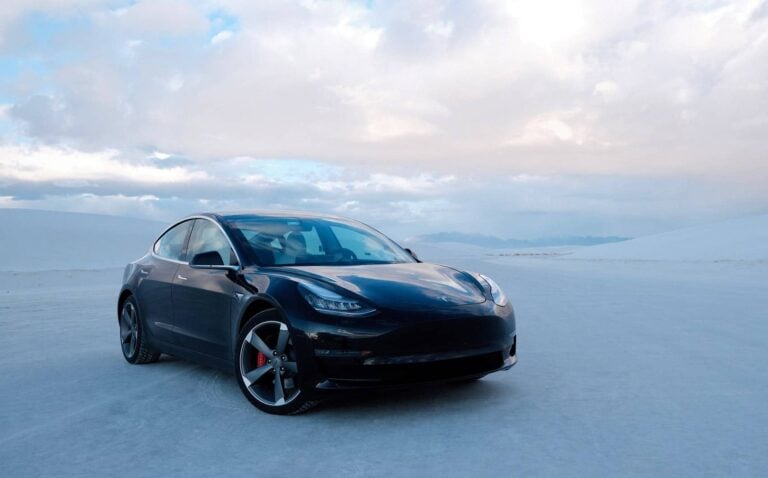
The final 2025 scorecard is brutal for Tesla. BYD sold 2.26 million battery-electric vehicles last year. Tesla delivered 1.64 million. That’s a 620,000-unit gap that grew every quarter, and it happened while BYD was locked out of the world’s second-largest auto market entirely.
The damage extends far beyond the headline numbers. In the countries where both companies compete directly, including Germany, Mexico, Thailand, and Australia, Tesla lost market share at a rate that would have been unthinkable two years ago. BYD’s European sales quadrupled. Tesla’s dropped 30%. Even in California, where BYD doesn’t sell a single car, Tesla registrations fell 11%.
- The Fact: BYD outsold Tesla by over 620,000 battery-electric vehicles in 2025, while Tesla posted its second consecutive year of declining deliveries.
- The Delta: BYD achieved this without selling a single passenger vehicle in the United States, where 100% tariffs on Chinese-made EVs block market entry.
- The Buyer Impact: If you’re shopping for an EV outside the U.S., BYD offers more models at lower prices. If you’re buying a Tesla, understand that the company’s leadership is focused on robots and robotaxis, not improving the car in your driveway.
BYD’s European sales explosion dwarfs Tesla’s decline
BYD quadrupled its sales across Europe’s top 10 markets in 2025 compared to the prior year, according to calculations from Segment Y Automotive Intelligence. Tesla’s European sales dropped 30% over the same period. The gap closed so fast that BYD now outsells Tesla in several individual European countries, including Germany, where Tesla operates its own Gigafactory.
We documented the full-year European numbers in December: Tesla’s EU market share halved from 2.2% to 1.3%, while BYD’s sales surged 240% to over 110,000 units. Combined, BYD and SAIC/MG outsold Tesla in Europe more than two-to-one. Three years ago, Tesla outsold BYD in Europe nearly six-to-one.
“Tesla didn’t just lose its sales crown, it squandered its position as a leader,” said Paul Blokland, co-founder of Segment Y Automotive Intelligence. “As the U.S. industry retreats behind a wall of tariffs and abandoned EV plans, Asia has taken the torch.”
Germany tells the story most clearly. Tesla’s sales there fell 57.8% for the year. We first reported that German collapse in August, when July registrations showed Tesla selling just 1,110 cars while BYD’s sales surged nearly fivefold to 1,126 units in the same month. By year’s end, the trend had only accelerated.

Tesla loses ground even where BYD can’t compete
Tesla’s California registrations fell more than 11% from 2024 to 2025, and the company’s EV market share in the state dropped 5 percentage points, according to data from the California Auto Outlook. Chevrolet and Honda both gained share during the same period. BYD doesn’t sell a single passenger vehicle in the United States.
That California data matters because it strips out the BYD variable entirely. Tesla isn’t just losing to Chinese competition. It’s losing to everyone. The September 30 expiration of the $7,500 federal EV tax credit accelerated the damage, but the decline was already underway before the subsidies disappeared.
The full-year 2025 U.S. EV sales data confirmed the split: Q4 EV sales collapsed 36% year-over-year after the tax credit expired, and the Cybertruck’s sales plummeted 48% for the full year. The pre-buy surge we warned about in July inflated Q3 artificially, and Q4 paid the price.

BYD’s battery roots are the real competitive weapon
BYD started as a battery company in 1995, making rechargeable cells for Motorola and Nokia. That origin story isn’t just corporate lore. It’s the reason BYD can price the Dolphin hatchback at less than $14,000 in China while Tesla’s cheapest Model 3 costs roughly $33,000 in the same market. When the most expensive component in an EV is the battery, owning the battery supply chain is the single biggest cost advantage a manufacturer can have.
“When the most expensive part of an electric car is the battery, and you have a massive advantage on the cost of producing a battery, you have a massive advantage in the EV world,” said Karl Brauer, an analyst at iSeeCars.com.
Battery materials are also cheaper to source in China. BYD’s vertically integrated supply chain, including its FinDreams Battery subsidiary, produces lithium iron phosphate Blade Batteries in-house. Those cells now power vehicles from other manufacturers too, including Mercedes-Benz, Toyota, Ford, and Kia. Tesla, by contrast, sources batteries from multiple suppliers and has struggled to scale its own 4680 cell production.
BYD may also benefit from government backing and lower labor costs.
“Our rules and environmental regulations and our laws about how you treat workers are not globally instituted,” said Brian Moody, an automotive expert and analyst. “It seems to give BYD a financial advantage in that they can charge next to nothing for a car that maybe costs more than that to build.”
Product depth is Tesla’s blind spot
Tesla sells a compact sedan, a midsize SUV, and the Cybertruck with some trim variations. BYD sells more than eight models spanning sedans, SUVs, minivans, and trucks. In markets where both brands compete head-to-head, customers consistently report that BYD vehicles look better, cost less, and come with more features.
Amy de Groot, a Melbourne resident who bought a BYD Sealion 6 for around 55,000 Australian dollars (about $38,500 USD), said BYD vehicles are all over the roads in her community.
“Everyone that gets into the car is dead shocked at how nice it is,” she said. “It’s a beautiful car to look at and to be inside.”
De Groot didn’t give much thought to buying a Tesla. She estimated Teslas peaked in popularity in Australia about five years ago and said Musk’s reputation has significantly deteriorated since then.
“It was a real fad to have a Tesla, and I just don’t think that they’re competitive in any way,” she said.
We’ve tracked this product gap since mid-2025. As we reported in July, BYD launches cars roughly twice as fast as Tesla, introducing at least 17 SUV models from 2020 through 2025 while Tesla relied on the same Model 3 and Model Y platforms designed between 2017 and 2020. “Musk has got to find another concept to build his legacy on,” said Brauer.
Australia, Mexico, and the expansion playbook
BYD sold more than 52,000 electric vehicles in Australia in 2025, a 156% increase from the year prior, according to Segment Y. Tesla’s Australian sales fell 24%. In Mexico, more than 75,000 BYDs were sold last year. Canada recently reached a trade agreement with China that could open the door to more Chinese EV imports.
These aren’t marginal markets. Australia and Mexico combined represent millions of annual vehicle sales, and BYD is winning both without a manufacturing presence in either country. When BYD’s Hungarian factory comes online and its Turkish and Brazilian plants ramp production, the cost structure improves further by eliminating import tariffs. We covered BYD’s global factory strategy back in October 2024, when executive vice president Stella Li said:
“We don’t need to enter the US market. We’ve got a lot of opportunities to become a great company with the many markets outside of the US.”
Due to steep tariffs and federal restrictions, BYD passenger vehicles are effectively banned from the U.S. market. But they’re increasingly showing up just across the border. And while BYD vehicles are not expected to land in the U.S. anytime soon, the competitive pressure they exert on Tesla’s global margins affects every Tesla buyer regardless of geography.
Musk ends two car lines to build robots
While BYD floods global markets with new models, Tesla is going the other direction. On the company’s January earnings call, Musk confirmed Tesla would end production of the Model S and Model X and convert that Fremont factory space to manufacture Optimus humanoid robots. His stated goal: 1 million robots per year.
“It’s time to basically bring the Model S and X programs to an end with an honorable discharge because we’re really moving into a future that is based on autonomy,” Musk said on the call.
That’s a CEO telling you where the company’s attention is. Not on the Model Y that accounts for the vast majority of Tesla’s revenue. Not on building the $25,000 affordable EV that was canceled. Not on matching BYD’s product cadence. Tesla responded last week with a new $41,990 Model Y AWD variant, filling a gap that Ford and Chevy already covered. It’s a defensive pricing move, not a product offensive.
EVXL’s Take
I’ve spent the past year tracking this story across every continent where both companies compete. The data points are consistent: Europe down 48.5% in October. Global crown officially lost in January. The U.S. market cratering after the tax credit expired. The pattern is the same everywhere. BYD grows. Tesla shrinks.
What most coverage misses is the pressure building inside BYD’s own business. Profit margins are thinning at home, where a brutal price war has forced discounts of up to 34% on select models. Domestic market share actually slipped in the second half of 2025. That pressure is exactly why BYD is expanding overseas so aggressively. Europe, Australia, Mexico, and Southeast Asia aren’t just growth markets. They’re survival markets. BYD needs them to maintain the revenue trajectory its investors expect.
Here’s my prediction: by Q3 2026, BYD will outsell Tesla by more than 2-to-1 on a pure BEV basis globally. Tesla’s product pipeline is frozen. The Model Y refresh is done. The Cybertruck is fading. The Model S and X are dead. The $25,000 car doesn’t exist. BYD has at least four new models launching in Europe alone this year, plus its Hungarian factory starting production. The gap doesn’t close from here. It widens.
For Tesla buyers, the takeaway is simple: you’re buying a car from a company that has told you, publicly and repeatedly, that cars aren’t its priority. Act accordingly.
Editorial Note: AI tools were used to assist with research and archive retrieval for this article. All reporting, analysis, and editorial perspectives are by Haye Kesteloo.
Discover more from EVXL.co
Subscribe to get the latest posts sent to your email.