Electric car fleets in oil-importing countries displaced an estimated 200 million barrels of crude oil in the six months after the Strait of Hormuz closed, worth $20 billion at the Brent prices of those months. The figures come from the energy think tank Ember, which published the analysis on October 14 and posted the headline numbers on X this morning. The six months run from March to August 2026, the period since the U.S. and Israel went to war with Iran on February 28.
China accounts for $14 billion of the total, about three quarters, and the 27 EU countries saved a further $3.1 billion. Measured against its own oil use, Denmark leads Europe: its electric car fleet now displaces 13% of the country’s annual oil consumption.
The United States does not appear on Ember’s chart, which covers oil importers. Battery-electric cars took 6% of U.S. light-duty sales in the first eight months of 2026, and Ember counts the country as the outlier among the 56 markets it tracks.
China Alone Displaced $14 Billion of Crude Oil in Six Months
Ember puts China’s displaced crude at $13.96 billion for March through August, three quarters of the $20 billion total across oil-importing countries. EU member states displaced $3.1 billion, led by Germany at about $760 million and France at about $560 million. The United Kingdom alone displaced about $790 million.
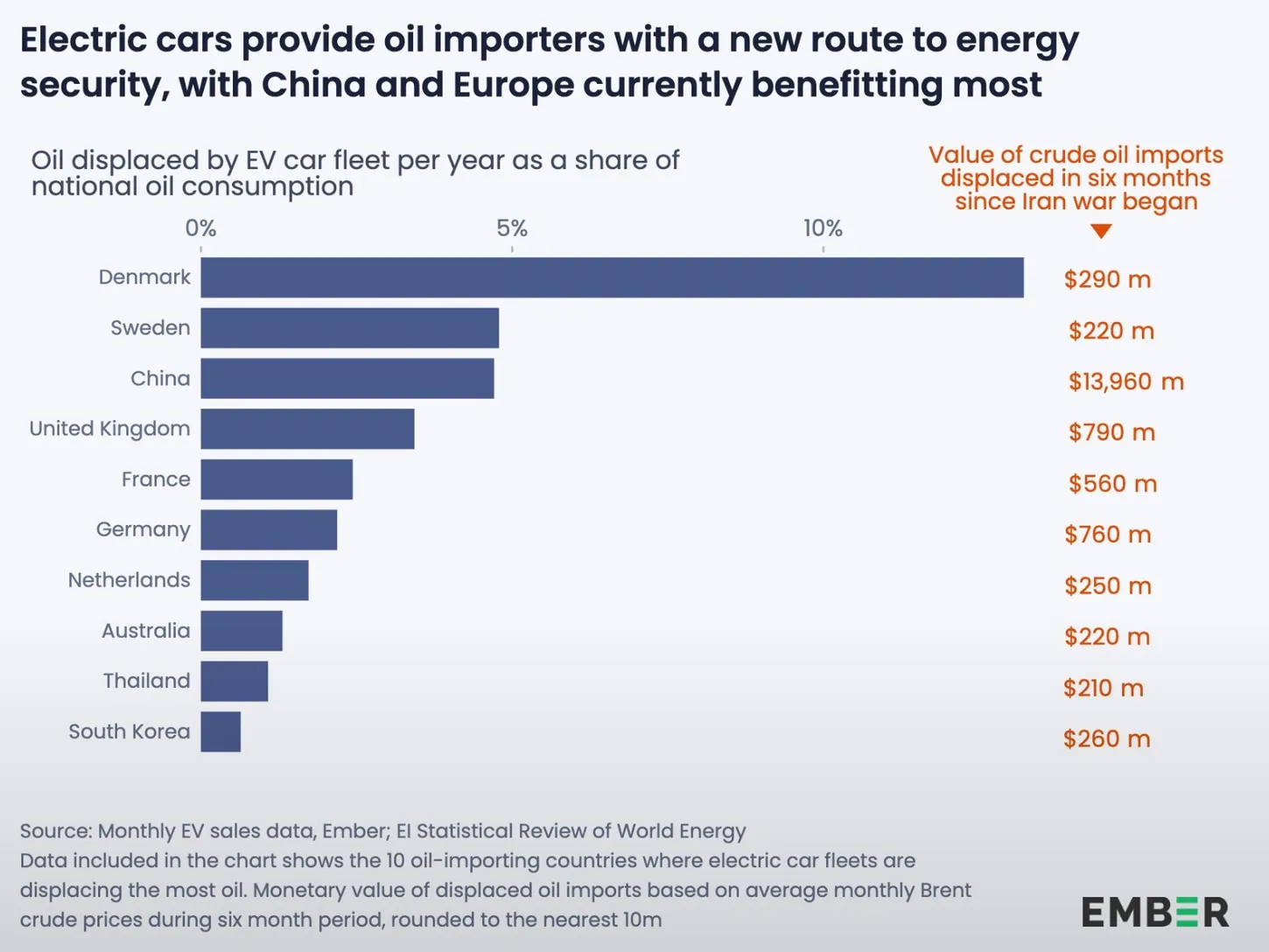
The rest of the top ten is smaller. Sweden and Australia each displaced about $220 million of crude, the Netherlands $250 million, South Korea $260 million and Thailand $210 million. Southeast Asia as a whole came to about $560 million, with Thailand and Vietnam in front, and Ember notes that electric two- and three-wheelers do more of the work in that region than cars do.
Fully electric cars produced $16.5 billion of the $20 billion. Plug-in hybrids supplied the remaining $3.5 billion, and Ember points to real-world evidence that their drivers lean on the combustion engine more than manufacturers claim.
Denmark’s Electric Fleet Now Covers 13% of the Country’s Oil Use
Denmark’s electric cars displace 6.4 million barrels of oil a year as of August 2026, equal to 13% of the oil the country consumed in 2025. Sweden and China follow at just under 5%, then the United Kingdom at about 3.5%. France sits near 2.5% and Germany just over 2%.
The dollar figures are a price times a volume. Ember estimates each country’s monthly oil displacement from its electric car fleet, multiplies it by that month’s average Brent price, and adds the six months together. Brent closed above $100 a barrel more than 60 times this year, something it last did in 2022 after Russia invaded Ukraine, and it returned above $100 in September for the first sustained stretch since May. Ember expects the running total to rise over the rest of the year.
Oil-importing countries with large electric fleets also insulated their drivers. Ember cites research showing a gasoline car driver in the EU is five times more exposed to the Hormuz closure than the driver of a typical battery-electric car, and that a battery-electric car in the UK is now up to nine times cheaper to drive than a gasoline or diesel one. EVXL found the same split in the U.S. in July, when EV drivers were paying $43 a month less for fuel than gasoline drivers in nearly every state.
Fifteen Countries Overtook the U.S. on EV Share This Year
Forty-nine of the 56 countries in Ember’s tracker now sell a higher share of battery-electric cars than the U.S. does on its 6% of light-duty sales. Fifteen passed the U.S. for the first time this year, including Brazil, India, Italy, Malaysia and New Zealand.
India has posted a higher battery-electric share than the U.S. in every month since April. Ember ties the U.S. position to the end of federal EV support last year, and the fuel shock has not reversed it. American drivers paid an average of $4.33 a gallon in September, and new EVs still held about 6% of sales, as EVXL reported when gasoline-only cars fell below half of global sales on October 6.
The global market moved the other way. Battery-electric sales rose 11% worldwide in the first eight months of 2026 and reached 18% of new car sales, up from 16% a year earlier, while plug-in hybrid sales fell 12% and combustion sales fell 6%. Strip out the U.S. and China, the two markets where policy changes slowed growth, and battery-electric sales grew an estimated 45%. In China, combustion cars fell to a third of September sales in a market that shrank 28%, a drop the China Passenger Car Association blamed in part on high oil prices.
EVXL’s Take
Ember’s $20 billion is a trade-balance number, and I’d read it as a strategic one. Every country on that chart imports its oil, and each of them bought less of it at $100 a barrel this year because of cars it put on the road in the years before. China built that hedge on purpose and now collects three quarters of the benefit. Denmark is the clearest case of a small importer buying itself out of a supply shock one car at a time.
The U.S. pumps its own oil, so it was never going to top an importer’s table, but its drivers still paid the highest September gas prices on record, and the pump price answers to the same Brent market as Copenhagen’s. Washington cancelled the $7,500 credit five months before the Strait closed, and the share of new cars that sidestep that price stayed at 6% while fifteen other countries passed it. I don’t expect Ember’s next six-month tally to look better for America, because the policy that produced this one is still in place.
Source: Ember, Electric energy security: how EVs are reducing oil import vulnerabilities, Ember on X
EVXL uses automated tools to support research and source retrieval. All reporting and editorial perspectives are by Haye Kesteloo.