
Michael Liebreich, the founder of what is now Bloomberg New Energy Finance (BNEF), says one in three cars sold worldwide is electric and that gas cars will go the way horses did, without a ban. He makes the case in an 11-minute TED talk that TED posted to YouTube on November 19. He recorded it on October 15 at TED Countdown: The Next Ten.
Liebreich argues that clean energy pushes fossil fuels out the way cars pushed out horses and mobile phones pushed out landlines, by being built and sold. He gives his reason near the end in four words: “Burning stuff is stupid.” He backs the argument with a model of the global energy system that is four lines on a spreadsheet, and in that model fossil fuel use keeps growing for about another decade.
Liebreich’s Own Model Has Fossil Fuel Use Rising Until About 2036
Run forward from 2026, the four lines put fossil fuel use about 4% higher in 2036 than it is today. It returns to today’s level around 2045 and reaches zero around 2067. Those dates are EVXL’s arithmetic on the growth rates Liebreich gave on stage.
Liebreich supplied the inputs. The economy grows 3% a year. Demand for useful energy, the energy that actually moves a car or heats a room after conversion losses, grows 2%. Clean supply starts at about 30% of useful energy and grows 5% a year, which Liebreich says is slower than its recent pace. Fossil fuels fill the gap, and the gap only starts to shrink once clean supply is adding more each year than demand does.
To keep clean supply ahead of demand, Liebreich wants more of the economy electrified, and he names heating as the next sector after transport. He says half of all heating systems are already electric and that half of industrial heat is low-temperature enough for heat pumps. He dismisses hydrogen in four words.
Liebreich says in the talk that fossil fuels do not get crushed in the model’s first couple of decades. He calls it an illustration that covers only the energy system, with a long tail of hard sectors at the end. He also points out that horses and landlines each kept growing for around 30 years after their replacements arrived.
China’s Trucks Have Already Passed the Number He Gave on Stage
Liebreich said one heavy truck in three sold in China is electric. Electric models took 50.3% of China’s heavy-truck sales in September and 38.1% for January through September, according to Electrek’s tally. The share was about 25% when EVXL reported on China’s electric truck boom in July 2025.
For cars, he put electric models at one in three sales globally and two in three in China. The International Energy Agency (IEA), which counts plug-in hybrids as electric, expects 29% globally and more than 60% in China for the full year. China’s September matched his figure, when combustion cars dropped to 33% of the market.
Liebreich also said sales of fossil-fueled cars peaked in 2017 and are down by a third. BNEF’s analysis dates the peak to 2017. EVXL reported in October that gas-only cars fell below half of global sales in the first half of 2026, and that new EVs have held close to 6% of the U.S. market all year.
On electricity, he showed a chart of non-hydro renewables, which he described as basically wind and solar, at 20% of global generation. Ember’s Global Electricity Review 2026 puts wind and solar alone at 17.3% for 2025, up from 4.5% in 2015, and confirms that solar output has doubled about every three years.
Europe’s Electric Trucks Are at 5%, and Liebreich Chairs a Charging Firm
Plug-in electric trucks took 5.3% of EU truck registrations in the first nine months of 2026, up from 3.8% a year earlier, while diesel held 91.7%, per ACEA figures reported by electrive. Among heavy trucks of 16 tonnes and up, the electric share was 2.5%.
Liebreich put Europe at one electric truck in 25 and told the audience he is trying to change that. He said on stage that he chairs PragmaCharge, a truck-charging company, and he showed its hub at MercaValencia near the Port of Valencia, Spain, which he called Europe’s largest for heavy trucks.
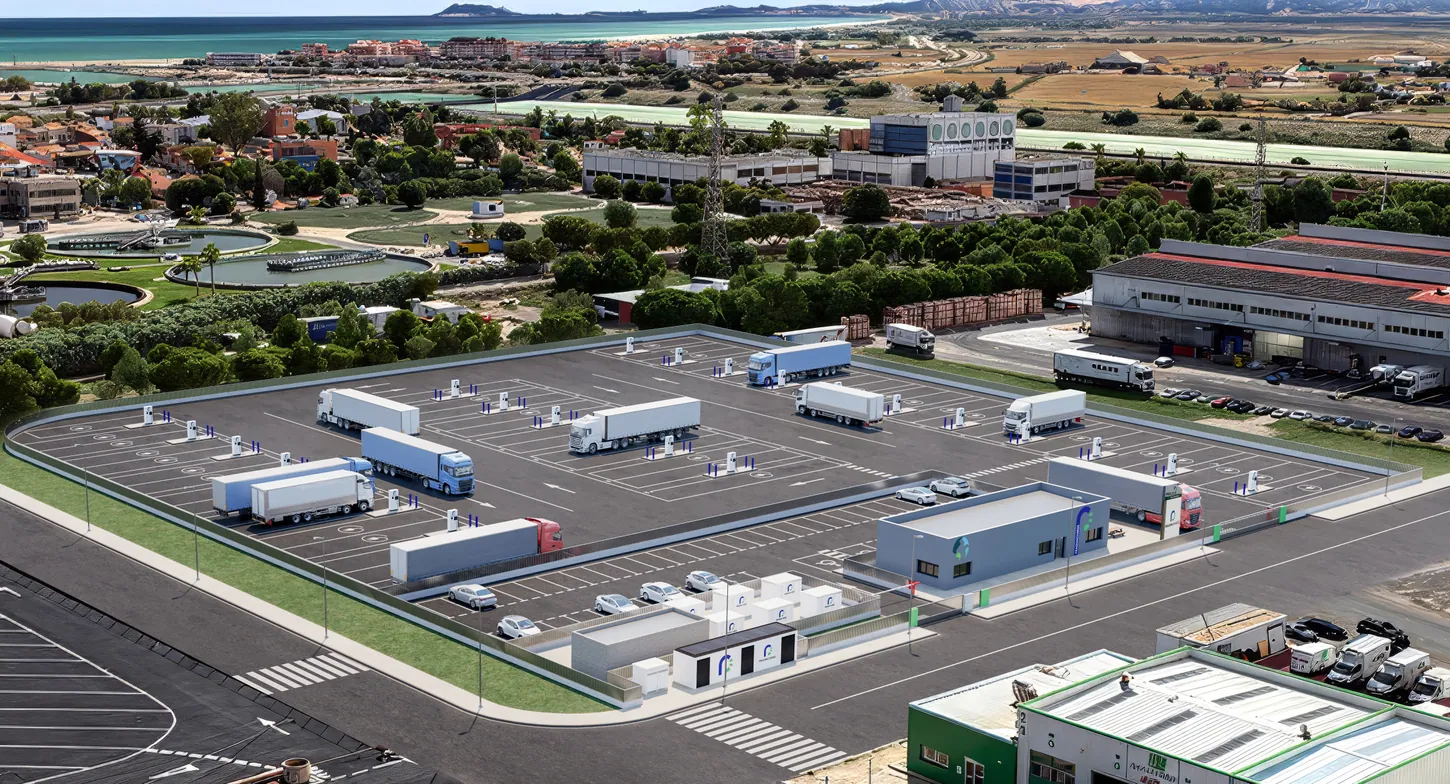
The first 14 charging ports there went live in September. Another 36 are planned on a 4 MW grid connection, with the rollout due to finish in 2027, EV Infrastructure News reported. Prologis owns the charging facility and leases it to PragmaCharge, and the two companies describe it as one of Europe’s largest.
EVXL’s Take
Liebreich’s model is the most useful part of this talk for anyone who drives an EV or is thinking about buying one. It shows how fossil fuel use can keep rising for another ten years while electric cars take a third of the market, so a record year for oil or coal doesn’t mean the cars are failing.
I think the U.S. is the weak spot in his horses-and-cars argument. Cars replaced horses because anyone could buy one. American buyers can’t buy the cheap electric cars that pushed combustion down to a third of China’s market, because a 100% tariff keeps them out, and new EVs are stuck near 6% of sales here. My read is that his 5% a year is a world average that China is carrying.
I’d watch trucks more closely than cars from here. Fleets buy on cost per mile, and China’s heavy trucks are at 38% electric this year with Europe still at 5%.
Sources: TED, Ember, IEA, Bloomberg, Electrek, electrive, EV Infrastructure News
EVXL uses automated tools to support research and source retrieval. All reporting and editorial perspectives are by Haye Kesteloo.