
Combustion cars took 33% of China’s new-car sales in September 2026, the first month they have fallen to a third of the market. Battery-electric cars reached a record 47.3% and plug-in hybrids took 19.7%, according to monthly data from the energy think tank Ember. In April 2021, combustion cars still held 90.2%.
Ember senior data analyst Nicolas Fulghum posted the figures on X on Thursday, October 15. Elon Musk quoted the post the same day with “China’s dependency on oil is dropping fast,” and his post showed 1.7 million views by late Friday morning. Ten days earlier, EVXL reported that gas-only cars had fallen below half of global sales for the first time.
The record share came from a smaller market. Chinese buyers took 765,000 battery-electric cars in September, 7.7% fewer than a year earlier, and total car sales fell 27.9%.
Combustion Sales Fell 43.5% While Battery-Electric Sales Slipped 7.7%
China’s electric share hit a record because combustion sales fell faster than electric sales. Combustion sales fell from 945,000 in September 2025 to 534,000, a 43.5% drop. Plug-in hybrids fell 32% to 319,000. Combustion’s share dropped from 42.1% to 33.0% in those 12 months.
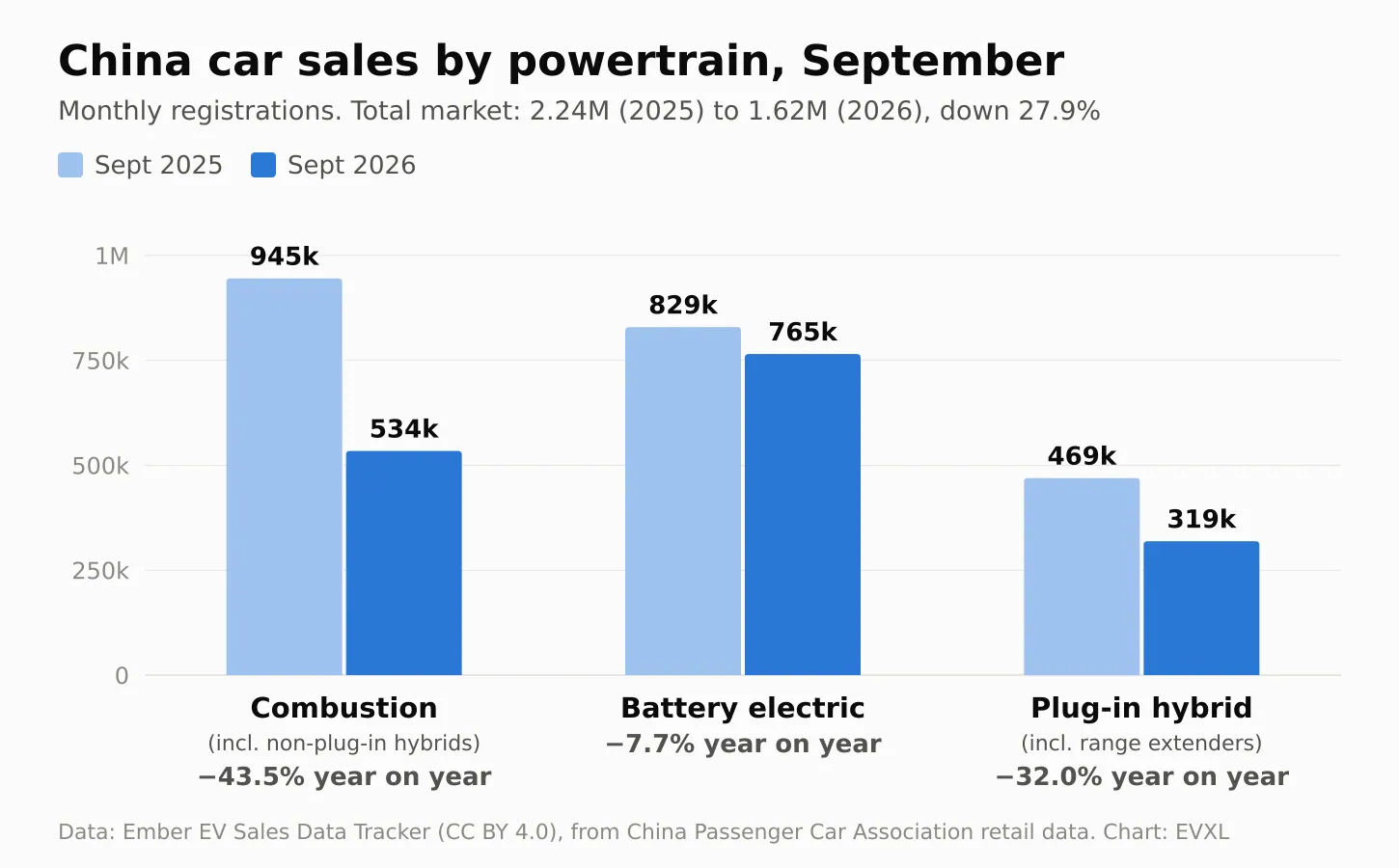
The pattern holds for the year. China sold 13.33 million cars from January through September, down almost 22% on the same months of 2025, per Ember’s EV Sales Data Tracker. Battery-electric sales fell 4.3% to 5.22 million in that stretch. Combustion sales fell 31.4% to 5.58 million, and battery-electric cars took 39.2% of the year’s sales.
Ember builds its China series from China Passenger Car Association (CPCA) retail data, and two definitions matter. Ember’s combustion figure includes conventional hybrids, which CPCA says grew 25% in September while gasoline-only cars fell 49%. Range-extended EVs count as plug-in hybrids.
CPCA Blames High Oil Prices for the Collapse in Gasoline Car Sales
High oil prices kept Chinese buyers away from gasoline cars, the CPCA said, explaining September’s 28% retail drop. It also cited an earlier Mid-Autumn Festival and a high base from last September’s rush to beat expiring provincial subsidies, CnEVPost reported.
Electric cars had their own problems. Rising memory-chip prices and shortages slowed sales of new EV models, the CPCA said, and it blamed unfavorable subsidy policy for steep declines in China’s smallest A00-class EVs. Chinese buyers faced the same oil shock as everyone else this year, after the Iran war and the Strait of Hormuz disruption pushed crude above $100 a barrel.
X user Vishal G ran Ember’s chart forward and projected combustion falling under 3% of China’s sales around 2035. His curve extends a share gain that came from falling combustion sales, not from rising EV sales.
The U.S. Sits at 6.25% Battery-Electric Behind a 100% Tariff
Battery-electric cars took 6.25% of U.S. new-car sales and plug-in hybrids 1.16% in the 12 months through August, in a market that taxes Chinese-made EVs at 100%. China’s 12-month figures through September are 38.1% and 20.2%. The EU sits at 21.2% battery-electric and the UK at 25.8%, both through August.
The U.S. battery-electric figure was 8.36% a year earlier, before the federal EV tax credit expired on September 30, 2025. It kept falling while American drivers paid an average of $4.33 a gallon in September, the highest September on AAA’s books.
The Section 301 tariff on Chinese-made EVs went from 25% to 100% in 2024, after President Biden directed the U.S. Trade Representative. The Commerce Department’s connected-vehicle rule bans Chinese-linked software from model year 2027, with hardware following in model year 2030. From model year 2027 it also bars manufacturers with a sufficient nexus to China from selling connected vehicles here, even if they build them in the U.S., unless Commerce grants a specific authorization.
Europe took a different route. The European Commission set countervailing duties in October 2024 sized to the subsidies it found: 17.0% for BYD, 18.8% for Geely, 35.3% for SAIC, and 7.8% for Tesla’s Shanghai-built cars, all on top of the standard 10% import duty. Brussels now lets exporters swap the duty for a minimum price and a volume cap, and Volkswagen’s China-built Cupra Tavascan got the first deal in February.
A Cox Automotive survey of 802 U.S. consumers found that 40% support Chinese brands entering the U.S. market.
EVXL’s Take
The U.S. will fall behind China for good if it keeps answering Chinese EVs with walls instead of competition, and Europe will follow if its duties harden into one. In a Chinese market that shrank 28% in September, electric cars held their buyers far better than gasoline cars did.
American drivers got the same oil shock, and battery-electric share here slid to about 6% once the federal credit was gone. My read is that the gap is supply, because the cheapest EVs in the world aren’t for sale in the U.S.
Beijing’s subsidies are real, and the EU measured them before setting duties of up to 35.3%. That is a fair fight with a price on the distortion, and Europe sells battery-electric cars at more than three times the U.S. rate. A 100% tariff stacked on a rule that bars Chinese-linked automakers’ connected cars from model year 2027 keeps the competitor out without pricing anything.
I’ve watched this play out at DroneXL. As I see it, Washington spent years restricting DJI to give American drone makers room. Skydio stopped selling consumer drones in August 2023 to focus on enterprise and public-sector customers, and Skydio, Red Cat’s Teal Drones and BRINC now sell mainly to military, police and other public agencies. When the FCC added foreign-made drones, DJI’s included, to its Covered List in December 2025, there was still no American DJI to replace them. Detroit is on the same path. American car buyers will pay for it at the pump.
Sources: Ember EV Sales Data Tracker, Nicolas Fulghum on X, Elon Musk on X, CnEVPost (CPCA data), The White House, Bureau of Industry and Security, European Commission.
EVXL uses automated tools to support research and source retrieval. All reporting and editorial perspectives are by Haye Kesteloo.


