Volkswagen is preparing a recall in Germany and other markets for several thousand electric cars whose battery cells may be defective, a company spokesperson told the German business daily Handelsblatt. VW blames production faults at its suppliers and says a fire can’t be ruled out in extreme cases. Until the cars are checked, it recommends charging them to no more than 80%.
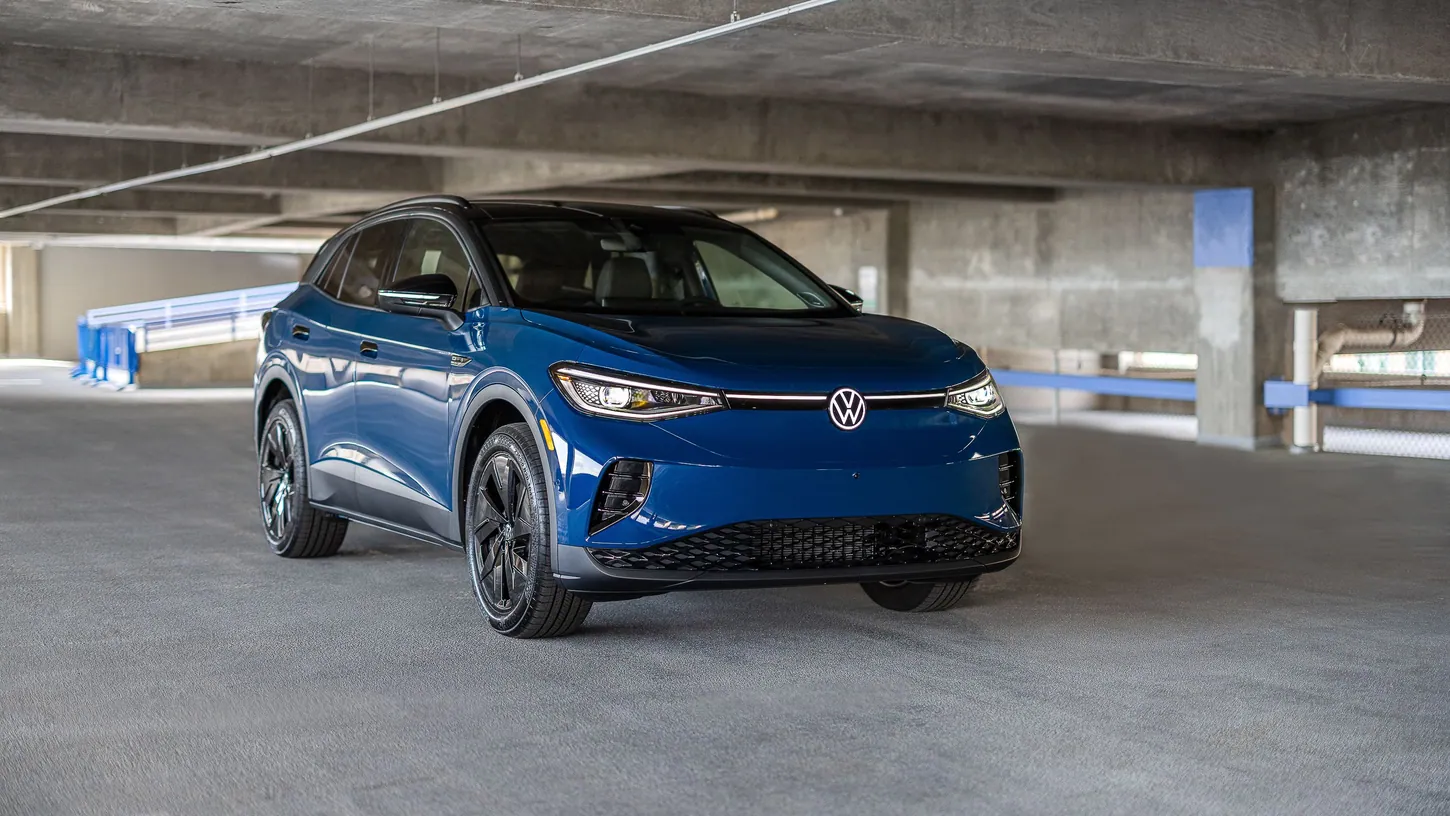
Handelsblatt reports the action covers the ID.3, ID.4, ID.7, ID. Buzz and Cupra Born built between 2023 and 2025, a list Euronews says VW has not confirmed. In the US, VW’s September 30 recall filing with the National Highway Traffic Safety Administration (NHTSA) already gives the same 80% advice for 22,524 ID.4s from the 2023 to 2026 model years. The US filing names the cell maker, SK Battery America of Commerce, Georgia. The European statement doesn’t name one.
Volkswagen Told NHTSA the Root Cause Is Unknown
Volkswagen’s Part 573 safety recall report, amended October 1, says the root cause is still unknown. In some packs, certain charging profiles combined with a charge above 80% “may trigger thermal propagation,” which can end in a vehicle fire. VW counts 22 US claims between January 2024 and August 2026.
The recalled cars were built between January 1, 2023, and February 1, 2025, and VW estimates 0.1% of them carry the defect. On June 17, during an ongoing review of thermal events in the field, preliminary data pointed to isolation-resistance values and DC-charging ratios as possible influences. VW’s product safety committee ordered a field study of packs from Volkswagen vehicles not covered by earlier battery recalls, and VW decided to recall on September 23.
VW drew the boundary partly with its owners’ own charging data. The report says the ID.4s outside the recall either carry cells made outside the suspect production range or have recent, complete data showing they were charged below VW’s threshold.
Recalled ID.4s Get a Sticker and a Stop-Sale, Not a Repair
No repair exists yet for the 22,524 US cars or the 5,633 ID.4s covered in Canada, so owners get a sticker reminding them not to charge past 80% and interim letters due November 27. Depending on configuration and connectivity, some cars may also be configured to stop there.
VW’s October 6 dealer notice reminds dealers that federal law bars them from selling or leasing an affected new ID.4 until it is fixed, and VW tells them not to deliver affected used ones either. Dealers can diagnose an owner’s complaint under existing procedures, but that work can’t be billed to the recall. VW is offering no reimbursement plan because the cars are still under the New Vehicle Limited Warranty, and its owner FAQ says the 80% limit may cut range between charges.
Europe’s Version Adds an Inspection the US Recall Doesn’t Offer Yet
In Europe, VW plans to bring some affected cars into service centers for a battery inspection, Euronews reported. Cars where no fault turns up get the 80% limit lifted. A faulty module may not need replacing if a software update can fix it.
As of Euronews’ October 16 report and a dpa report carried by Handelsblatt, the recall had not appeared in the database of Germany’s Federal Motor Transport Authority (KBA), and VW says it is preparing the action in coordination with the authorities. Euronews reports recalls are already under way in the UK. VW’s European statement gives supplier production faults as the cause, two weeks after its US filing said the root cause is unknown, and neither Euronews nor the dpa report says whether the European cars use SK Battery America cells. NHTSA’s recall database showed no battery recall for the US ID. Buzz when EVXL searched it on October 16. VW sold the van here as a 2025 model before pausing it for the 2026 model year.
This Is the ID.4’s Fourth US Battery Recall Since December 2025
Every US ID.4 battery recall since December 2025 names SK Battery America as the cell supplier. The first two, in December and January, covered 629 and 670 cars whose modules may contain misaligned electrodes, and told owners to cap charging at 80%. The third, also in January, covered 43,881.
That third recall, NHTSA campaign 26V030, covered cars built from September 2022 to April 2025. Its chronology says the misaligned electrodes, which the supplier found in a teardown in late September 2025, did not account for every incident: VW still had thermal events outside the suspect ranges and no clear root cause for them. It wrote that “certain deviations at the supplier of the battery modules may result in self-discharge” and recalled every ID.4 without its self-discharge detection software for a battery health check, the software and new cell modules where needed. VW says that software would have warned in advance of at least three known incidents.
Battery trouble on the ID.4 is older than this run. VW recalled 2021 models in 2022 over faulty soldering inside the pack and in 2023 over battery-management software, before its 2024 door-handle recall of nearly 100,000 ID.4s.
EVXL’s Take
VW has now recalled ID.4s twice over battery thermal events it couldn’t trace to a root cause, and three of its four US battery recalls since December have told owners to charge less. If you own a 2023 to 2026 ID.4, set the 80% limit in the car today and don’t wait for the November 27 letter, because the filing says only some cars may be capped automatically. VW should also offer American owners the inspection it is planning in Europe. It ran a battery health check at US dealers for the January recall, and I think that shows most of the process already exists here. VW also has charging data on at least some ID.4s, because the filing says it used that data to leave cars out of this recall. Owners warned in September shouldn’t wait longer than Europeans for a way to get their full battery back.
Sources: NHTSA Part 573 Safety Recall Reports 26V630 and 26V030, Volkswagen dealer notice 93EX, Euronews, Handelsblatt, dpa
EVXL uses automated tools to support research and source retrieval. All reporting and editorial perspectives are by Haye Kesteloo.