
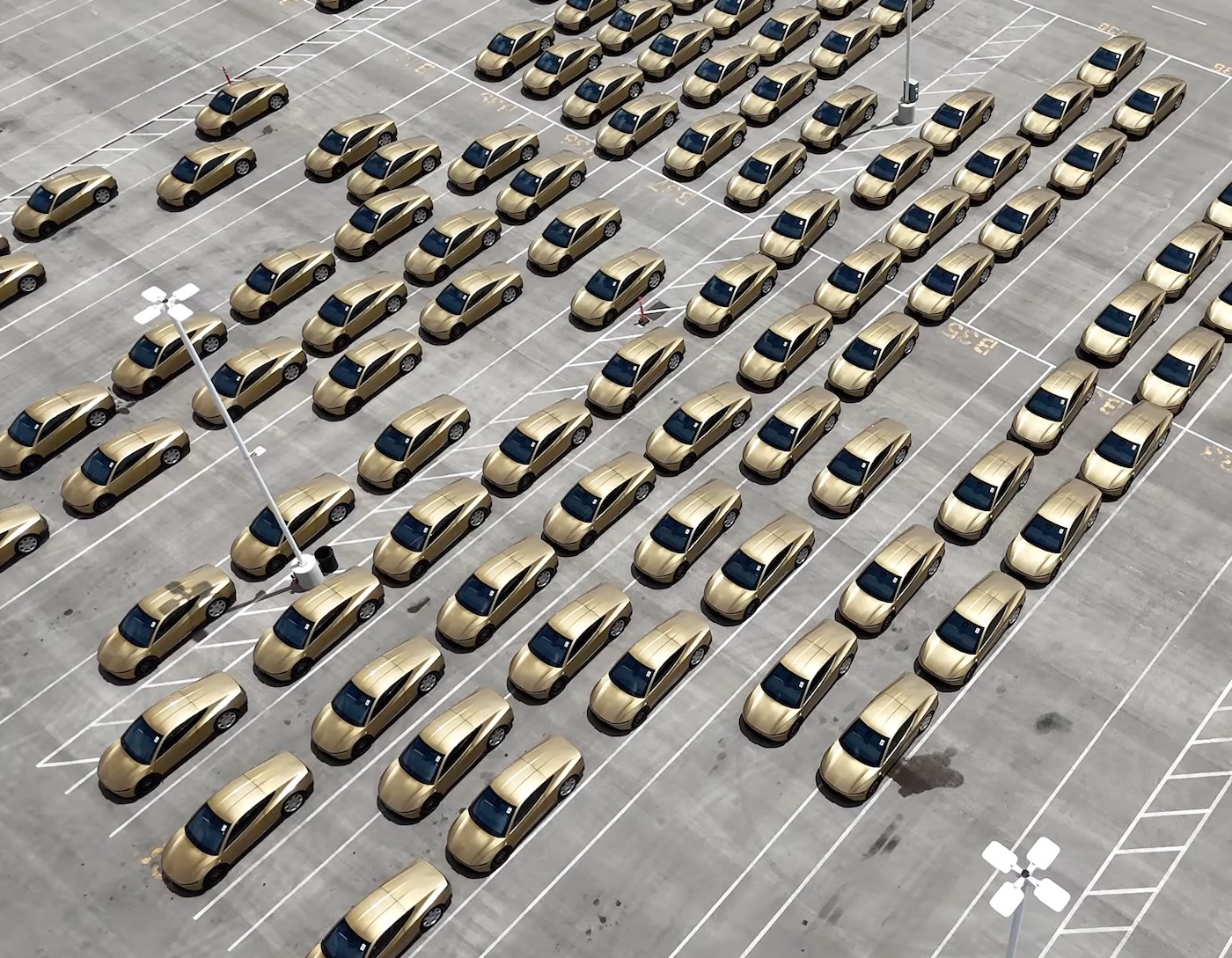
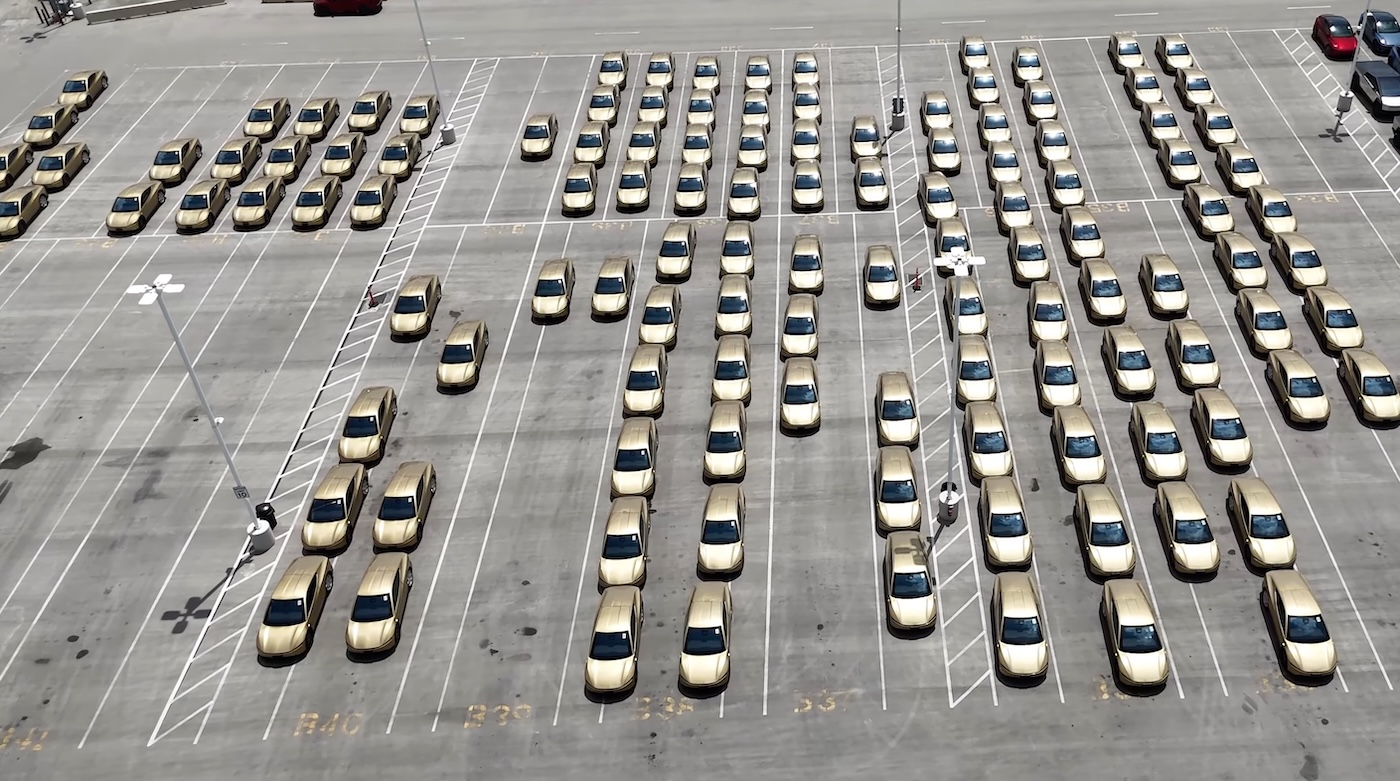
A drone flyover of Gigafactory Texas on Saturday, July 18, 2026, captured 245 Tesla Cybercab units staged across the Austin factory’s lots, a new record and more than double the 102 cars observers counted just five weeks earlier. The gold two-seaters sat in tight rows across multiple staging areas, some in the familiar outbound lot, others spread across a second parking field on the campus.
EVXL has tracked this staging count since six Cybercabs sat in simultaneous crash testing back in February, and the curve keeps steepening. Roughly 60 units in early April. More than 70 by mid-May. A record 102 on June 14. Now 245, a tally not yet independently confirmed but counted from aerial footage shot by the same drone channel that documented the June record.
The line is sprinting. The question that matters has not changed: where do these cars go?
The Staged Fleet More Than Doubled in Five Weeks
The July 18 count of 245 units marks a 140% jump from the 102 cars EVXL reported at the same factory on June 14, which was itself a record at the time, and it confirms the production ramp has moved well past its early stumbles. The first production Cybercab rolled off the Giga Texas line on February 17, 2026, and volume manufacturing followed in April. If the observer counts hold, Tesla built and staged roughly 143 additional finished units in 34 days, a pace of more than four cars per day added to the lots alone. Actual output runs higher, since some units have already shipped to test sites and showrooms in other cities.
The reflective gold finish that makes these counts possible from the air is not paint. Tesla applies a mirror-like coating that throws back the Texas sun, a detail drone observers have flagged since the first glossy units appeared in late April. It also makes miscounting hard. These cars are not subtle.
What makes a lot this full legally possible is Tesla’s decision to self-certify the Cybercab under FMVSS, the federal safety standards, rather than seek a NHTSA exemption. As EVXL detailed when the EPA certification filing surfaced in June, that route sidesteps the 2,500-unit annual cap that exemptions impose on operators like Waymo. The factory can build without a ceiling. And it clearly is.
Deployment Still Trails the Production Line
Not one of these 245 Cybercabs has carried a paying passenger, because the vehicle remains in engineering validation while Tesla’s commercial robotaxi service in Austin continues to run on Model Y vehicles fitted with conventional controls, steering wheel and pedals included. Cybercabs began public-road testing in Austin around the end of June with a safety monitor aboard, and the Texas Department of Transportation has confirmed the controlless design of the roughly 34 units testing downtown. On July 11, Tesla announced that employee rides would start soon at Giga Texas, not on the public network.
The Model Y fleet is scaling in parallel. EVXL reported that Tesla registered 58 robotaxis in Texas in a single day on July 15, lifting its state total to 175 vehicles, still behind Waymo’s 642. Every one of those additions was a Model Y. The purpose-built robotaxi, the one stacking up by the hundreds outside the factory that builds it, is not yet on that tracker earning its keep.
So the picture on July 18 is this: 245 finished Cybercabs in the lots, 34 or so validating downtown with minders, employee shuttle duty pending on factory grounds, and a commercial network that still runs entirely on retrofitted crossovers.
EVXL’s Take
On June 14, I wrote that before the end of Q3 2026 we should expect a drone flyover showing more than 200 staged Cybercabs at Giga Texas with no commercial fleet deployment to match it. That flyover arrived July 18, ten weeks ahead of the deadline, and both halves of the call landed. The lot filled before the network did.
I take no victory lap on the second half, because it is the half that should worry Tesla. A 245-car pile of finished robotaxis is capital parked on concrete. These cars cannot be sold to consumers, cannot be driven by a human, and cannot earn a fare until unsupervised FSD clears Tesla’s own validation bar in a vehicle with no fallback controls at all. Elon Musk has spent a decade promising autonomy timelines the software could not keep. Now the factory is keeping timelines the software cannot match, which is a more expensive version of the same problem.
The honest read: this is a genuine manufacturing achievement, likely the fastest ramp of a purpose-built autonomous vehicle anyone has managed, and it proves nothing about the service until a Cybercab picks up a stranger and takes their money. Whether the employee rides announced on July 11 convert into public Austin service before the staged count crosses 300 is the open question worth watching. At the current build rate, Tesla has about two weeks to beat its own parking lot.
Source: Giga Texas drone flyover, July 18, 2026 (Airwave Dynamics)
EVXL uses automated tools to support research and source retrieval. All reporting and editorial perspectives are by Haye Kesteloo.


