
Tesla’s Cybercab now has a federal certificate. The EPA issued certification for test group TTSLV00.0L1A on May 26, 2026, with an introduction-into-commerce date of May 29, 2026, and the public filing settles months of guesswork about what the two-seat robotaxi actually is under the skin. It is front-wheel drive. It runs a single AC three-phase permanent-magnet motor rated at 163 kW. Rated horsepower is 219.
The number that will get screenshotted is range. The certification lists a calculated charge-depleting range of 418 miles, with a highway figure of 375 miles. Those are not the EPA label numbers a buyer would see on a window sticker, and the gap matters. I pulled the certification summary directly to confirm the test group and the drive configuration before writing a word of this, because a calculated depleting range and an adjusted EPA rating are different animals, and conflating them is exactly the error a press-release rewrite makes.
Tesla has previously stated the Cybercab targets roughly 300 miles. Hold that thought.
The filing confirms a front-wheel-drive single-motor layout
The Cybercab is a front-wheel-drive battery electric vehicle with one drive motor, certified as a light-duty vehicle under both the Federal program and California’s ZEV rules. The EPA document spells out the powertrain in plain terms: drive source is a single electric motor, fuel is electricity, and there is no second axle in the picture.
That front-drive choice is the surprise. Most Tesla vehicles in the current lineup are rear-drive or dual-motor all-wheel drive. A purpose-built robotaxi going front-wheel drive reads as a packaging and cost decision, not a performance one. The motor is rated at 163 kW, which Tesla’s own manufacturer comment in the filing confirms verbatim. Pair that with 219 horsepower and you have a vehicle built to move two passengers across a city efficiently, not to win a stoplight.
The battery is lithium-ion, a single pack, with a total pack voltage of 326 volts. The filing lists a battery specific energy figure of 154 and an on-board charger. Curb weight comes in at 3,113 pounds, with a gross vehicle weight rating of 3,730 pounds. For context, that curb weight undercuts a base Model 3 by more than a thousand pounds. Tesla built this thing light.
Regenerative braking runs through the front wheels only, and the filing flags driver-controlled regen as “No.” On a vehicle with no steering wheel and no pedals, that answer makes sense. There is no driver to control anything.
The 418-mile figure is a calculated depleting range, not a window-sticker rating
The certification reports a calculated charge-depleting range of 418.226 miles and a calculated highway depleting range of 375.369 miles. These come from the dynamometer test bags, and the final adjusted EPA rating, the one printed on the Monroney label, almost always lands lower after the agency applies its correction factors. Tesla’s prior public guidance of about 300 miles likely reflects where the adjusted number settles, or where Tesla expects to set its own conservative claim.
The mismatch is normal and worth flagging anyway. A reader who sees 418 in a tweet and assumes it is the rated range will be disappointed by a sticker that reads closer to 300. The test data and the label are not the same document. The 418 figure says the car can physically cover that distance under specific lab conditions. The label number is what survives EPA’s real-world adjustment math.
What the filing does establish cleanly is that the Cybercab is a genuine 300-plus-mile vehicle on a battery pack small enough to keep curb weight under 3,200 pounds. That efficiency is the headline, not the lab range. A sub-3,200-pound two-seater clearing 300 miles of usable range on a single front motor is a tighter energy budget than anything else Tesla sells.
Self-certification, not a NHTSA exemption, is what lets the line run hot
The EPA certificate covers emissions and energy. It does not address the harder question of whether the Cybercab can legally carry passengers on public roads without a steering wheel. Those are separate federal tracks. NHTSA governs the Federal Motor Vehicle Safety Standards that assume a human driver with manual controls, and the Cybercab has neither.
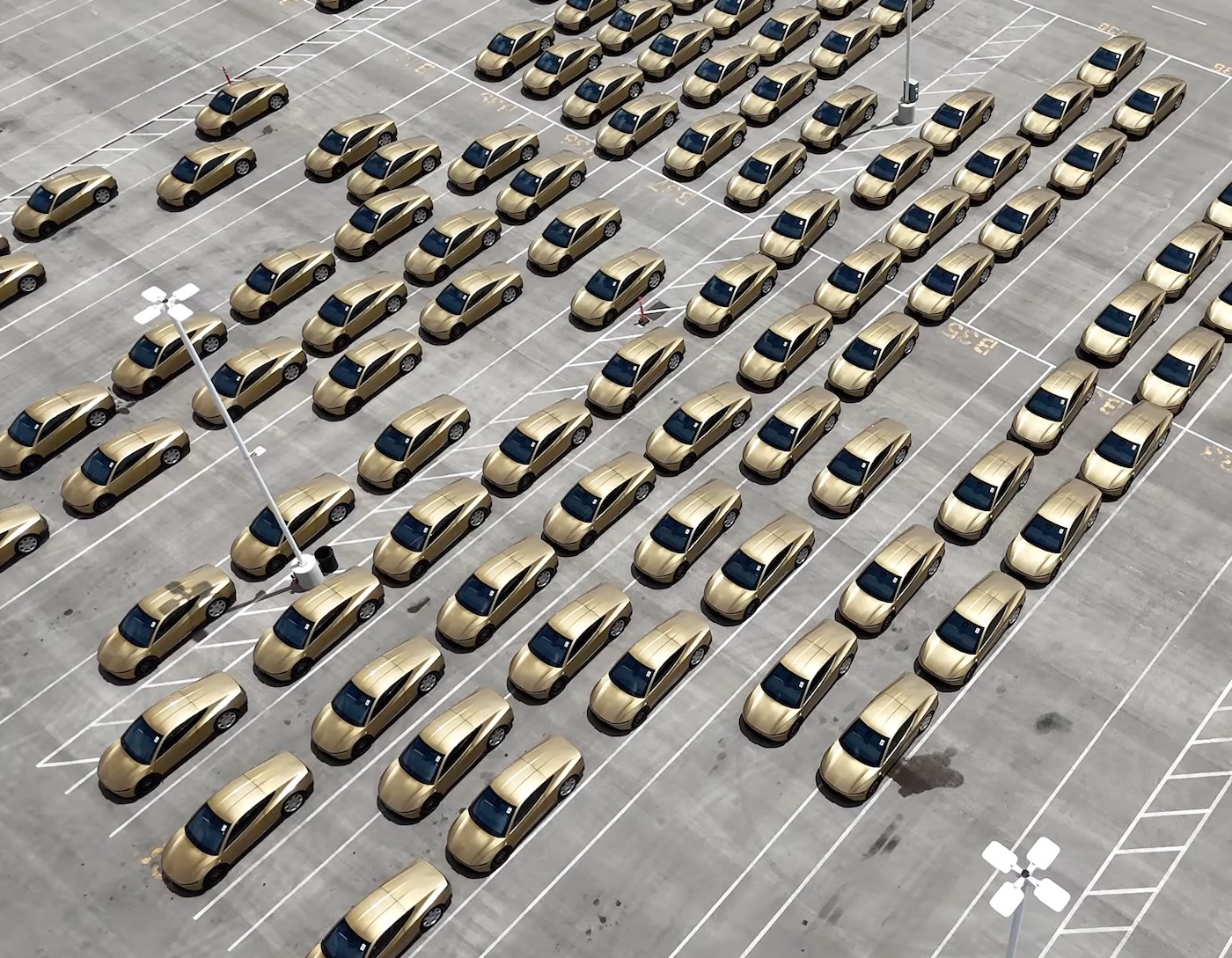
As EVXL reported on June 14, Tesla has chosen to self-certify the Cybercab under FMVSS rather than seek a NHTSA exemption, a path that sidesteps the 2,500-unit annual cap that exemptions impose on vehicles like Waymo’s. The factory can build as many as it wants. The outbound lot at Gigafactory Texas hit its fullest visible count yet that same weekend, gold-finished units stacking up while Tesla still has no consumer sales channel open.
The EPA certificate removes one regulatory box from the checklist. Production has been removing the manufacturing risk for months, since EVXL documented six units in simultaneous crash testing back in February. What remains is deployment. Building the car was never the bottleneck. Proving the software clears Tesla’s own validation bar is.
EVXL’s Take
This certificate is a milestone with an asterisk, and the asterisk is the interesting part. Tesla cleared the EPA hurdle for a vehicle it cannot yet legally fill with paying passengers, which tells you the company is sequencing its regulatory approvals to keep the production line moving while the autonomy case gets built in parallel.
I’ve been tracking the Cybercab paper trail since the trademark fight, when the USPTO stalled Tesla’s “Robotaxi” and “Cybercab” filings in May 2025 for being too generic. The pattern across every step has been the same. Tesla moves fast on the parts it controls, the factory, the certification, the hardware, and slower on the parts that require a regulator or a court to say yes. That same tension showed up when EVXL covered the Austin robotaxi service launch, where the hardware was ready well ahead of the supervised-to-unsupervised software jump. The 418-versus-300 range gap is a smaller version of the same story: the lab says one thing, the real-world label says another, and the honest number sits in between.
Here’s my prediction. The Cybercab’s final adjusted EPA range will land between 290 and 320 miles when the Monroney label publishes, well under the 418 calculated figure, and Tesla will quote the rounded 300-mile number it has used all along. Watch for that label before the end of 2026.
Source: EPA Certification Summary Information Report, Test Group TTSLV00.0L1A.
EVXL uses automated tools to support research and source retrieval. All reporting and editorial perspectives are by Haye Kesteloo.