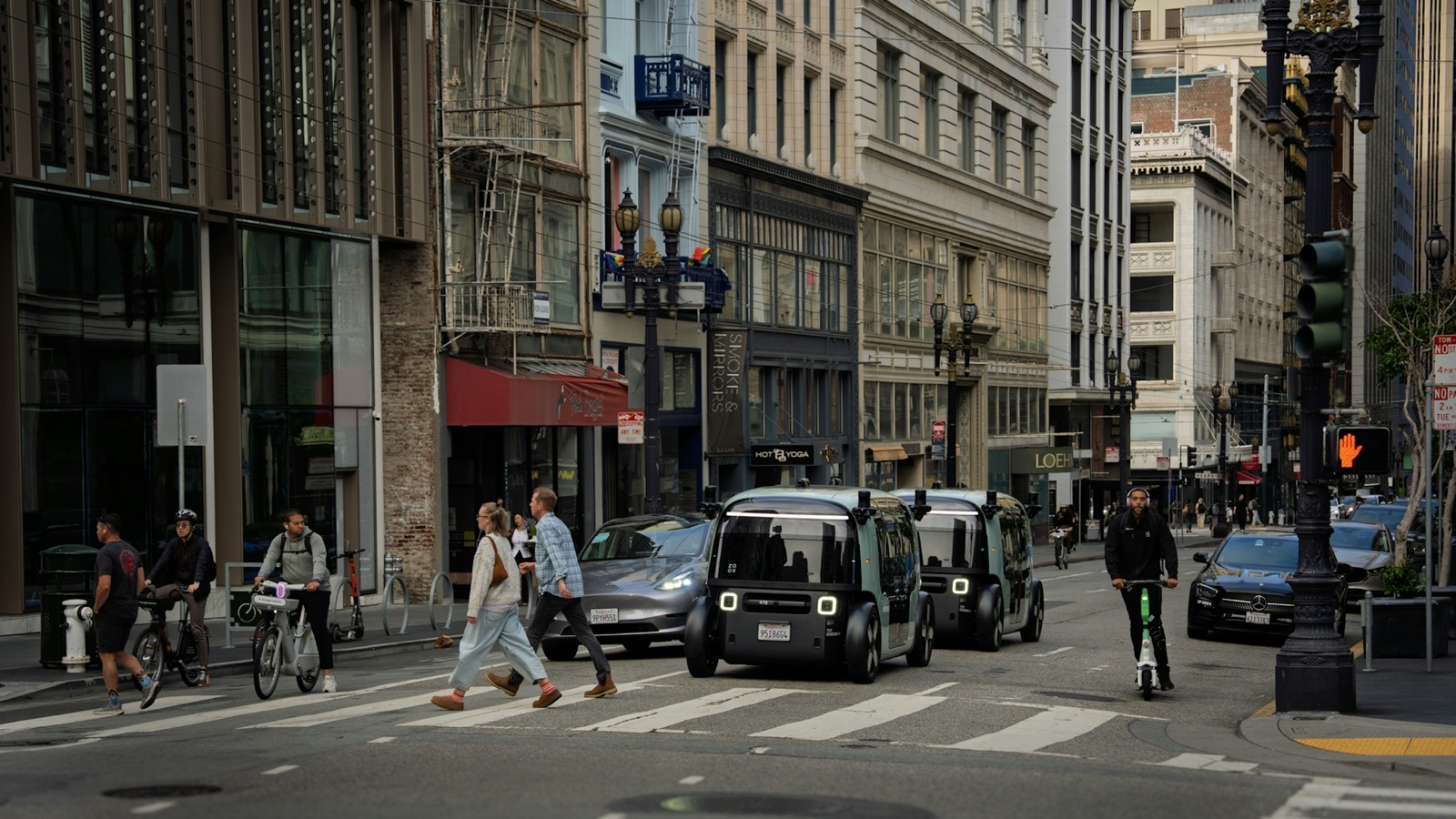
The National Highway Traffic Safety Administration announced federal approval Thursday for Zoox to charge passengers for rides in its purpose-built electric robotaxis, giving the Amazon-owned company a legal route to commercial service without a steering wheel, pedals, or other controls meant for a human driver.
The temporary exemption covers up to 2,500 vehicles annually for two years and is scheduled to take effect Friday, July 31, when the grant notice is published in the Federal Register. Zoox says it will start collecting fares in Las Vegas in August after completing remaining state requirements. State and local approvals remain necessary wherever the vehicles operate.
This is the first NHTSA commercial exemption for a purpose-built robotaxi. It turns Zoox’s free passenger program into something closer to a real transportation business, while keeping the fleet under federal limits and oversight.
NHTSA Gives Zoox Two Years Under Adaptive Oversight
NHTSA’s temporary exemption allows Zoox to deploy as many as 2,500 vehicles during each of two 12-month periods, while preserving federal authority to revise oversight as commercial data arrives, making this a capped test of a new vehicle architecture rather than blanket approval for unlimited production.
That annual 2,500-vehicle limit comes from the temporary-exemption authority in Part 555 of federal law. Zoox requested relief from portions of eight Federal Motor Vehicle Safety Standards, covering windshield defrosting and wiping, lighting, rear visibility, brakes, interior-impact protection, glazing, and occupant crash protection.
Calling the robotaxi “non-compliant” without context would be misleading. Several rules assume a human sits in a forward-facing driver’s position and needs a windshield, mirrors, pedals, and controls. Zoox instead built a bidirectional carriage with two inward-facing rows of seats and no driver’s position at all.
NHTSA said the exemption sits inside an adaptable enforcement framework rather than replacing safety review. Administrator Jonathan Morrison described the agency’s approach as removing unnecessary barriers while retaining enforcement oversight and developing measurable automated-vehicle performance requirements.
Paid Las Vegas Rides Are Scheduled For August
Zoox says Las Vegas will become its first paid market in August, after the company completes Nevada’s remaining commercial requirements, while San Francisco remains subject to a separate California process because the federal exemption clears specified equipment rules but does not authorize paid operations in every city.
The company launched free public rides in Las Vegas last year and an Explorers testing program in San Francisco. It now claims more than half a million completed riders and another half million people on its waitlist. Those figures come from Zoox and have not been independently audited.
The distinction between federal and local authority matters. NHTSA can exempt the vehicle from specified federal equipment standards, but Nevada and California still control commercial operations on their roads. A federal yes removes the vehicle-design barrier. It does not erase operating permits, service-area limits, or local enforcement.
A Purpose-Built Robotaxi Finally Gets A Commercial Path
Zoox’s approval gives the United States its clearest regulatory path yet for a passenger vehicle designed around autonomy rather than converted from a conventional car, because NHTSA has now identified how a purpose-built vehicle can enter paid service under a temporary exemption tied to continuing federal review.
EVXL previously covered NHTSA’s National AV Safety Forum, where regulators focused on remote assistance, measurable safety performance, emergency response, and the move from limited demonstrations to commercial scale. This exemption is the first concrete commercial decision to emerge from that broader policy push.
NHTSA is also working with SAE Industry Technologies Consortia on a three-year, $5 million program to develop automated-vehicle performance standards. The agency says those standards could eventually replace some vehicle-by-vehicle exemptions with national rules written for vehicles that drive themselves.
That is the right long-term destination. Temporary waivers can get a small fleet on the road, but an industry cannot scale around one-off permission slips forever.
EVXL’s Take
Zoox has reached the kind of robotaxi milestone that matters: federal permission to collect fares in a purpose-built vehicle, earned through a documented exemption process that names the rules its design cannot literally satisfy and limits the deployment while regulators gather evidence from commercial operation.
The company did not rename a supervised driver-assistance system, stage a short demonstration, or ask investors to accept another future promise. It submitted the vehicle to a federal process and accepted a capped deployment under continuing oversight.
The exemption also exposes the weakness in Washington’s old rulebook. Requiring a steering wheel in a vehicle with no driver’s seat does not protect anyone by itself. Requiring Zoox to demonstrate equivalent safety for the exempted standards, report how the fleet behaves, and operate under continuing federal oversight does. Regulation should police outcomes and evidence, not preserve hardware whose only job was to serve a human driver.
Zoox still has to prove that paid service works outside a controlled launch. Federal approval is the starting gun, not the finish line. But once the order takes effect and local requirements are met, the company will hold something many robotaxi announcements lack: permission to collect money from passengers in a vehicle built without human controls.
Sources: National Highway Traffic Safety Administration, Zoox, and the NHTSA grant notice.
EVXL uses automated tools to support research and source retrieval. All reporting and editorial perspectives are by Haye Kesteloo.