
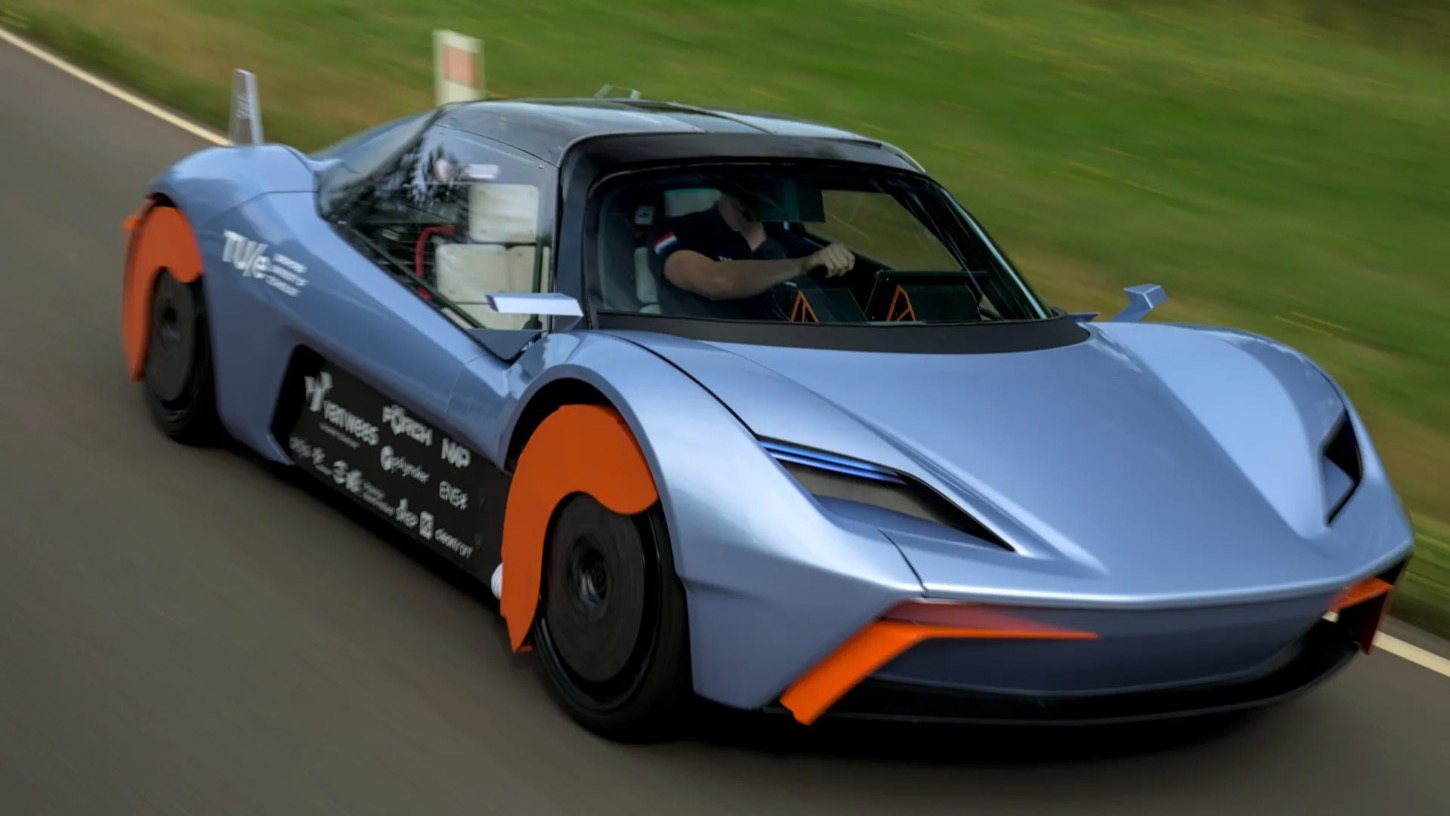
Students at Eindhoven University of Technology in the Netherlands have built an electric concept car that tries to catch the pollution an EV still makes after the tailpipe is gone: particles worn off its tires and brakes. The car is called VENTRA, and the university announced it on September 29.
The student team TU/ecomotive built VENTRA as a two-seat concept, not a car you can buy. The point is to get carmakers to copy its ideas. Team manager Tim Spencer put the problem in one line: “No exhaust emissions does not necessarily mean no emissions.” The public can see the car at Dutch Design Week in Eindhoven from October 17 to 25.
In the team’s simulations, VENTRA catches 42% of the particles its tires release in city driving. At 31 to 50 mph (50 to 80 km/h), the share falls to about 24%.
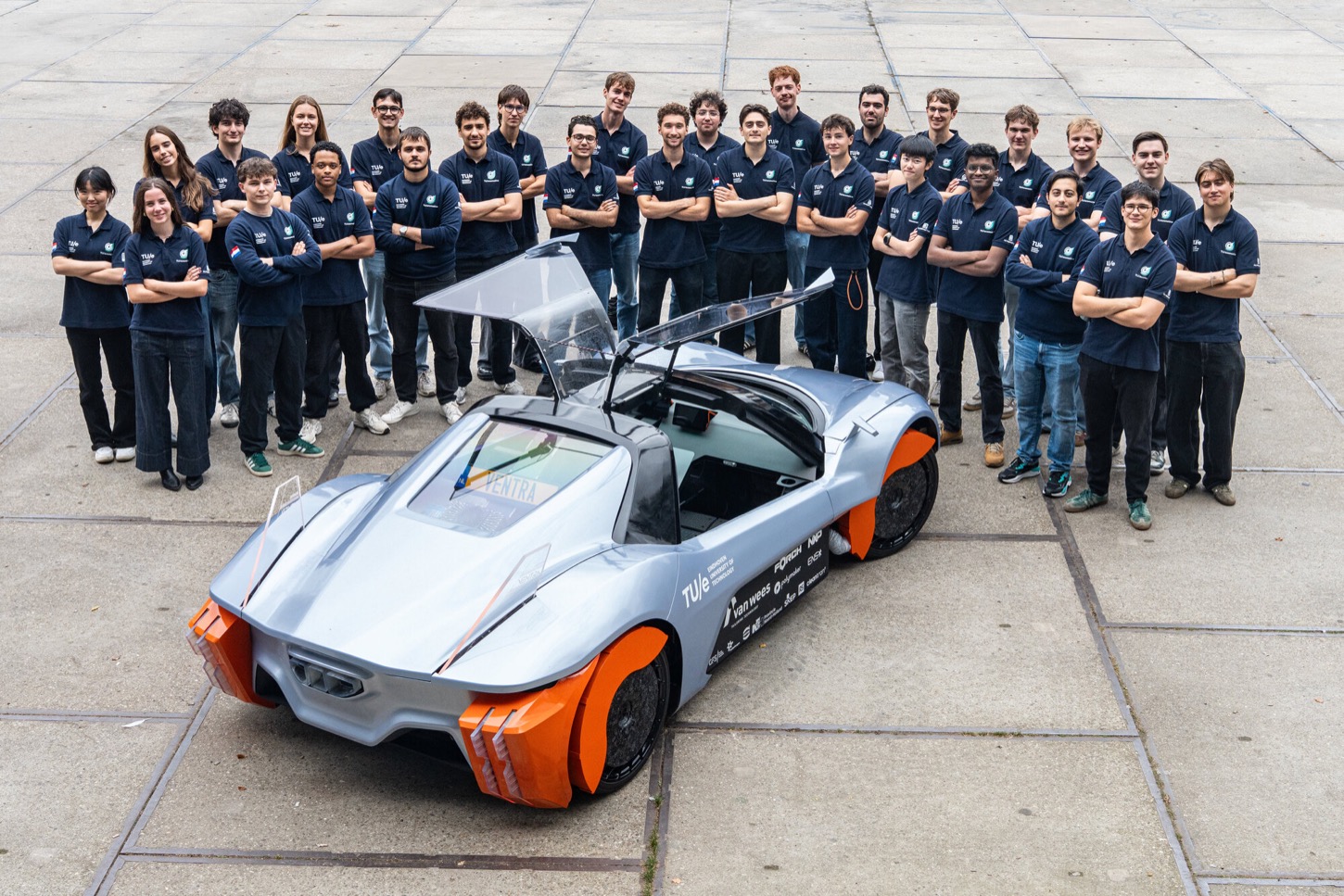
T.R.A.C.E. Grabs Tire Particles With an Electric Charge, Not a Filter
VENTRA’s T.R.A.C.E. system, short for Tire and Road Abrasion Capture by Electrostatics, gives particles near the wheels an electric charge so they stick to grounded collection surfaces. At speed, airflow carries particles in. In slow city traffic, fans do the pulling, which is why the city figure is higher.
Because there is no conventional filter, there is no filter to replace. The collection surfaces get cleaned with a vacuum or water. TU/ecomotive then worked some of the captured particulate matter into an enamel coating used inside the car, where the particles stay sealed in.
Both capture numbers come from computer simulations that TU Eindhoven published with the announcement, not from measurements in real traffic.
A 298-Pound Chassis Leaves Less Tire Wear to Catch
VENTRA’s chassis is built mostly from carbon-fiber-reinforced thermoplastic sandwich panels. TU/ecomotive says the complete chassis weighs about 298 pounds (135 kilograms), including a 100-pound (45.5-kilogram) monocoque. A comparable chassis built the traditional way would weigh around 507 pounds (230 kilograms). VENTRA’s version is about 40% lighter.
Less weight means less force pressing the tires into the road, so less rubber wears off. That matters most on an EV. The team points out that battery packs make electric cars around 20% heavier than comparable combustion cars, the same figure behind the EIT Urban Mobility study EVXL covered in May 2025. That study found regenerative braking cuts EV brake wear emissions by more than 80%, while the extra weight wears tires faster. The whole car weighs 790 kilograms (1,742 pounds) and has an estimated WLTP range of 180 miles (290 kilometers).
A third system, Clean Drive, works on the driver. It reads steering, braking and acceleration data in real time and uses the dashboard display to coach smoother driving, which wears tires and brakes more slowly.
Euro 7 Puts Brake Dust Limits on New Cars Starting in November
The European Union’s Euro 7 regulation is the first to limit brake particle emissions. The limits apply to new car and van types from November 29, 2026, and to all new cars and vans from November 29, 2027. Battery-electric cars get the tightest cap: 3 milligrams of PM10 per kilometer.
Tires come later. Euro 7 abrasion limits start with new types of passenger-car tires on July 1, 2028, and those rules land on tire makers rather than carmakers.
EVXL’s Take
I like that T.R.A.C.E. skips the filter. There is no part to buy every few thousand miles, though somebody still has to clean the plates and decide what to do with the dust. Turning it into the car’s own enamel coating is a clever answer to that second problem.
The weight is the idea I’d steal first. When I wrote about Volkswagen’s Mission Efficiency two weeks ago, the whole car was built around wasting less energy. VENTRA makes the same argument for tires: a lighter car wears out tires and brake pads more slowly and uses less electricity. The owner pays less for both. My read is that carmakers will borrow pieces of this, starting with lighter parts and Clean Drive-style coaching, because they have to meet Euro 7’s brake limits in Europe anyway. Building one car for Europe and a different one for everywhere else makes little sense. The full capture system is a harder sell until someone shows the 42% holds up on a real street.
Sources: TU Eindhoven, TU/ecomotive, Regulation (EU) 2024/1257 (Euro 7)
EVXL uses automated tools to support research and source retrieval. All reporting is by Damien Kesteloo, edited by Haye Kesteloo.