
Volkswagen drove a concept car 794 miles (1,278 kilometers) from Wolfsburg, Germany, to Vienna, Austria, and stopped to charge once. The battery holds 54.9 kWh. The motor makes 133 horsepower (99 kW). Neither number belongs on a car that covers that distance.
That is the whole idea. Instead of chasing range with a massive battery, the Mission Efficiency is built to use as little energy as possible getting down the road. It reached Vienna with 102 miles (164 kilometers) still showing, averaging 9.02 miles per kWh (6.89 kWh per 100 kilometers) before charging losses.
Volkswagen says the prototype set three world records, certified by Germany’s Record Institute in a category for near-production, everyday four-seat electric cars. All three trace back to one figure: a drag coefficient of 0.158, which Volkswagen says is the lowest ever measured on a road-approved vehicle.
The Wolfsburg-to-Vienna Run Took a Single Charging Stop
Volkswagen logged 794.34 miles (1,278.36 kilometers) from its Wolfsburg development center through Poznań, Poland, and Olomouc, Czech Republic, to Vienna. Average speed came to 42 mph (67.72 km/h) and the run peaked at 86 mph (138 km/h). The 54.9-kWh battery was recharged once.
Including charging losses, consumption worked out to 8.27 miles per kWh (7.51 kWh per 100 kilometers), according to Volkswagen’s announcement of the run. Strip the losses out and it rises to 9.02 miles per kWh.
The average speed is what makes the rest of it credible. This was four countries of public road rather than a closed course, and it touched 86 mph along the way, which is exactly where an ordinary EV starts handing the energy back.
A 0.158 Drag Coefficient Undercuts Every EV You Can Buy
Aerodynamics matter more the faster a car travels, because pushing air out of the way takes energy and the amount climbs steeply with speed. Cutting drag improves efficiency without adding a single battery cell, which also means less weight and lower cost. That is what Volkswagen set out to prove.
The numbers back it up. Above 50 mph (80 km/h) the Mission Efficiency uses more than 30 percent less energy than a standard ID. Polo, and at 87 mph it draws what an ID. Polo needs at 62 mph. Volkswagen pairs the 0.158 figure with a frontal area of 22.4 square feet (2.08 square meters).
For scale, the Tesla Model Y Long Wheelbase EVXL covered in July runs a 0.216 drag coefficient and the Kia EV4 sedan claims 0.23, matching the Model 3. Volkswagen’s concept lands 27 and 31 percent below them, though both carry far more frontal area than a low two-door coupe.
The Mission Efficiency Looks the Way It Does for a Reason
The shape is dictated almost entirely by the aerodynamic target. A teardrop body, three active cooling flaps set flush into the nose, clad rear wheels, a fully covered underbody, frameless door windows and handles sunk into the outer skin. None of it is styling for its own sake.
Volkswagen puts the wheels alone at 25 to 30 percent of a car’s aerodynamic drag and fitted patented deflectors inside every rim to stop air entering and churning there. Continental supplied a concept tire based on the EcoContact 7 with a rolling resistance of 4.9 kilograms per tonne, roughly 25 percent under the threshold for the EU’s top tire label class.
Chief designer Andreas Mindt said “the DNA of the legendary Volkswagen XL1 shines through.” That car appeared in 2013 with a plug-in hybrid drivetrain and was, by Volkswagen’s own measure, the most economical production car in the world at the time.
The Motor and Battery Came Out of the ID. Polo
Nothing exotic drives this car. The 99-kW motor and the high-voltage battery are production parts from the ID. Polo, riding on the MEB+ front-wheel-drive architecture that also underpins the ID. Cross. The body mixes ID. Polo components with an aluminum structure and a carbon-fiber and aramid composite.
Thomas Schäfer, CEO of the Volkswagen brand, called it “technology for the masses.” The claim is checkable, which is more than most concept cars offer. The ID. Polo is the small electric hatchback EVXL flagged as one of the cars that could reshape Europe’s market back in November.
The rest of the car is stranger. There is no speaker system, just a Bluetooth box, and the infotainment display is your own phone or tablet. A 370-watt solar array sits in the glass roof and boot lid, adding up to 18.6 miles (30 kilometers) of range on a good day. At the rear, an electromechanical brake replaces the hydraulic one, a first for Volkswagen, developed with supplier AUMOVIO.
The coupe seats 2+2, with the rear pair rated for passengers up to about 5 feet 3 inches (1.60 meters). Volkswagen says it holds EU road approval and meets the crash requirements, which is what lets it claim a road-approved aerodynamics record at all.
The Second Record Came From a Test No Owner Will Repeat
Volkswagen’s other consumption record, 9.59 miles per kWh (6.48 kWh per 100 kilometers), came from an ideal drive at a constant 42 mph (68 km/h) on flat ground at the Ehra-Lessien test track, with the air conditioning and other auxiliary systems switched off. Volkswagen states those conditions in the release.
That number should not be read as the kind of consumption an everyday owner would see. Weather, temperature, traffic, elevation changes, speed and climate control all move real figures, and the Vienna run is the one worth carrying forward.
The bigger gap is what happens next. Volkswagen’s announcement names MEB+, the ID. Polo motor and the ID. Polo battery as the production technology behind the records, and stops there. The aerodynamic body, the rim deflectors, the composite structure, the electromechanical rear brake and the solar roof are presented as demonstrations, with no model and no date attached to any of them. The car is labeled a concept and explicitly not for sale.
Mercedes Set a Comparable Record in 2022 With Twice the Battery
Mercedes-Benz drove its Vision EQXX 747 miles (1,202 kilometers) from Stuttgart to Silverstone in 2022 on a single charge, averaging 7.49 miles per kWh (8.3 kWh per 100 kilometers) behind a 0.17 drag coefficient. Its battery was bespoke and just under 100 kWh.
The EQXX went farther without stopping, and that still counts. But Volkswagen used 17 percent less energy per mile on drive energy alone, or about 10 percent less once charging losses are counted, with a pack a little over half the size. Mercedes built the EQXX around a Formula One drivetrain and sold none of it.
EVXL’s Take
I think this could work as a production car, and I also think Volkswagen is nowhere near finished. The efficiency argument is real. A 54.9-kWh pack is cheaper to build and lighter to haul, and getting 794 miles out of one by fixing the car instead of the battery reverses how the last decade of EV engineering has gone.
My problem is the battery anyway. Nine miles per kWh held up over a documented route, but that route still needed a charging stop, and every condition a real owner drives in works against the number. Cold mornings, a full car, the heater running, 75 mph on an interstate. Take the record-run conditions away and 54.9 kWh is a short-range car wearing a very clever body. I would rather see Volkswagen keep all of the aerodynamics and add pack on top, because those two gains stack instead of substituting for each other.
The looks are the other half of it. This is a striking car, and genuinely futuristic for something shaped start to finish by a wind tunnel. But Volkswagen built that 0.158 around a two-door coupe with rear seats capped at 5 feet 3 inches and a phone where the screen should be, and it says itself the car is not for sale. Pull the shape back toward something conventional and it would find real buyers.
Credit where it is owed: using the ID. Polo’s own motor and battery is a real distinction from the EQXX, and it is the kind of claim a buyer can check later against a car on a dealer lot.
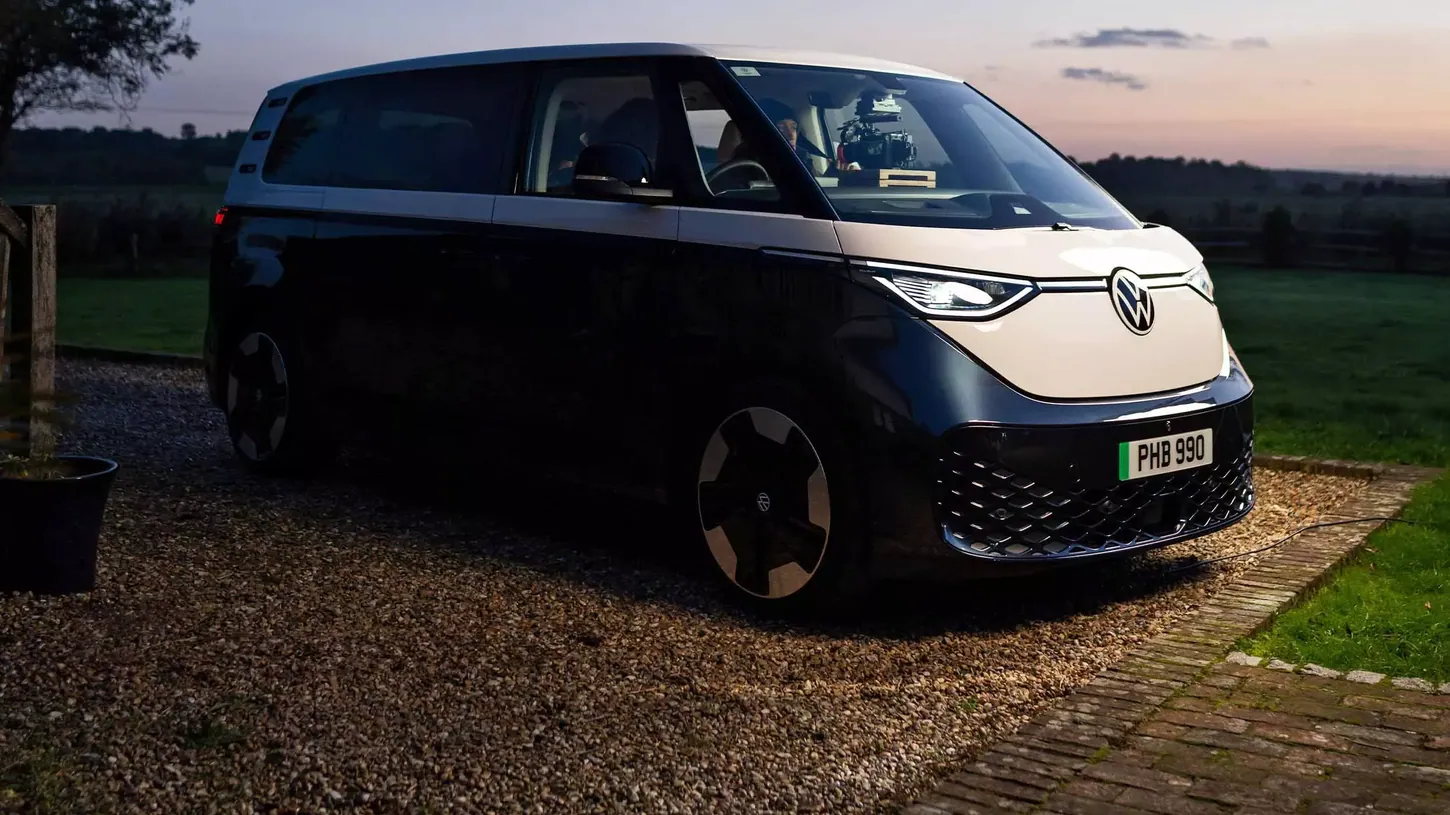
For American readers the practical answer is none of it. Volkswagen skipped the 2026 ID Buzz in the US entirely and dealers cleared the leftovers at up to $25,500 off, part of the broader pullback EVXL has tracked all year that keeps landing hardest at the affordable end.
Watch the ID. Polo’s production spec for the wheel deflectors and the covered underbody. They cost almost nothing, and they either show up on a car people can buy or this was a press event with a record certificate stapled to it.
Sources: Volkswagen Newsroom, Mercedes-Benz Group
EVXL uses automated tools to support research and source retrieval. All reporting is by Damien Kesteloo, edited by Haye Kesteloo.