Volkswagen spent five years and three full-scale prototypes trying to build a flying car in China, and killed the program in June 2024. Reuters reconstructed the whole thing this week from hundreds of pages of internal documents and court records.
The wreckage did not stop at a written-off research line. A Shanghai startup accused Volkswagen of misappropriating its trade secrets, police opened a criminal investigation in December 2023, and the person they named as the suspect was not Volkswagen. It was Zhou Jin, the Chinese manager Volkswagen had promoted in its own videos as the face of its innovation program.
I wrote in October 2024 about Ralf Brandstätter warning Volkswagen’s supervisory board that Chinese rivals were leaping ahead. This file is what that warning looked like from the inside, one product line over.
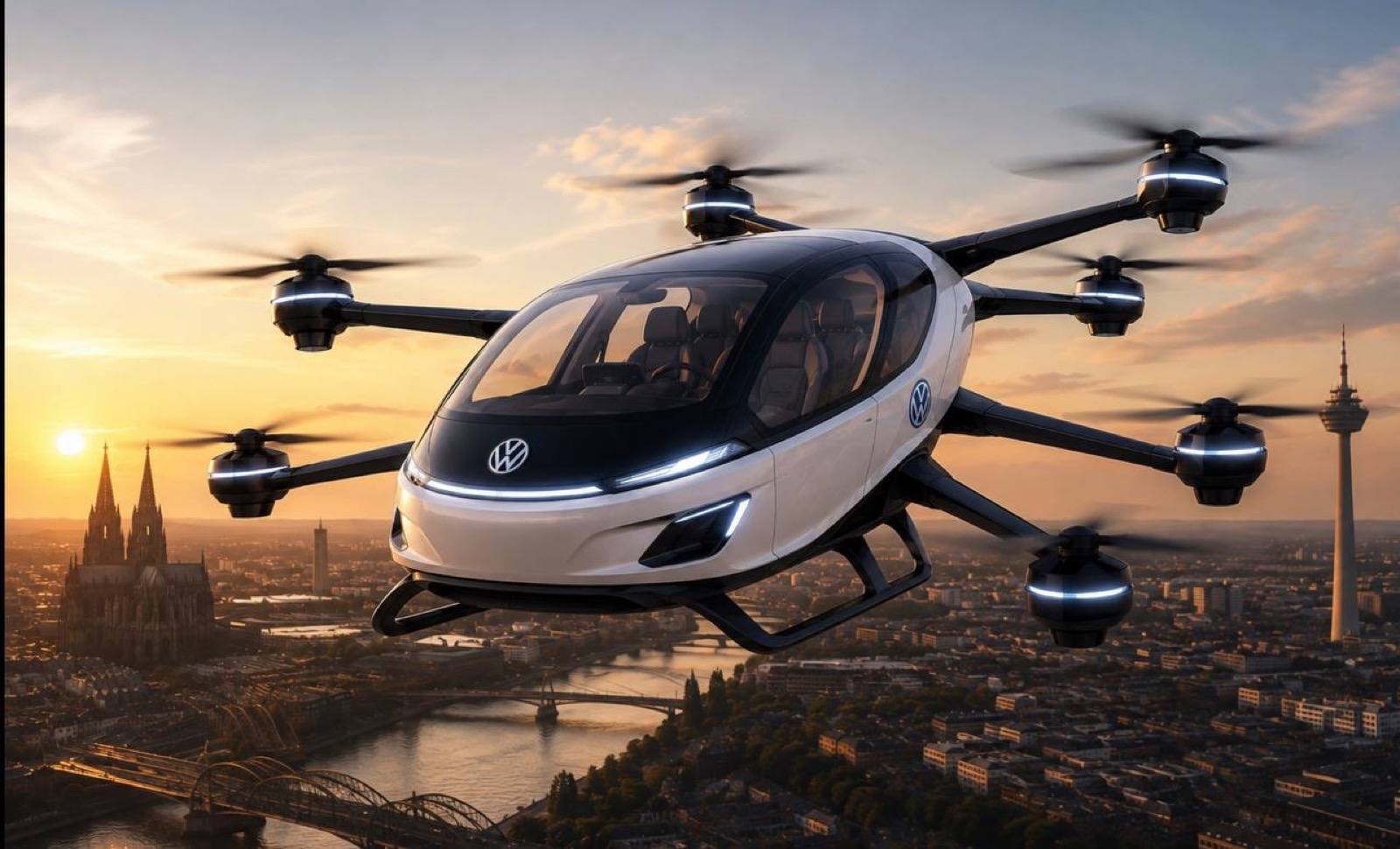
Volkswagen Built A Four-Seat Flying Car For China’s Wealthy Buyers
Volkswagen launched the project in 2019 with a team of fewer than ten people in Beijing, chasing an electric vertical takeoff and landing aircraft branded V.MO. Internal marketing materials named the target customer as China’s “established life enjoyers,” wealthy individuals buying status and exclusivity.
The cabin had to seat four passengers with luggage and carry entertainment screens. The pitch was intercity travel, Beijing to Tianjin, at roughly half a helicopter’s noise. It was a moonshot that had already defeated two of the group’s own brands: Porsche partnered with Boeing, Audi partnered with Airbus, and neither venture produced a commercial aircraft.
Zhou, then the 39-year-old director of Volkswagen’s Beijing innovation center, led the team. Volkswagen concluded it needed a Chinese partner because the local market was running ahead of European research and development, a judgment Zhou delivered on camera in a company promotional video.
The Partner Search Ran Straight Into China’s State Defense Contractor
Finding a capable Chinese aerospace partner without political exposure turned out to be the first unsolvable problem, and one internal presentation warned explicitly that government ties could trigger scrutiny outside China. Volkswagen worked the list and kept hitting walls.
An August 2020 assessment concluded that Guangzhou-based EHang had a gap to close against Volkswagen’s automotive engineering standards. Military drone maker Sichuan Tengden withdrew on its own, citing capacity constraints that a Volkswagen note connected to the China-US arms race. Volkswagen’s lawyers separately flagged that Tengden was founded by a veteran of Aviation Industry Corporation of China, the state defense contractor that builds the J-20 stealth fighter.
Volkswagen then hired an AVIC subsidiary, AVIC General Huanan Aircraft Industry Company, as its flying-car consultant in 2021. AVIC faced US export restrictions at the time, though it was not a fully blocked entity under US sanctions. That decision is where the legal trouble starts.
A $590,000 Contract Turned Into A $30 Million Lawsuit
That same year Volkswagen picked Pantuo Aviation, a two-year-old Shanghai startup run by Zhang Qiong, for a feasibility study on a Volkswagen-badged aircraft. Pantuo’s four-rotating-wing concept, known as Pantala, impressed Volkswagen managers. Zhang was less impressed in the other direction, telling Reuters the automaker treated a novel aircraft program like a parts-assembly job.
“They had never done this before,” she said.
A September 2021 Volkswagen status document declared the concept carried “uncontrollable risk,” with aerodynamic performance leaving projected range far short of target. A later internal assessment called the Pantuo collaboration a mistake and blamed Volkswagen’s own lack of in-house aviation experience. Volkswagen offered to terminate the roughly $590,000 contract for about $414,000. Pantuo refused and went to arbitration, arguing Volkswagen had improperly shared its concept work with the AVIC unit.
The arbitrator sided with Volkswagen in April 2023 and ordered Pantuo to pay damages and fees above $120,000. Volkswagen’s legal team called the ruling an outstanding result in an internal email. Pantuo escalated in September 2025 with a $30 million suit in a Guangdong court against Volkswagen and AVIC GA. China’s Supreme People’s Court dismissed the claim against Volkswagen in June on arbitration grounds while allowing the case against the AVIC unit to proceed, which leaves Pantuo free to return to the arbitrator.
Zhou Jin Is The Only Individual Carrying Criminal Exposure
Pantuo filed its criminal complaint in 2021 against Volkswagen. When Shanghai police opened the investigation in December 2023, case documents named Zhou as the suspect, and prosecutors took the matter up in 2024. She has been under travel restrictions since.
Zhang has confirmed she filed against the company, not the manager. Zhou told Reuters she cannot understand being left alone to face “a criminal case I was innocently dragged into,” and said she has repeatedly asked Volkswagen to resolve the underlying commercial dispute in full. She called it shocking and heartbreaking that Volkswagen treats the case against her as an individual legal matter, a position she says senior executives restated to her as recently as July.
Volkswagen declined to comment publicly on the flying-car program or the case against its employee, saying only that the claims against the company are “entirely without substance.”
China Is Now The Plaintiff In Technology Disputes
For decades the anxiety ran one way, with foreign firms worried that Chinese partners would copy their technology. The Volkswagen case is the inversion, and the numbers say it is not an outlier.
Chinese courts accepted 11,066 intellectual-property cases involving foreign parties in 2025, up 34 percent from the prior year, according to a Supreme People’s Court report. Foreign-related matters at China’s Intellectual Property Court grew at an average 19 percent a year between 2019 and 2025, reaching 2,546 cases. In February, the national agency overseeing prosecutions said it was stepping up enforcement on technology-leakage claims.
Mark Cohen, former senior intellectual-property attaché at the US embassy in Beijing, framed the shift in seven words: “The shoe is on the other foot.” As China owns more of the technology worth defending, he said, it becomes the plaintiff more often.
Brandstätter Killed It, And The Partner Bought Volocopter
Volkswagen’s top management committee reviewed the program in March 2024 and green-lit it, but left the real decision to China chief Ralf Brandstätter. Legal, compliance, finance and strategy had all raised objections, and the strategy paper warned that momentum in China was already held by established local players, naming Xpeng and Geely.
Brandstätter ended it that June, concluding Volkswagen needed to focus on a core business whose passenger-car sales were sliding. He told the team it was disbanded and broke the news to Chinese partner Wanfeng Auto Holding Group by WeChat. A Wanfeng unit disclosed in a November 2024 regulatory filing that the joint venture agreement had ended.
Wanfeng did not slow down. In March 2025 its Austrian subsidiary Diamond Aircraft acquired the assets of insolvent German eVTOL developer Volocopter for about €10 million. Emerson Xu, chief executive of consultancy NexAvian and the former China head of that same Volocopter, told Reuters that firms lacking local speed “don’t stand a chance.”
The core business tells the same story. Volkswagen’s China deliveries peaked at 4.2 million in 2019 and fell to 2.7 million last year, dropping it to third behind BYD and Geely. Volkswagen has since announced plans to cut vehicle models and up to 100,000 jobs. To be fair to Wolfsburg, the Chinese market has punished its own champions too, as BYD’s own profit collapse and the 2026 subsidy cliff showed. But VW is losing to Geely, the same Geely that already builds cars in South Carolina, and to a BYD that still holds the global BEV crown even in a shrinking quarter.
EVXL’s Take
Volkswagen sold “in China, for China” as risk management. The flying car shows the opposite. Localization concentrated Volkswagen’s exposure rather than spreading it, and the file reads like a company that thought hiring Chinese engineers and Chinese consultants was the same thing as acquiring Chinese speed. It is not. Zhang put her finger on it precisely: Volkswagen approached a novel aircraft the way it approaches a car, as parts that exist and get bolted together. That is a manufacturing mindset applied to a research problem, and it is the same instinct that produced the ID. software mess.
The detail that should bother every Western executive with a China operation is not the failed prototype. It is Zhou Jin. Volkswagen put her in its promotional videos as the face of Chinese innovation inside a German company, and when the legal exposure arrived, the company’s position was that her criminal case is her own matter. Whatever the legal merits, that is a recruiting problem in a market where Volkswagen needs local engineering talent to choose it over Xpeng or NIO. Every senior Chinese hire at a Western automaker read this story this week.
I have argued for two years that legacy automakers are failing on strategy rather than on the EV transition itself, and this is the purest example yet. Nobody sanctioned Volkswagen out of the flying-car market. It had money, access, a Premier photographed in its mock-up and a five-year head start on most of its Chinese competitors. It lost anyway, to companies that moved faster and to a legal system that now defends domestic technology with criminal referrals.
Watch what Volkswagen does with Xpeng from here. That partnership carries the EV turnaround, and Xpeng’s Aridge unit is simultaneously one of the flying-car competitors Volkswagen’s own strategy paper named as the reason to quit. Wolfsburg is now dependent on a partner that beat it in an adjacent market, and it continues to lean on Chinese firms elsewhere, including Horizon Robotics for autonomous driving. Whether that dependence deepens or quietly narrows over the next year is the real signal about how much leverage Volkswagen has left in China.
Sources: Reuters, Supreme People’s Court of China, Wanfeng Auto Holding Group regulatory filings.
EVXL uses automated tools to support research and source retrieval. All reporting and editorial perspectives are by Haye Kesteloo.