
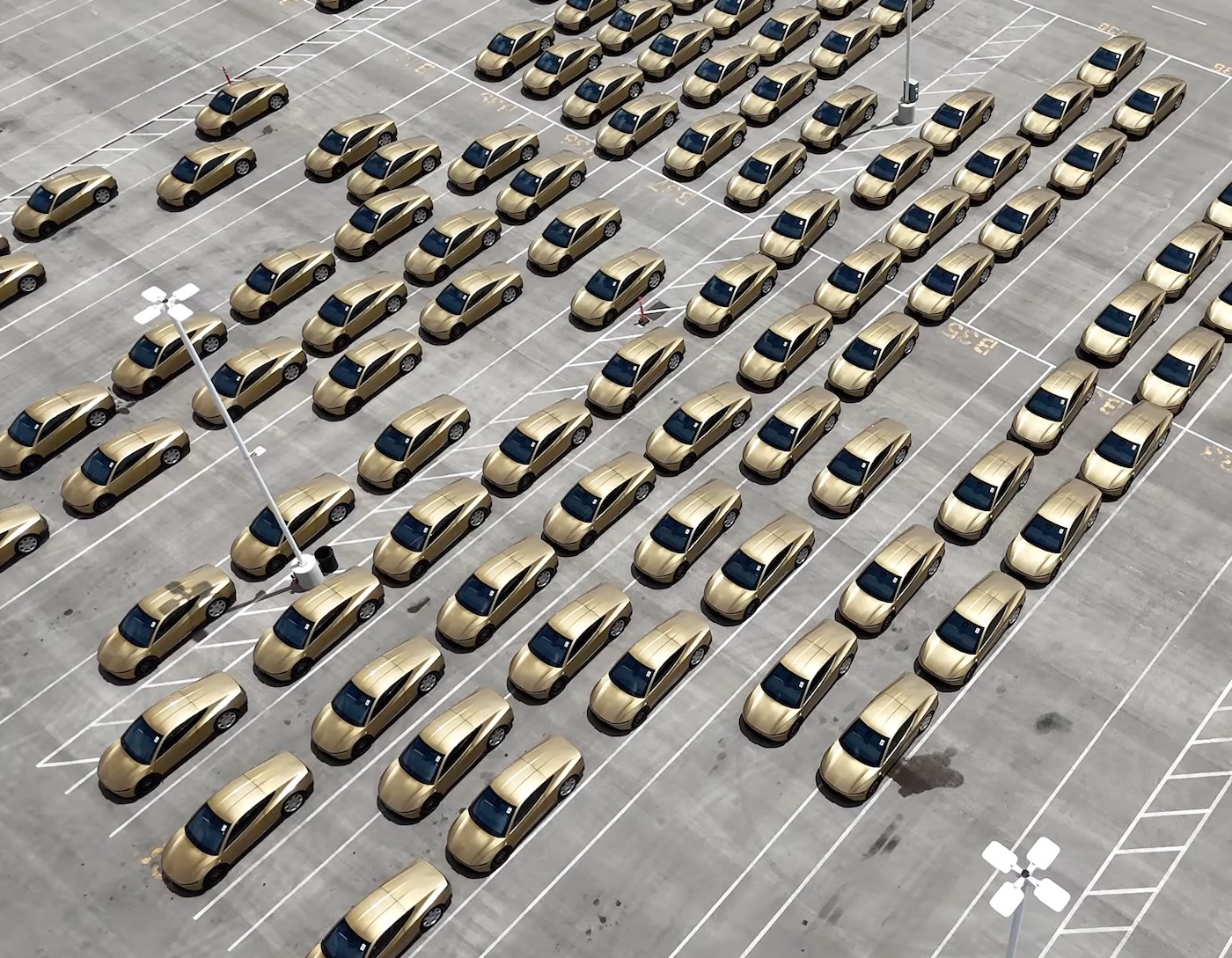
Fourteen Tesla Cybercab robotaxis and 14 Model Y vehicles, all wearing Texas plates, turned up in a Charlotte-area parking lot this week, photographed by longtime Tesla investor Michael Konen. Tesla is also advertising for an AI Safety Operator in Charlotte to “oversee daily operations of ride-hailing services” and collect data by driving a defined zone six to eight hours a day.
The sighting lands nine days after EVXL counted a record 245 finished Cybercabs staged at Gigafactory Texas with no commercial fleet to absorb them. Test prototypes have left the country before, including the steering-wheel Cybercab now winter testing in New Zealand, but Charlotte is the first documented multi-car batch of that gold inventory staged outside Texas for what looks like service preparation.
Tesla did not respond to Axios Charlotte’s request for comment. The company’s latest earnings report named Las Vegas and Phoenix as the next metros in line. Charlotte was not on the slide.
Charlotte Sets Up a Direct Race With Waymo
Charlotte is shaping up as a head-to-head market between Tesla and Waymo, because Alphabet’s robotaxi unit has been testing and mapping the city for months while Tesla now has vehicles on the ground, a job posting live, and no announced launch date for either service.
The AI Safety Operator listing on Tesla’s careers site describes daily oversight of ride-hailing operations and hours of data-collection driving in a set area. Similar operator postings are live for more than 30 other locations, including Nashville and Atlanta, so Charlotte is one front in a much wider staging effort.
Konen, who shared the photos on X, told Axios Charlotte the city isn’t usually first to new technology, adding, “But I love that technology is coming here.”
The Cybercab Pile Starts to Move
The Charlotte batch is the first sign that the record inventory of finished Cybercabs at Gigafactory Texas has somewhere to go, after EVXL’s July 18 count of 245 staged units documented a production line running far ahead of any deployed commercial service.
Tesla currently runs driverless robotaxis in six metros: Austin, Dallas, Houston, Miami, Orlando, and Tampa. San Francisco cars still carry safety drivers because, as EVXL reported in March, California classifies Tesla’s service as a supervised limo operation, not an autonomous one. In its Q2 report on July 22, Tesla said preparations were underway in Las Vegas and Phoenix for further rollouts.
The safety-operator role matters for reading the timeline. A human driving a mapped zone for hours a day is the data-collection phase Tesla ran in every prior market before opening service. Charlotte is at the start of that playbook, not the end.
EVXL’s Take
I’ve spent months asking where the Giga Texas Cybercab pile would drain to, and Charlotte just gave me the first answer. Fourteen cars in a Carolina parking lot won’t dent a 245-unit backlog, but it proves the inventory has started shipping.
Read the two signals together, though. The earnings deck named Las Vegas and Phoenix. The parking lots named Charlotte. When Tesla’s slides and Tesla’s logistics disagree, I trust the logistics, because this company communicates by deployment, not press release. Thirty-plus operator postings say the real map is far bigger than anything investors were shown on July 22.
The caveat is the job description itself. A safety operator driving six to eight hours a day is mapping, not service, and every market Tesla has launched so far opened on Model Ys while the Cybercab stayed in validation. Waymo has months of Charlotte mapping already banked. Whether Tesla’s arrive-late, launch-fast pattern from Florida repeats here, or whether Waymo converts its head start into the city’s first driverless fare, is the race worth watching. The October earnings call is the next forced disclosure. If Charlotte makes that slide, the lots called it first.
Source: Axios Charlotte
EVXL uses automated tools to support research and source retrieval. All reporting and editorial perspectives are by Haye Kesteloo.


