China’s January-February sales window is always distorted by Lunar New Year. Factories go quiet, showrooms empty, and delivery figures swing 30 to 50 percent on calendar timing alone. Strip out the noise and the picture for Tesla is actually decent: 127,728 China-made EVs sold in the first two months of 2026, up more than 35% from 93,926 in the same period last year, according to data published Thursday by the China Passenger Car Association (CPCA). That figure covers both domestic China buyers and export shipments from Shanghai.
- The Fact: Tesla’s Shanghai factory produced 127,728 EVs in January-February 2026 — for both domestic sales and export markets — a gain of more than 35% from 93,926 units in the same two months of 2025.
- The Delta: BYD reported a 36% decline in deliveries over the same period, meaning both brands moved in opposite directions by nearly identical percentages simultaneously.
- The Context: Tesla’s combined two-month volume is still more than double that of the next closest automaker, Leapmotor.
- The Buyer Impact: Tesla is holding No. 2 in China despite brand headwinds and growing domestic competition. That position is real, but it is not safe.
Tesla’s Shanghai Output Is Driving Sales on Two Continents
Tesla’s Shanghai Gigafactory produces the Model 3 and Model Y for both domestic China buyers and export markets across Europe, the Asia-Pacific, and beyond. The 127,728 figure covers that full output, not just domestic sales, so a portion of those units are accounted for elsewhere as European registrations. That distinction matters: we noted in early March that Tesla’s February Europe registration gains in Norway, France, and Spain all drew heavily on Shanghai-built stock. One factory is doing double duty, and right now, it is doing it well enough to maintain the No. 2 position in the world’s largest EV market.
The same CPCA data shows BYD — which posted a 41% global sales drop in February alone — is running a six-month streak of year-on-year declines. That’s the context Tesla’s gain sits inside: BYD is shrinking fast at home, and Tesla is one of the few brands visibly picking up share.
BYD’s Domestic Drop Is Not Tesla’s Win
BYD’s 36% combined drop over January-February 2026 does not translate directly into Tesla gains. Much of BYD’s lost domestic volume went to Geely, Xiaomi, and a cluster of Chinese brands that have spent two years closing the gap on features, software, and price. In February, Geely’s Xingyuan was the best-selling car model in all of China, ahead of both Tesla and BYD. In January, Xiaomi’s YU7 SUV displaced the Model Y as China’s top seller.
That’s the more interesting story here. Tesla is gaining ground on BYD, yes. But it’s gaining in a market where the pressure isn’t coming from one direction — it’s coming from every domestic brand that has figured out how to undercut on price while matching on tech. A Rhodium Group analysis published in February put BYD’s structural cost advantage over Tesla at roughly $4,700 per vehicle, mostly from manufacturing efficiency rather than subsidies. Chinese brands below BYD in the market are competing on similar logic, with even thinner margins and more aggressive feature lists.
Leon Cheng, head of the mobility practice at management consulting firm YCP, told CNBC that BYD’s real hedge is exports: the company’s overseas sales crossed 1 million units in 2025 for the first time, a buffer purely domestic rivals can’t match. That hedge also insulates BYD from what’s happening at home right now. Tesla doesn’t have an equivalent export buffer from China — its Shanghai output feeds Europe and Asia-Pacific, but those are still downstream of a single factory’s capacity.
BYD’s New Blade Battery Is the Competitive Threat Tesla Should Watch
While BYD’s sales numbers deteriorate in the short term, the company’s technology pipeline is not standing still. BYD unveiled a new Blade battery last week, claiming it can charge from 10% to 97% in nine minutes — though independent verification of that figure is still pending. BYD’s Super E-Platform, which launched in April 2025 with the Han L and Tang L, already demonstrated 400 km of range added in five minutes under its own test conditions. The new Blade announcement follows that architecture and specifically targets range anxiety — historically one of the few areas where Tesla’s Supercharger network gave it a meaningful user-experience edge in China.
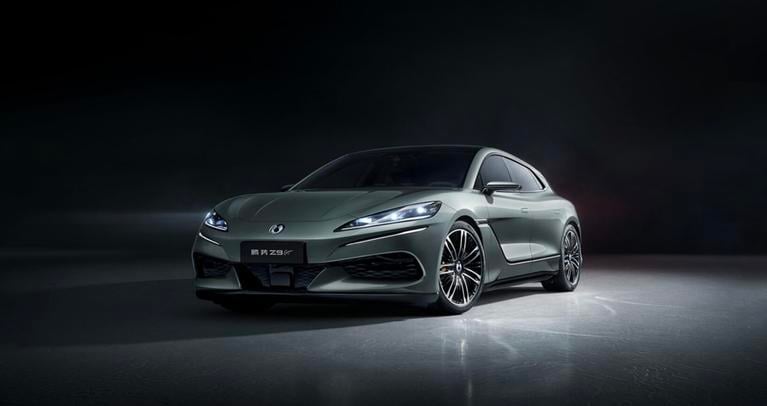
If BYD can deliver fast charging at that speed and at scale, the Supercharger advantage narrows. Chinese buyers already have more DC fast charging infrastructure per capita than any other country. Speed becomes the differentiator, not availability. BYD has also recently claimed the world’s longest EV range with its Denza Z9GT at 1,036 km on the CLTC cycle, though real-world figures will be significantly lower than that test cycle suggests.
March Data Will Tell a Clearer Story
The CPCA explicitly flagged March as the more meaningful read on 2026 market direction. “As various industries quickly return to normal operations after the Spring Festival holiday, the month-on-month growth in production and sales in March will be quite rapid,” the Association wrote, adding that post-holiday periods are when manufacturers concentrate new product launches.
That framing is accurate and worth taking seriously. The January-February window is genuinely noisy. BYD’s 36% decline and Tesla’s 35%-plus gain both carry significant calendar distortion from a Lunar New Year that fell mid-February. March strips most of that out. If Tesla holds or extends its gain in March without the holiday base effect helping it, that’s a meaningful data point. If BYD’s domestic sales recover sharply once factory output normalizes, the two-month narrative will look different. Tesla has also been managing its Shanghai output carefully for export markets, including Canada, where it cleared Model 3 inventory in early March ahead of cheaper Shanghai-built replacements.
EVXL’s Take
The number that matters most in this report isn’t Tesla’s 35%-plus gain. It’s that Leapmotor is now the closest competitor to Tesla in combined China output — and it’s less than half Tesla’s volume. Leapmotor wasn’t a credible comparison point 18 months ago. Now it is. That’s how fast the competitive tier below BYD and Tesla is reshaping itself.
Tesla’s Shanghai results are genuinely solid. I don’t want to dismiss a two-month gain of more than 35% as pure calendar noise — some of it reflects real demand, real financing incentives, and the Model Y’s continued grip on buyers who want a recognizable brand with a reliable charging network. But the competitive environment has moved. Xiaomi’s YU7 beating the Model Y in January is not an anomaly I’d be comfortable writing off. Xiaomi was still ramping the next-generation SU7 during a holiday-shortened February and still managed to move meaningful volume.
BYD’s short-term numbers are ugly, but the export strategy is working. According to CNBC, overseas shipments exceeded domestic sales in February for the first time — a threshold that shows BYD is building a structure that doesn’t depend entirely on the home market. Tesla has no equivalent hedge. Its European and Asia-Pacific volumes depend on the same Shanghai factory serving China. If domestic China demand softens again, there’s no overseas buffer that offsets it the same way.
On the Blade battery: BYD’s nine-minute charge claim is worth watching, not celebrating yet. The Super E-Platform’s earlier figures looked strong on paper too, and real-world charging behavior at scale has a way of differing from launch-day specs. That said, if BYD gets anywhere close to that number in production vehicles, Tesla’s Supercharger network advantage in China shrinks to a software and brand story — and that’s a harder sell at current price points.
My prediction: Tesla holds the No. 2 China position through Q2 2026, but the margin over Leapmotor narrows to less than 1.5x by June. If BYD’s new Blade battery reaches mass production vehicles by Q3, the Supercharger network advantage in China becomes much harder to quantify.
Source: CNBC, March 13, 2026.
Editorial Note: AI tools were used to assist with research and archive retrieval for this article. All reporting, analysis, and editorial perspectives are by Haye Kesteloo.
Discover more from EVXL.co
Subscribe to get the latest posts sent to your email.