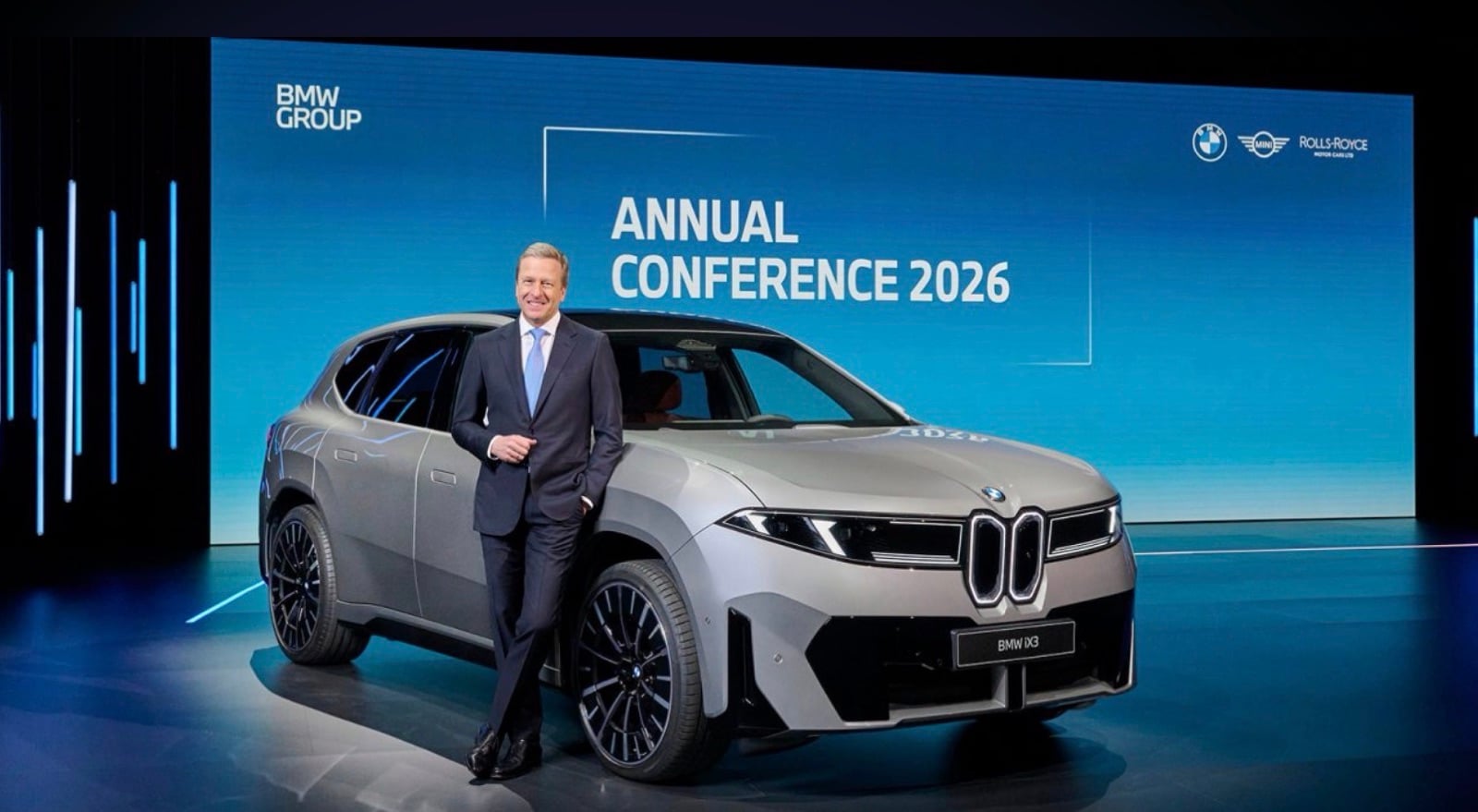
The numbers from Munich tell a clear story. BMW reported full-year 2025 EBIT of €10.2 billion — its lowest since the Covid pandemic — as China sales fell more than 12% and trade tariffs shaved 1.5 percentage points off its automotive margin. For a group that promised an 8–10% margin corridor, landing at 5.3% is a meaningful miss. CFO Walter Mertl put it plainly: without tariffs, BMW would have posted a year-over-year earnings increase.
- The Fact: BMW’s 2025 EBIT fell 11.5% to €10.2 billion, with its automotive EBIT margin dropping to 5.3% — well below its 8–10% target, dragged down by US import duties and EU levies on Chinese-made Mini EVs.
- The Delta: Volume held up — 2.46 million vehicles delivered, up 0.5% — with European sales topping one million units for the first time since pre-pandemic levels. The profit problem is a margin story, not a global demand story. China is a different conversation.
- The Buyer Impact: BMW’s cautious 2026 margin guidance of 4–6% signals pricing pressure won’t ease soon. Buyers waiting for deals on slower-moving inventory may find more room to negotiate over the next 12 months.
China’s Collapse Is the Real Wound
BMW’s largest single market fell more than 12% in 2025, as domestic Chinese brands continued to take share at every price point. This isn’t a new pattern — we’ve been tracking the systematic retreat of European luxury automakers from China for more than a year. European luxury car sales were already collapsing in China by late 2025, with BYD and a wave of domestic brands cutting into territory that BMW, Mercedes, and Audi treated as structurally reliable profit pools.
What’s different now is the scale. A 12%-plus China volume decline at BMW’s unit levels represents hundreds of thousands of cars — many of them high-margin sedans and SUVs that used to underwrite the group’s global profitability. The Chinese consumer has moved on. BYD doubled its exports in 2025 while Western automakers retreated, and local brands like Zeekr are now taking the fight directly to Germany. Zeekr launched in Germany last December with three EVs priced from €37,990 — well below comparable BMW models.

Tariffs Took 1.5 Percentage Points Off the Margin
Two separate tariff regimes hit BMW in 2025: US import duties on vehicles entering the American market, and the EU’s levy on Chinese-made EVs, which affected Mini brand production sourced from China. Together, they cost BMW approximately 1.5 margin points for the full year. The EU’s tariff policy on Chinese EVs has been one of the more contentious trade tools in Brussels’ toolkit — and one we’ve covered closely since it started affecting production decisions. The EU tightened its stance on Chinese EV imports in late 2024, and the full financial impact is now visible in BMW’s annual results.
For 2026, BMW guides for tariffs to cost roughly 1.25 margin points — slightly less than 2025, but still a meaningful headwind. The company’s overall automotive EBIT margin guidance of 4–6% means the floor is now lower than the 5.3% it just reported. That’s not a recovery trajectory. Automakers face additional per-vehicle port fees on top of existing tariff structures. Cost visibility for 2026 is nearly impossible even under best-case trade policy assumptions.
BMW’s Electric Sales Grew, But the Architecture Bet Is Still Unproven
BMW delivered more than 640,000 electrified vehicles in 2025 — about 26% of total sales — with fully electric models accounting for 18%. That’s real growth, and it’s happening without the kind of incentive dependency that has warped US EV sales data for years. The Neue Klasse platform, which launched with the new BMW iX3, is the company’s long-term answer to Chinese cost competition and internal combustion-era architecture constraints.
We’ve been following the Neue Klasse rollout closely. The BMW i3 Neue Klasse entered pre-series production at Munich in February amid real uncertainty about US EV demand. The iX3 covered 626 miles on a single charge in a controlled efficiency run last November — climate off, highways avoided, but the result still shows what the platform can do when pushed. The architecture supports 400 kW charging, which puts it ahead of most current premium EVs on paper. The question isn’t whether the technology is good. It’s whether BMW can bring Neue Klasse vehicles to market fast enough, and at margins that make sense, before Chinese competitors deepen their grip on global EV buyers.
The BMW M performance division delivered one clean win: a record 213,000 vehicles in 2025. High-performance, high-margin, and less exposed to Chinese competition. It’s the one segment that didn’t require a tariff asterisk. BMW’s electric M3 shows where this sub-brand is headed — four motors, software-controlled torque vectoring, and pricing that keeps it comfortably out of BYD’s reach.
Daimler Truck Reports a Sharp North American Decline
Daimler Truck — a separately listed company spun off from Daimler AG in 2021, with no operational connection to BMW Group — reported 2025 adjusted EBIT of €3.78 billion, down 19%, as North American unit sales fell 26% to 141,814 vehicles. Earnings per share dropped 30% to €2.56, though the dividend held at €1.90. North American freight weakness and US trade policy were the primary culprits.
Not all of it was bad. Daimler Buses crossed the 10% return on sales threshold for the first time, posting adjusted EBIT of €599 million — up 39%. Mercedes-Benz Trucks held European volumes roughly flat. CEO Karin Rådström pointed to a 7,000-unit Mercedes-Benz Zetros order from the French Army as evidence that its defense business is gaining traction, though a single military contract doesn’t offset a 26% North American collapse.
The broader German auto earnings picture for 2025 is consistent. Volkswagen reported a €1.3 billion operating loss in Q3 2025. Porsche’s full-year 2025 operating profit fell 98%, though that figure was heavily distorted by €4.7 billion in one-time writedowns. BMW’s 2025 result is the least damaging of the group — but that’s context, not comfort.
EVXL’s Take
BMW’s result matters because it’s the clearest financial proof yet of what happens when a European automaker gets squeezed from both ends: Chinese manufacturers taking share in the East, trade tariffs compressing margins in the West. VW’s Q3 loss was dramatic. Porsche’s near-wipeout was shocking, if partly accounting-driven. BMW’s 2025 result is quieter but arguably more instructive, because BMW executed well on volume — 2.46 million deliveries, European sales above one million — and still couldn’t defend its margins.
CEO Oliver Zipse says BMW doesn’t need to change strategic direction. That’s a defensible position if you believe the Neue Klasse platform arrives fast enough to compete on cost with Chinese EV architecture. I’m not convinced the timing works. BYD’s vertical integration advantage — cells, software, chassis — isn’t something a new platform generation closes overnight. BMW needs Neue Klasse to be volume-ready by 2027 at the latest, or the China share story gets worse before the product can fix it.
The tariff hit will be with BMW through at least 2026, and likely longer if US–EU–China trade tensions don’t meaningfully resolve. My call: BMW’s automotive EBIT margin lands closer to 4.5% in 2026 than the 6% top of its own guidance range, and the company announces a Mini production restructuring by Q3 2026 to reduce its EU tariff exposure on Chinese-sourced EVs.
Source: Euronews
Editorial Note: AI tools were used to assist with research and archive retrieval for this article. All reporting, analysis, and editorial perspectives are by Haye Kesteloo.
Discover more from EVXL.co
Subscribe to get the latest posts sent to your email.