The National Highway Traffic Safety Administration proposed on October 23 to let self-driving vehicles carry cyan marker lamps that tell police and other road users an automated driving system is in control and nobody inside is expected to watch the road. The change amends FMVSS No. 108, the federal lighting standard. It was published in the Federal Register today, October 26, and comments are open until November 25.
The same notice strips steering-wheel turn-signal and hand-operated high-beam rules from vehicles built without manual controls, the kind of purpose-built robotaxi that NHTSA Administrator Jonathan Morrison said in July he would consider freeing from the steering wheel requirement.
The cyan lamps would stay optional. NHTSA writes that it lacks the information to conclude they are needed on every automated vehicle, and it is asking for comment on whether to stop states from requiring them.
Cyan Lamps Would Switch On Only When No Human Is Watching the Road
The cyan lamps could come on only while a vehicle is “operating without the expectation that an occupant is monitoring the roadway,” and must switch off when that expectation returns. A vehicle could carry four to eight of them, one or two at each end and on each side.
A car running a supervised driver-assistance system, Tesla’s Full Self-Driving (Supervised) included, could never switch them on. NHTSA’s proposed rule also reads the activation language as barring the lamps from vehicles with no automated driving system at all. The lamps would sit at least 15 inches (38 centimeters) off the ground and switch on and off together.
The agency caps their brightness at 125 candela for front lamps, and at 90 candela on the sides and rear with the headlamps off, dropping to 18 candela when they are on. The lamps must burn steadily and can’t be optically combined with any other light, which rules out a cyan glow built into a daytime running lamp. NHTSA is asking whether flashing them to show a robotaxi’s next move would help pedestrians, and says it knows of no research supporting the idea.
Robotaxis Without Steering Wheels Would Shed Driver-Era Lighting Rules
Vehicles with no manual driving controls would shed several rules written for a human driver. Their turn signals would no longer have to cancel through steering wheel rotation or by hand, their high-beam switches would not need to work by hand or foot, and turn-signal and high-beam telltales could go.
NHTSA’s reasoning is that the software, unlike a person, can’t forget a signal is on. These vehicles keep their turn signals and a way to switch beams, because other road users still depend on them. Two headlamp changes in the proposal reach beyond robotaxis to all vehicles: integral-beam headlamps would be tested at the voltage the manufacturer stipulates instead of the 12.8 volts fixed in 1967, and the rule requiring the low beam to sit above the high beam in a vertical headlamp stack would be dropped.
The steering-wheel changes matter most to operators like Zoox, which needed a federal exemption covering parts of eight safety standards, lighting among them, before it could charge fares in its purpose-built robotaxis. NHTSA says that without the rewrite, these vehicles would keep seeking exemptions rather than carry equipment they cannot use.
NHTSA Wants One Lamp Standard Before Each Automaker Invents Its Own
NHTSA’s case for writing a lamp specification it won’t require is standardization. Without one, the agency says, automakers could fit their own lamps that become a nuisance or confuse other road users. Its cost analysis says it cannot yet estimate any safety benefit from the cyan lamps.
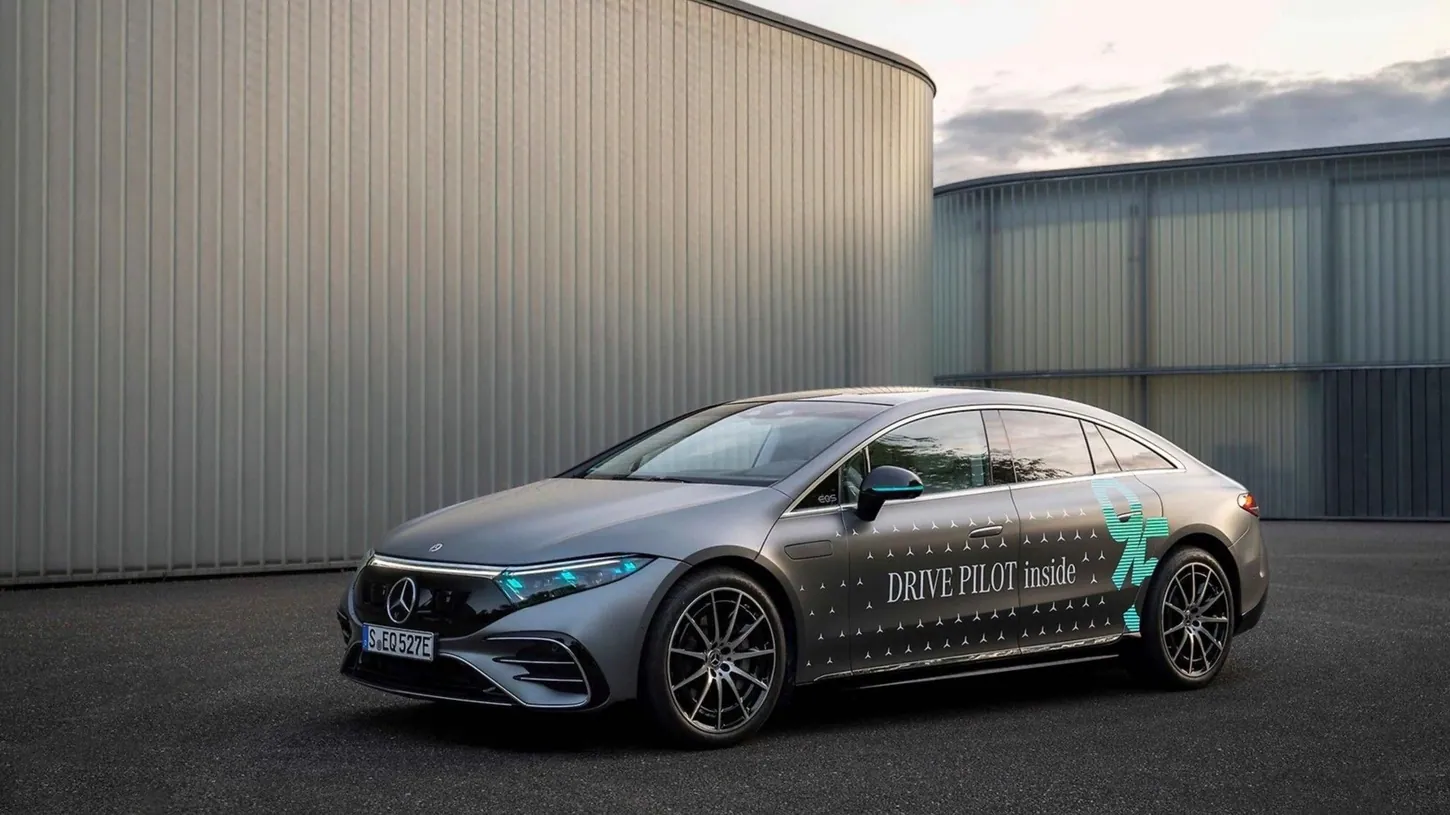
EVXL reported in October 2025 that GM’s eyes-off system for the 2028 Cadillac Escalade IQ would signal it is active with turquoise lighting on the exterior mirrors. Mercedes-Benz presented its own cyan lamp concept to a UN lighting task force in July 2024 and met with NHTSA, arguing that a 360-degree view of the lamps would help police and other road users. It ran five lamp-equipped vehicles on California roads from 2023 to 2025 to study how people reacted to them.

The color itself comes from SAE J3134, an industry recommended practice first issued in May 2019 and revised in December 2025 to add side and rear lamps. SAE’s rationale notes that the American Association of Motor Vehicle Administrators recommends the lamps so police can tell whether a person or the software is driving. The strongest demand evidence NHTSA cites is a survey of more than 4,400 drivers in the US, UK, Japan and Germany, presented to the UN lighting working party in April 2025, in which upwards of 80% of US and UK respondents said automated vehicles should carry a marker lamp. The UN’s automated-vehicle working party declined in 2022 to recommend requiring the lamps, citing the need for more research.
NHTSA’s Rule Would Override California’s Lamp Law as China Drafts Its Own
If finalized, the federal rule would preempt California Vehicle Code sections 25950 and 38750, which already permit lamps built to SAE J3134, wherever NHTSA’s version departs from that standard. China published its own draft three days before NHTSA’s, reserving a blue-green color for the same job.
The departures from J3134 include brightness limits, mounting locations, combined lamps and the exact cyan color boundaries. NHTSA says it knows of no state law that requires or prohibits the lamps today. It would likely preempt any future state ban, and it wants comment on whether to also bar states from requiring them, which would leave the decision with manufacturers. On lawsuits, NHTSA says the rule would likely block tort claims arguing that fitted lamps should have performed differently, but not claims over whether a lamp should have been fitted at all.
China’s Ministry of Industry and Information Technology opened comments on its draft revision of GB 4785, the country’s mandatory lighting installation standard, on October 20. The draft makes the lamps optional on vehicles with Level 3 or higher automated driving and bans them on everything else. It sets a minimum mounting height of 250 mm (9.8 inches) and proposes taking effect on January 1, 2028. Comments there close December 19.
EVXL’s Take
I think NHTSA should leave states free to require these lamps, even if the agency won’t. The lamp tells an officer the most on a car that can be driven either way, like GM’s eyes-off Escalade IQ, where a person might or might not be in charge. That is exactly where an optional signal fails, because a dark car could have a driver at the wheel or an eyes-off system from a maker that skipped the lamps.
NHTSA says it lacks the data to justify a federal mandate, and in the same notice it asks whether to block states from imposing one. Those two positions pull against each other. If the evidence for a mandate isn’t in yet, a state like California, which already allows the lamps and hosted Mercedes’ five-car test, is a reasonable place to collect it. The docket closes November 25, and police groups and the motor vehicle administrators who recommend these lamps should tell NHTSA to leave that door open.
Sources: NHTSA proposed rule, Docket No. NHTSA-2026-1519 (Federal Register), National Highway Traffic Safety Administration, China Ministry of Industry and Information Technology.
EVXL uses automated tools to support research and source retrieval. All reporting and editorial perspectives are by Haye Kesteloo.