Three months after the federal EV tax credit expired, a collector car fintech CEO told WardsAuto what we’ve been reporting since last summer: legacy automakers bet billions on government subsidies instead of building EVs people would buy without them. The combined damage now totals $53 billion across Ford, GM, and Stellantis.
The write-downs keep getting bigger, and the explanations keep getting more obvious.
- The fact: Ford, GM, and Stellantis have collectively written off $53 billion in EV investments since December 2025, the largest capital destruction in automotive history.
- The delta: A WardsAuto interview with a collector car CEO confirms what EVXL reported months ago: these losses were predictable, driven by subsidy dependence rather than genuine consumer demand.
- The buyer impact: If you’re shopping for an EV from a Detroit brand, expect fewer all-electric options and more hybrids by 2027. Used EV prices from these brands will continue falling as manufacturers retreat.
Ford, GM, and Stellantis wrote off $53 billion in EV bets since December
Detroit’s three largest automakers have collectively taken $53 billion in charges related to failed electric vehicle strategies since December 2025, with each write-down larger than the last. Ford started with $19.5 billion in December while killing the F-150 Lightning. GM followed in January with $7.6 billion, including $6 billion for its Ultium EV platform. Stellantis then dropped the biggest bomb: a $26.5 billion charge announced February 6, exceeding the company’s own market capitalization.
WardsAuto published an interview today with Curt Hopkins, CEO of MCQ Markets, a fintech firm that facilitates investments in collector cars. Hopkins told the publication that the industry’s EV challenges were “hardly surprising” and that automakers “got the BEV market so horribly wrong.”
He pointed to the gap in EV adoption between the U.S. and Europe. EVs account for about 17% of sales in Europe but just 8% in the U.S. The reasons aren’t complicated: American gasoline is cheaper than in Europe, and American drivers cover longer distances. Those are structural realities, not temporary market conditions.
“What happened, I think in context, is Ford invested very significantly in their EV production and they decided that it just doesn’t hold water in the short term,” Hopkins told WardsAuto. “Or probably even in the longer term because I’m sure their planning horizon is 5-to-10 years and they decided to just back away from it entirely.”
The hybrid pivot was inevitable once subsidies died
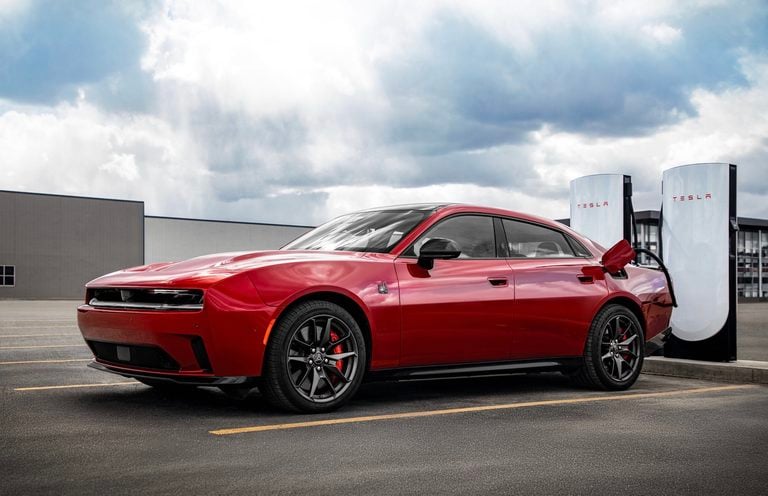
Hopkins, who owns an EV himself, expects more automakers to shift toward hybrid and range-extended electric vehicles. That pivot is already happening across the industry. Ford is replacing the all-electric F-150 Lightning with an extended-range version that includes a gasoline engine. Stellantis canceled the Ram 1500 BEV and brought back the HEMI V-8. GM is leaning harder into its profitable ICE and hybrid truck lineup while scaling back Ultium production at two battery plants in Ohio and Tennessee.
The pattern is identical at all three companies. Each built their EV strategy around the $7,500 federal tax credit. When Congress eliminated the credit effective September 30, 2025, demand collapsed. EV sales cratered 24% in October alone. By Q4 2025, sales had fallen 36% year-over-year.
Without taxpayer subsidies bridging the gap between sticker price and perceived value, buyers walked away.
China controls the EV supply chain, and the tech stack war is already lost
Hopkins raised a point that gets far too little attention in the mainstream press: China dominates the entire EV supply chain, from rare earth mining and processing to battery cell manufacturing. This gives Chinese automakers like BYD a structural cost advantage that no amount of tariff protection can permanently offset.
“Europe needs to be careful about dumping of vehicles because the Chinese are not taking a free market approach,” Hopkins said. “They’ve done this repeatedly in industries if you look at the telecoms’ technology and equipment industry.”
His most striking warning: the technology competition is already over. “The EV tech stack war is probably now being won by the Chinese,” he said. The danger for the U.S. and Europe goes beyond manufacturing costs. It extends to autonomous driving software and urban micromobility solutions, areas where Chinese firms are investing while Detroit retreats.
Chinese brands already control nearly two-thirds of China’s passenger car market. Meanwhile, all three Detroit automakers combined hold less than 5% of the global EV market. BYD, Geely, and Tesla together control nearly 40%.
EVXL’s Take
I appreciate WardsAuto’s reporting here, but this story reads like someone discovering water is wet. We’ve been covering every one of these write-downs as they happened. We wrote about Ford’s Lightning cancellation discussions in November. We tracked Ford’s $19.5 billion write-off in December. We documented Stellantis’s $26 billion charge last week.
What’s telling here is the source WardsAuto chose. Not an automotive analyst. Not a former Big Three executive. A collector car fintech CEO. That’s how obvious this has become. You don’t need to be an industry insider to see that building EVs that required $7,500 in government money to sell was never a sustainable business model.
Hopkins is right about the Chinese supply chain threat. But he’s also underselling the problem. Detroit isn’t just retreating from EVs. It’s retreating from the technology competition entirely. When your response to Chinese cost advantages is to bring back the HEMI V-8, you’ve conceded the future to save the present. That’s a valid short-term survival strategy. It’s a terrible long-term competitive position.
My prediction: the total industry EV write-down will exceed $100 billion by the end of 2026. Volkswagen’s $6 billion Porsche charge and whatever BMW eventually books will push the total past that threshold. And when it happens, nobody should be surprised.
Editorial Note: AI tools were used to assist with research and archive retrieval for this article. All reporting, analysis, and editorial perspectives are by Haye Kesteloo.
Discover more from EVXL.co
Subscribe to get the latest posts sent to your email.