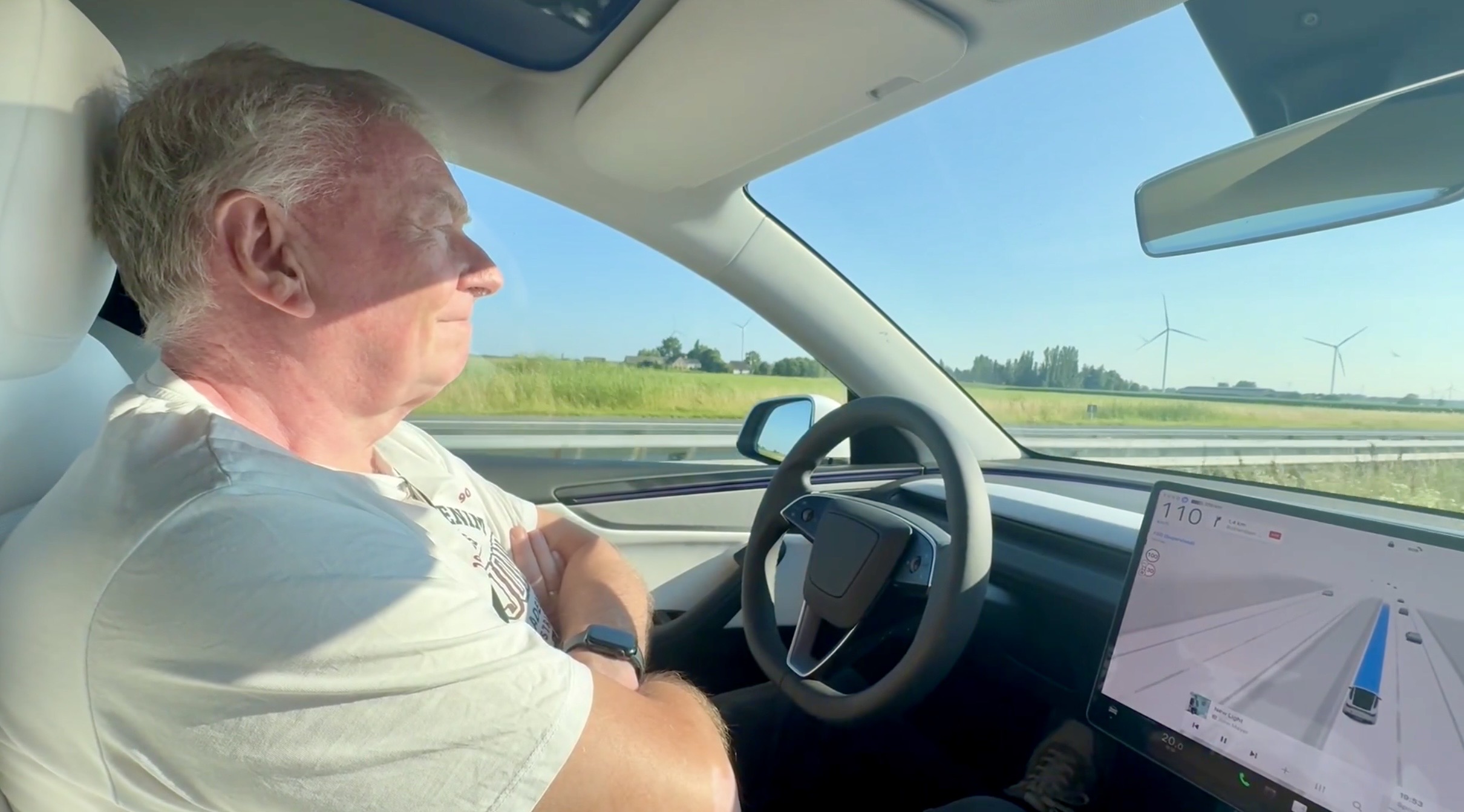
A Dutch Tesla driver with nearly 10,000 kilometers on FSD Supervised will switch the system off next week at the German border. Not because it stopped working, but because Germany has not approved it. Hans Noordsij posted on X on July 10, 2026, that he had covered a 240-kilometer family trip the night before without a single intervention, then noted his upcoming vacation drive from Venlo to Passau crosses a country where the software he trusts remains illegal. The post drew 385,000 views in a day.
His frustration is the European FSD story in miniature. EVXL has tracked this approval saga since the RDW publicly corrected Tesla’s premature claims in November 2025, and the pattern holds: the safety data keeps stacking up on one side while the approval map fills in one border at a time.
Five Countries Have Approved FSD Supervised, Twenty-Two Have Not
The Netherlands approved FSD Supervised on April 10, 2026, Lithuania followed on May 20, Estonia on May 29, Denmark on June 9, and Belgium on June 10, which leaves Germany, France, Italy, Spain, and 18 other EU member states without a national approval as of this weekend. The pace within that group of five was quick. As EVXL reported when Belgium and Denmark signed off within 48 hours of each other, the gap between national approvals shrank from 40 days to a single day.
Every one of those clearances is provisional. They all rest on the type approval the RDW issued under UN Regulation 171 and an Article 39 exemption, the decision EVXL covered on April 10 after the Dutch regulator spent more than 18 months testing the system. If the European Commission rejects the software at the bloc-wide level, the Dutch approval lapses after six months and takes every national recognition down with it. The Commission’s Technical Committee on Motor Vehicles has discussed the file but has scheduled no vote.
Germany’s KBA is still reviewing. That is why Noordsij’s post tags Germany’s federal transport ministry directly: he can drive hands-free from his front door to the German border and not one meter past it.
The Safety Numbers Keep Pointing the Same Way, Caveats Included
Tesla’s Vehicle Safety Report, as of its February 2026 update, puts FSD Supervised at one major collision every 5.3 million miles in North America against a US average of roughly 660,000 miles, and the RDW counts about 24 million kilometers driven in the Netherlands since April, in its words, “without any relevant incidents.” The February update to Tesla’s report, covered by Not a Tesla App, also confirmed the global fleet had passed 8.2 billion cumulative FSD miles.
The caveats are real and EVXL has reported them. FSD Supervised is a Level 2 system, so incident-free supervised miles measure the driver-plus-software combination, not the software alone. Safety researcher Philip Koopman has detailed how Tesla’s baseline comparisons flatter the system, since FSD owners skew toward safer demographics and newer cars. And the EU build differs from the US software, a distinction the RDW itself insists on. A Reuters investigation into Tesla’s marketing statistics reached the Dutch parliament, where the transport minister defended the RDW on June 16 by pointing to the agency’s own independent testing rather than Tesla’s slides.
Discount the numbers as hard as you like. Cut Tesla’s ratio in half for demographics and road mix, ignore the company’s marketing entirely, and lean only on what an independent European regulator measured across 18 months of its own testing and two months of live monitoring, now reported monthly instead of annually. The direction never flips. The supervised system plus an attentive human is producing fewer wrecks than the human alone.
The Lidar Cost Argument Died in a $1,099 Drone
New Jersey’s Senate Bill S1677 would require robotaxis to pair cameras with two additional sensor types, and the redundancy argument behind it deserves a straight answer now that lidar, once a $100,000 research instrument, ships in production Chinese EVs and in a $1,099 consumer drone. As EVXL reported yesterday, the bill’s sponsor rests his case on physics: cameras struggle in glare and heavy rain, radar cuts through fog, and lidar maps the road in full darkness.
Hesai, the Chinese sensor maker supplying Mercedes-Benz’s Level 3 program, says it has cut lidar pricing from $100,000 down to roughly $200 per unit, according to its co-founder Kai Sun. The company is expanding capacity to 4 million units this year, and solid-state units already sell in the $400 to $500 range, per The Robot Report, while IEEE Spectrum reports US supplier MicroVision is targeting sub-$200 production pricing. The technology is so cheap it flies: DJI’s Air 3S, a $1,099 camera drone our sister site DroneXL reviewed in October 2024, carries a forward-facing lidar unit for obstacle avoidance in the dark.
Elon Musk’s case against lidar was never only about money. He argues roads were designed for eyes and neural networks, and that fusing conflicting sensor inputs adds failure modes rather than removing them. That is a legitimate engineering debate for a supervised Level 2 system, where the human is the redundancy. It gets much weaker for the unsupervised robotaxi future Tesla is selling, where nothing backs up the cameras when a lens is blinded by low sun or caked in slush. GM’s eyes-off Cadillac program, Mercedes-Benz’s Drive Pilot, and Waymo all chose sensor fusion. When the backup sensor costs $200, the burden of proof sits with the company leaving it out.
EVXL’s Take
I’ll hold both positions at once, because the story demands it. FSD is not what Elon Musk promised. We were told robotaxis by 2020, and what shipped six years late is a very good Level 2 system that still needs your eyes on the road. EVXL has held Tesla to that record for years, and the “Full Self-Driving” name still writes checks the software can’t cash.
And yet Europe’s slow-walk has become its own safety problem. The RDW built the template: test independently for 18 months, approve provisionally, monitor monthly, and keep a kill switch. Two months and 24 million kilometers later, its data shows no relevant incidents. If regulators believe their own numbers, every month Germany, France, and Italy spend deliberating is a month of purely human-driven miles that the evidence says would be safer supervised. Noordsij will cross Germany next week the old way, at exactly the moment Dutch roads are demonstrating the alternative. That’s not caution anymore. That’s inertia dressed up as caution. Copy the Dutch homework, keep the monthly reporting, and approve.
On sensors, I’d flip the challenge back at Tesla. The vision-only bet made sense when lidar cost more than the car. At $200 a corner, with the sensor now standard on Chinese EVs and bolted to consumer drones DroneXL has covered since 2024, refusing redundancy for the unsupervised era saves pennies and stakes the entire robotaxi program on a lens never getting blinded. Cameras got FSD this far. Cheap lidar is how it survives its first blizzard without a human in the seat.
Watch two dates: the Commission’s TCMV calendar, still without a scheduled vote, and Germany’s KBA, which faces mounting pressure from its own Tesla drivers. When we covered the Belgium and Denmark approvals on June 10, we called at least eight national recognitions by December 31. Nothing since has moved that bet.
Sources: Hans Noordsij (X), RDW, Tesla, optics.org, The Robot Report, IEEE Spectrum.
EVXL uses automated tools to support research and source retrieval. All reporting and editorial perspectives are by Haye Kesteloo.