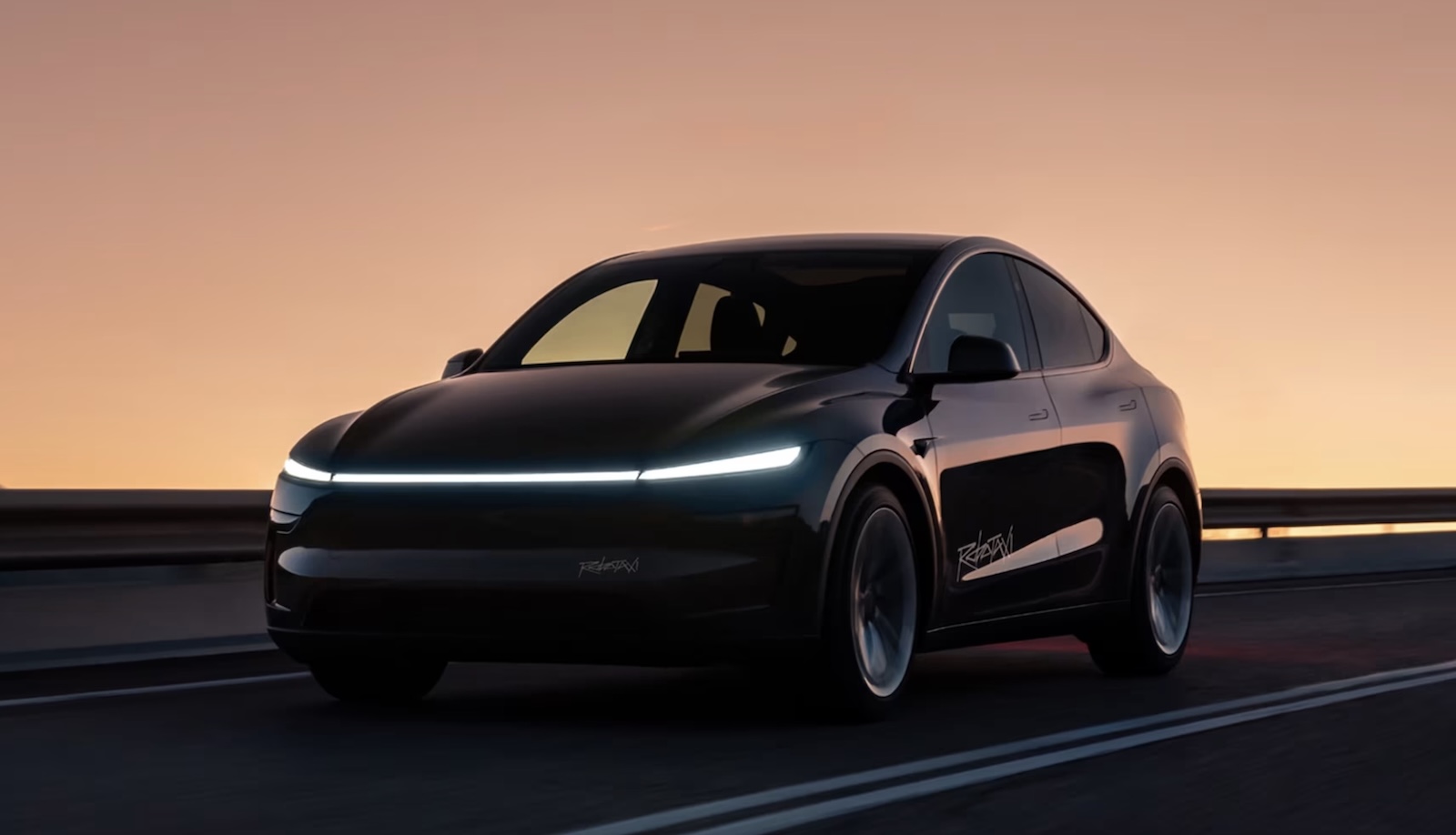
New Jersey lawmakers are weighing a bill that would keep Tesla’s robotaxi out of the state before it ever carries a passenger there. Senate Bill S1677 would create a three-year autonomous vehicle pilot program overseen by the state Department of Transportation and the Motor Vehicle Commission, and it requires every participating vehicle to pair its cameras with two additional sensor types, such as lidar or radar. Tesla builds its autonomous stack on cameras alone, so the requirement works as a hardware ban on Full Self-Driving and the Cybercab that depends on it.
The bill was introduced on January 16 and now sits in the Senate Budget and Appropriations Committee after clearing the Transportation Committee this spring. Tesla has responded with open lobbying against it. The timing stings: three weeks back, EVXL documented a record count of production Cybercabs staged at Gigafactory Texas with no commercial fleet to absorb them. Every state that closes its doors makes that gold-finished inventory pile harder to explain.
The Bill Mandates Cameras Plus Two Backup Sensor Types
S1677 sets up a three-year pilot program for fully autonomous vehicles in New Jersey, overseen by the state Department of Transportation and the Motor Vehicle Commission, and it requires every participating vehicle to carry a camera system plus two distinct sensing modalities that keep working if the cameras fail. The operative language demands crash-avoidance systems built around “a camera system and two distinct sensing modalities” capable of detecting and tracking obstacles when the cameras go dark.
The requirements stack up from there. Operators must submit a law enforcement interaction plan and document their redundant safety systems and data recording capabilities. Fifty thousand supervised, crash-free miles in the state come before any human safety driver leaves the seat. The bill also restricts where autonomous vehicles can operate, keeping them out of school zones and active construction areas. For Waymo and Zoox, which already run lidar and radar alongside their cameras, the sensor clause is paperwork. For Tesla, it is a wall.
The Sponsor Is a Physicist Who Rode in a Waymo First
State Senator Andrew Zwicker, the Democratic sponsor of S1677 and a physicist at the Princeton Plasma Physics Laboratory, drafted the legislation after riding in a Waymo in Phoenix, and he rejects the charge that the sensor requirement was written to keep any single company out of New Jersey. “This is not anti-Tesla. I’m pro-New Jersey safety,” Zwicker told The Verge, which first reported the bill’s collision course with Tesla’s camera-only approach.
Zwicker’s argument rests on redundancy. Cameras read signs and lane markings but struggle in glare and heavy rain. Radar cuts through fog. Lidar builds a three-dimensional map of the road regardless of lighting. His position is that the evidence does not yet show a single sensor type paired with software handling everything a human driver can. New Jersey is the most densely populated state in the country, which raises the cost of being wrong. The bill’s framework mirrors recommendations from SAVE-US, a nonprofit lobbying for tighter autonomous vehicle oversight, and New York legislators are working on a near-identical mandate next door, according to Road & Track.
Tesla Is Lobbying Its Own Customers to Kill the Bill
Tesla’s response has been to activate its owner base through Engage Tesla, the company’s public policy platform, which now hosts a call to action urging New Jersey residents to contact their state legislators and oppose both S1677 and its Assembly companion, A3968, before the measure advances further. The campaign page calls the legislation “anti-competitive favoritism that will cause New Jersey to fall behind” and argues the bill denies mobility to elderly and disabled residents who cannot drive.
The page leans on New Jersey’s 578 traffic deaths last year and the well-worn statistic that human error contributes to more than 94% of serious crashes. Both numbers are real. What the page skips is the reason the sensor debate exists at all: Tesla has never submitted its safety claims to an independent audit that would let a legislator take them at face value.
The Steering Wheel Language Is the Quieter Problem for the Cybercab
Beyond the sensor mandate, the bill favors keeping traditional steering wheel and pedal controls available in autonomous vehicles, a preference that collides directly with the Cybercab, the two-seat robotaxi Tesla is now building at volume in Texas with no steering wheel, no pedals, and no side mirrors. Adding lidar to a Cybercab is a hardware retrofit. Adding a steering wheel is a redesign of the product’s entire premise.
That is why this bill lands harder than a typical state skirmish. As EVXL reported on June 14, the outbound lot at Gigafactory Texas hit its fullest visible count yet, with a reported 102 Cybercabs staged and waiting while deployment lags behind production. A factory that can build cars faster than regulators will accept them needs every large market it can get. New Jersey and New York together would carve the densest metro region in America out of the map.
EVXL’s Take
I’ll say the part that cuts against my own instincts first: I don’t love prescriptive hardware mandates. Writing sensor counts into statute freezes today’s engineering consensus into law, and if camera-only autonomy someday proves itself, New Jersey will be stuck amending a statute instead of updating a performance standard. Regulating outcomes beats regulating parts lists.
But Tesla handed legislators the pen. Performance-based regulation only works when regulators can trust the performance data, and Tesla has spent years making that impossible. When EVXL covered the Senate letter on Tesla’s FSD safety math on June 16, the core complaint was that Tesla picks its own denominators and publishes ratios nobody can audit. A company that won’t open its books to independent verification can’t act shocked when a physicist-legislator decides to regulate the inputs he can see instead of the outcomes he can’t.
The lobbying page’s claim of proven technology also has a scoreboard problem. When EVXL dug into Tesla’s Nevada filing on June 6, independent trackers put the company’s actual driverless fleet at roughly 20 cars nationwide, against Elon Musk’s promise of hundreds of thousands of autonomous Teslas by the end of this year. Waymo runs thousands. Calling a 20-car fleet proven while the market leader fields more than a hundred times as many vehicles is the kind of gap that makes lawmakers reach for lidar mandates.
Watch the Senate Budget and Appropriations Committee. If S1677 clears it and New York’s companion effort keeps moving, Tesla faces a hardware wall around the entire New York metro market, built partly from bricks the company fired itself. The fix was never a lobbying page. It was independent safety data, and Tesla still hasn’t offered any.
Sources: Road & Track, The Verge, New Jersey Legislature, S1677, Engage Tesla.
EVXL uses automated tools to support research and source retrieval. All reporting and editorial perspectives are by Haye Kesteloo.