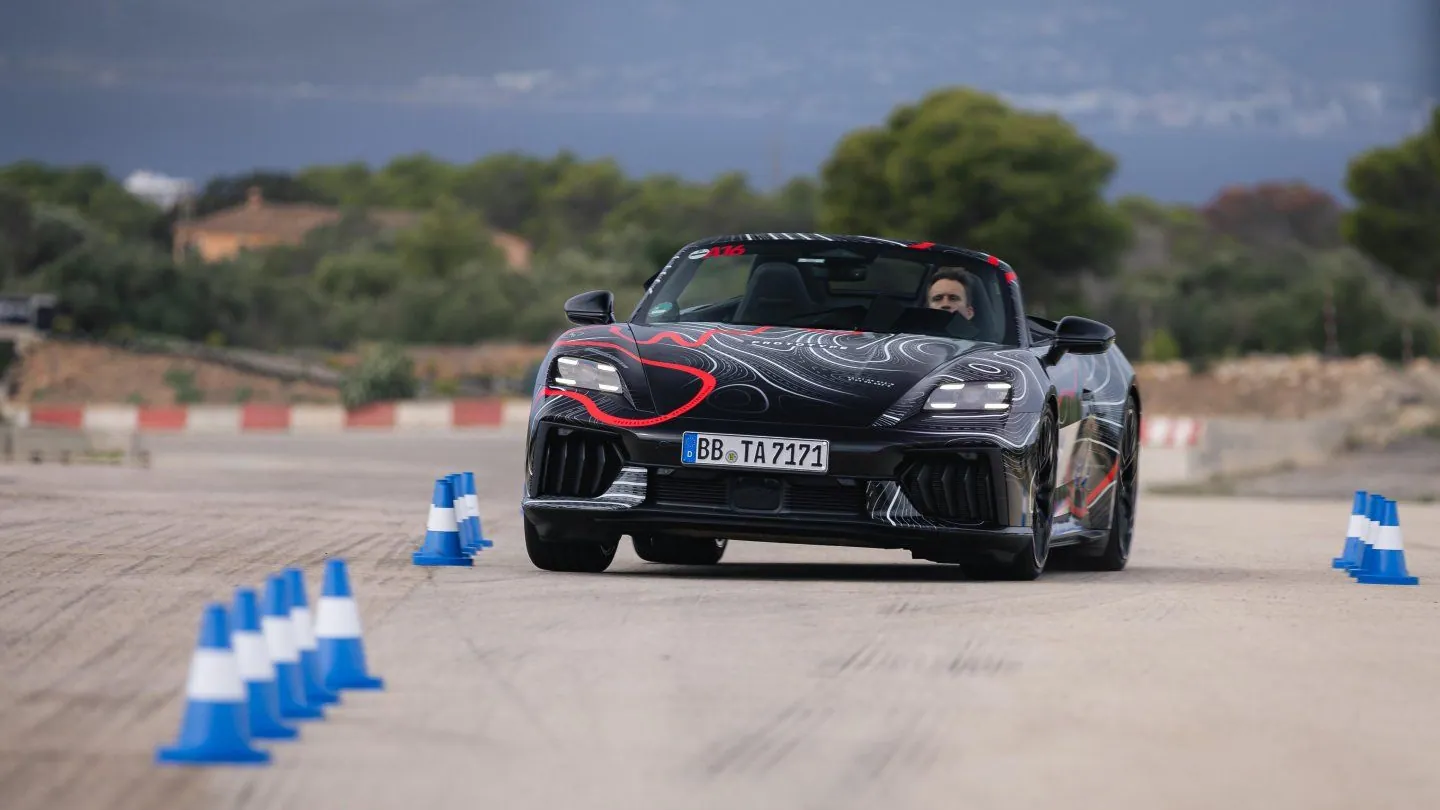
Porsche says its first all-electric two-door sports car, the new 718 Boxster, has entered the final stage of development and will have its world premiere in the first quarter of 2027. In a release from its U.S. newsroom on Wednesday, November 25, the company said the top version will reach 60 mph in less than three seconds, every version will be rear-wheel drive, and a simulated seven-speed gearbox with a reproduced boxer-engine sound will be standard.
Porsche published a weight distribution and the altitude of its test routes. It did not publish a range, a battery capacity or a price.
Porsche Put The Battery Where The Engine Used To Be
The 800-volt battery sits directly behind the seats, in the space a mid-engine Boxster’s engine occupied. Porsche calls the layout E-Core and says it gives a low seating position and a weight split of 40% front and 60% rear, the same as a traditional mid-engine sports car.
Porsche’s release says E-Core was tailor-made for this car and, unlike the layout of most electric vehicles, allows a low seat. The chassis borrows from the 911. The steering is based on the 911 Carrera GTS, and rear-axle steering is offered on a 718 Boxster for the first time.
Porsche describes the car’s weight only by comparison. It says overall weight is “similar to” the current 911 Cabriolet models with the T-Hybrid powertrain, and it gives no number.
Prototypes Covered Nearly 2.5 Million Miles, Some Of Them In Death Valley
Porsche says prototypes covered nearly 2.5 million miles (4 million kilometers) in more than 20 countries. Testing ran from -22°F (-30°C) in Sweden to 124°F (51°C) in Death Valley, California, with city driving in Las Vegas and Los Angeles to check everyday use.
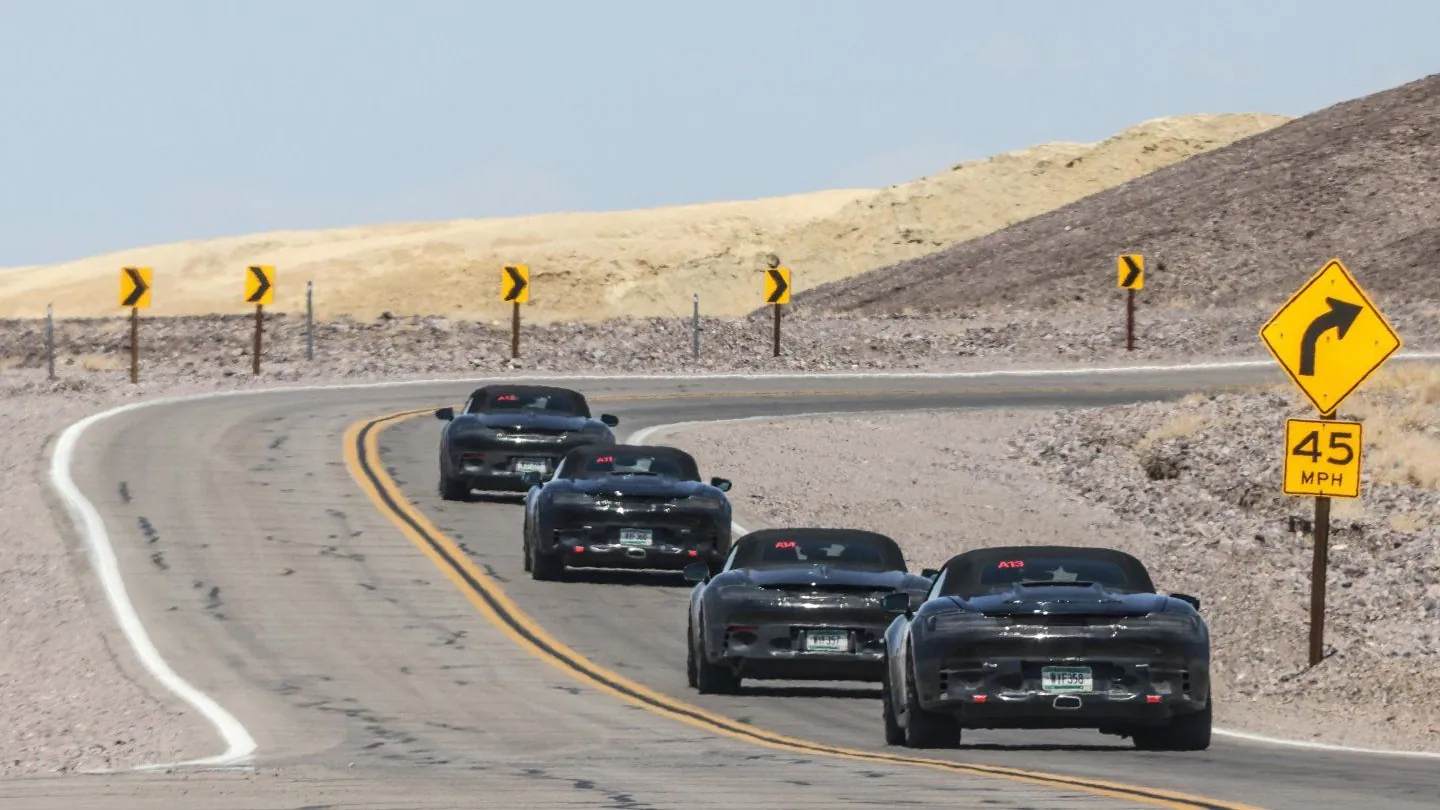
Routes ran from 282 feet (86 meters) below sea level to 9,022 feet (2,750 meters), and the cars charged on five charging standards. The car will be built at Porsche’s main plant in Stuttgart-Zuffenhausen. CEO Michael Leiters called it “a compelling entry point into our world of two-door sports cars.”
E-Shift Adds Seven Virtual Gears And A 981 Boxster GTS Soundtrack
Every electric 718 Boxster gets E-Shift as standard. A button turns on a virtual seven-speed PDK that shifts automatically or through the steering-wheel paddles, with a reproduction of the six-cylinder boxer sound of the 981-generation Boxster GTS. Porsche says performance is identical with E-Shift on or off.
With E-Shift off, the paddles choose between three levels of regenerative braking. Rally champion Walter Röhrl, who drove the car for Porsche, is quoted in the release: “It’s really sensational what this car can do.”
The top model’s top track speed is more than 155 mph (249 km/h), and Porsche says the electric car will be the most powerful 718 yet. The release gives no horsepower or kilowatt figure.
The release covers the Boxster only and does not mention an electric Cayman. It also changes one detail from earlier reporting. Autocar reported in December 2025 that Porsche was reworking this platform to take combustion engines, and EVXL’s story on that report described a floor-mounted battery. Porsche now puts the pack behind the seats. Gas-powered 718 production ended in October 2025, and the electric car’s debut had already slipped to early 2027 when EVXL reported in March that Porsche’s Australia chief had driven the new Boxster.
EVXL’s Take
In March I wrote that I’d believe the go-kart feel when I’m in the seat. This release moves me partway. Putting the pack behind the seats is the hard way to build an electric sports car, and a 40/60 weight split with a low seat is the right target for a Boxster.
The virtual gears don’t bother me, because they switch off and cost nothing in performance. The missing numbers do. A Boxster is supposed to be the light Porsche, and Porsche compared this one with a hybrid 911 Cabriolet without giving a weight. It told us the test routes reached 9,022 feet and left out what a buyer needs. I’d hold off on any deposit until the first-quarter premiere gives a price and a range on the EPA cycle.
Source: Porsche Newsroom USA
EVXL uses automated tools to support research and source retrieval. All reporting and editorial perspectives are by Haye Kesteloo.