
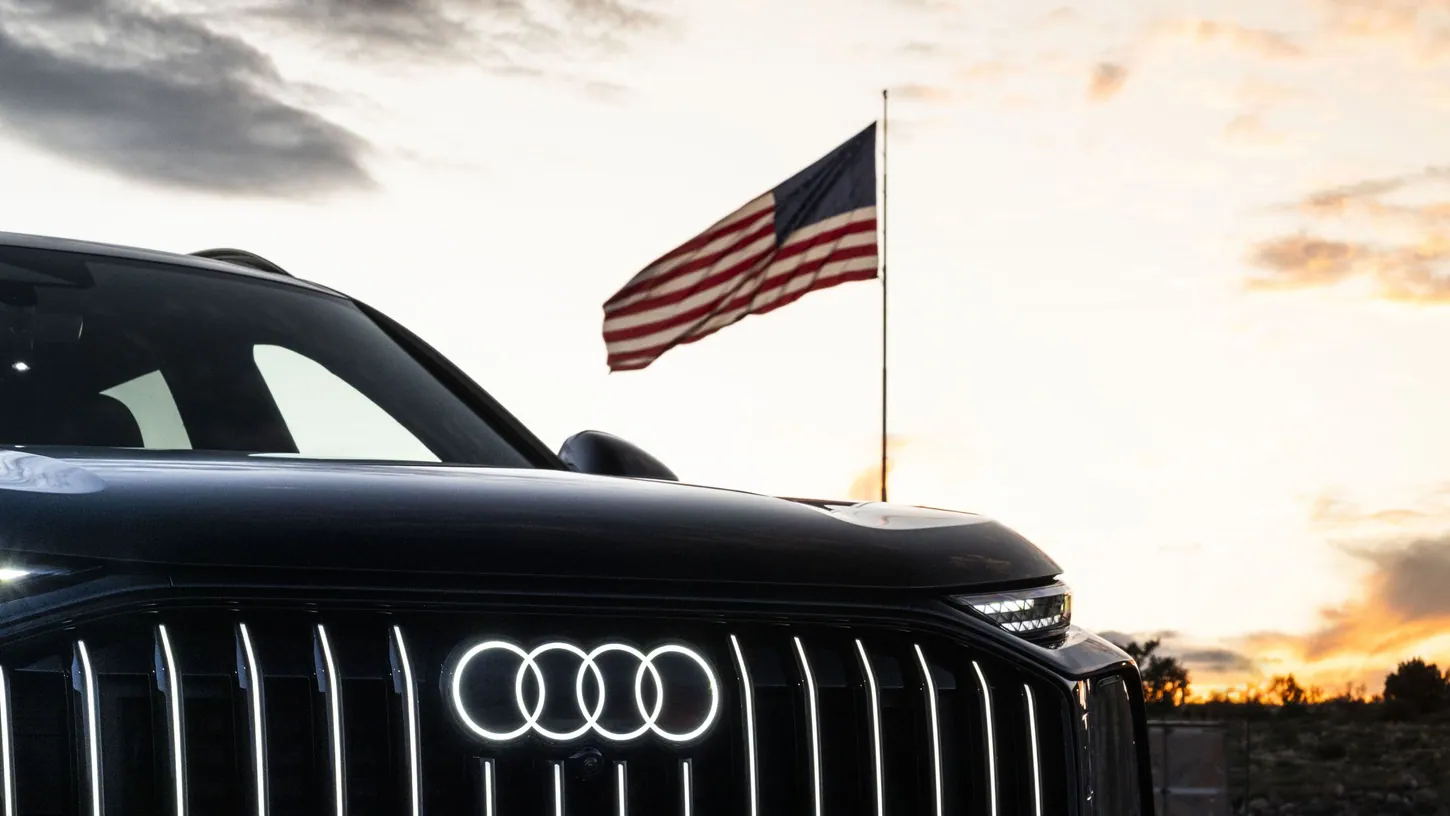
Audi plans to build its first American factory at the Middle Georgia Mega Site in Peach County, investing about $4 billion and hiring roughly 4,500 people. Construction starts in 2027, the plant is sized for up to 200,000 vehicles a year, and production begins in the early 2030s.
President Donald Trump announced the plant at a campaign rally in Perry, Georgia, on Saturday, October 24, with Audi CEO Gernot Döllner on stage. Audi’s own announcement followed on Sunday. It promises premium SUVs “tailored to North American customers,” and its text never uses the word electric.
Last year, the US production plans attributed to Audi in the German trade press were built around three e-tron models.
Tariffs Cost Audi About €1.2 Billion Last Year
Audi has no US factory today, so every car it sells here crosses a border. Tariffs on cars, steel, aluminum and parts cost the company about €1.2 billion (roughly $1.4 billion) last year. Its US lineup comes from Europe or from the Q5 plant in San José Chiapa, Mexico.
Döllner told reporters on Sunday that the decision followed months of negotiations, but he would not say whether the deal includes tariff relief, Reuters reported. On joining Trump at a rally ten days before the November 3 midterms, he said: “If the American president invites you, you accept the invitation.” An IG Metall spokesperson called that choice hard to understand, although union head Christiane Benner backed a US plant as the right move. Volkswagen’s supervisory board still has to take the final decision.
BMW builds its largest SUVs in Spartanburg, South Carolina. Mercedes-Benz’s Alabama plant, Carscoops notes, builds the GLE and GLS alongside the electric EQE SUV and EQS SUV. Georgia already has a dedicated EV factory in Hyundai’s Metaplant near Savannah, which started Ioniq 5 production in October 2024.
Audi’s 2025 US Plans Named Three Electric SUVs
In May 2025, German trade weekly Automobilwoche reported that Audi was studying US assembly of three electric models. The report, as relayed by electrive, put the Q4 e-tron at Volkswagen’s Chattanooga plant, the Q8 e-tron at Scout Motors’ South Carolina site and the Q6 e-tron at a third location.
By December the standalone plant was on hold. Manager Magazin reported that Döllner temporarily pulled it from a December 12 supervisory board agenda on cost grounds, while still weighing the Q4 e-tron for Chattanooga.
The plant Audi announced this weekend carries a different lineup. A US government official told Reuters it is expected to assemble the Q7, Q8 and Q9, and that Audi also plans 25,000 vehicles a year at Scout’s Blythewood factory. Audi sells none of those three as a battery-electric model. Its electric Q8, the Q8 e-tron, ended production when Audi closed its Brussels plant in February 2025. The Q9 launched in Europe this year with a 3.0-liter V6 diesel, and an Audi spokesperson told Motor1 that a gasoline V6 and a plug-in hybrid will follow.
Audi’s announcement names no models at all. Production chief Gerd Walker promised “highly efficient and flexible production processes,” which leaves room for any drivetrain.
EVXL’s Take
Building cars where you sell them is the right call, and Trump’s tariffs made it an expensive one to keep putting off. My read is that Georgia is a tariff decision and not an EV decision of any kind. Döllner told Autocar in June 2025 that Audi wanted powertrain flexibility for at least seven more years, perhaps ten, and in June this year Audi revealed a V8 flagship in the year its EV-only pledge was supposed to begin. A plant lined up for the Q7, Q8 and Q9 fits that retreat. Walker’s flexible plant could still take a plug-in Q9 or an electric SUV later, and big-SUV buyers here do seem to want a gas backup, since 87% of Scout’s 160,000 reservation holders picked the range-extender version. Still, Audi got a rally stage and a $4 billion headline and gave EV buyers nothing to hold on to. Anyone shopping for an electric Audi today is buying an import, and this plant gives no date for when that ends.
Sources: Audi, Reuters via TimesLive, Carscoops, Euronews, electrive, Motor1
EVXL uses automated tools to support research and source retrieval. All reporting and editorial perspectives are by Haye Kesteloo.


