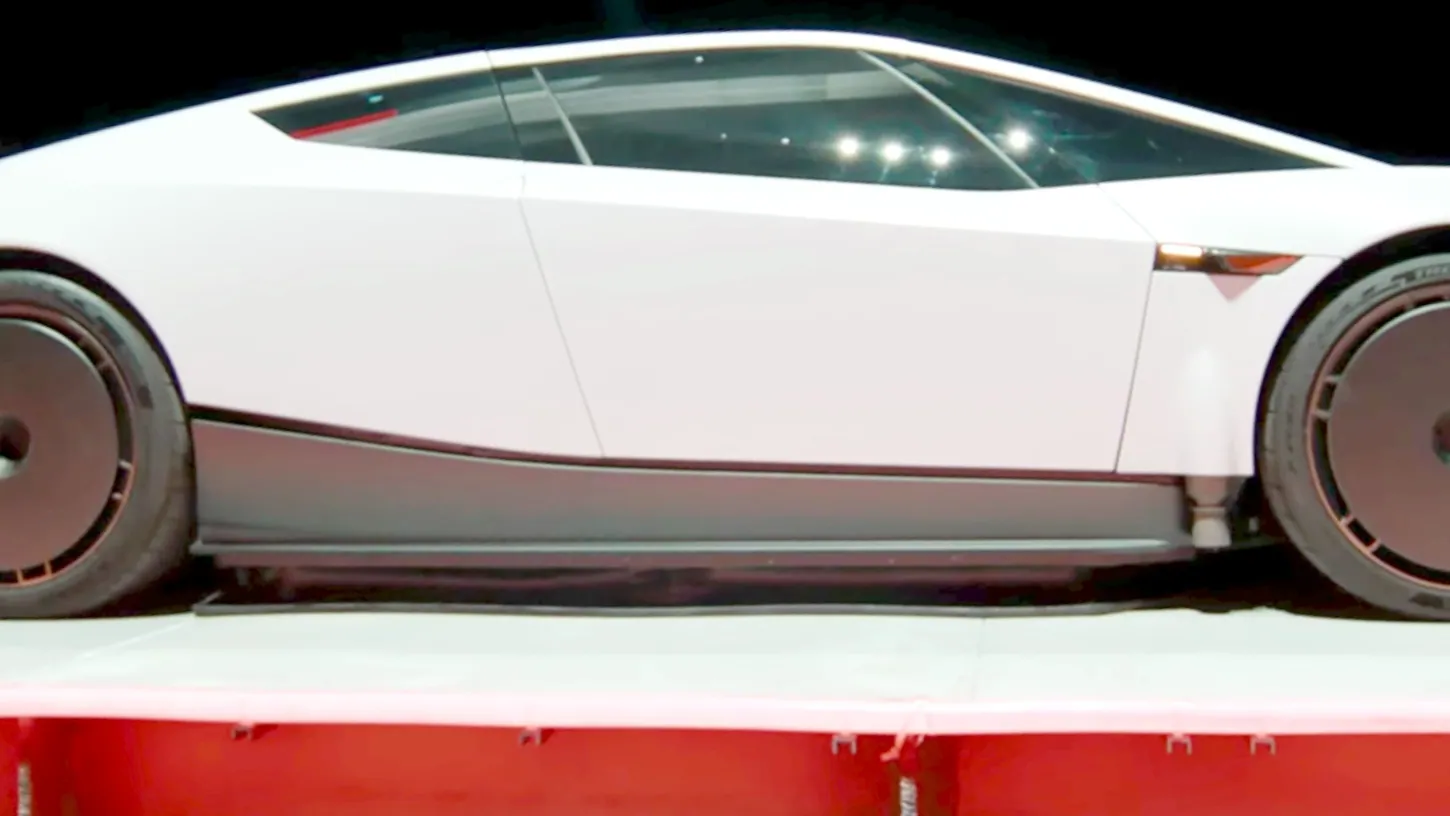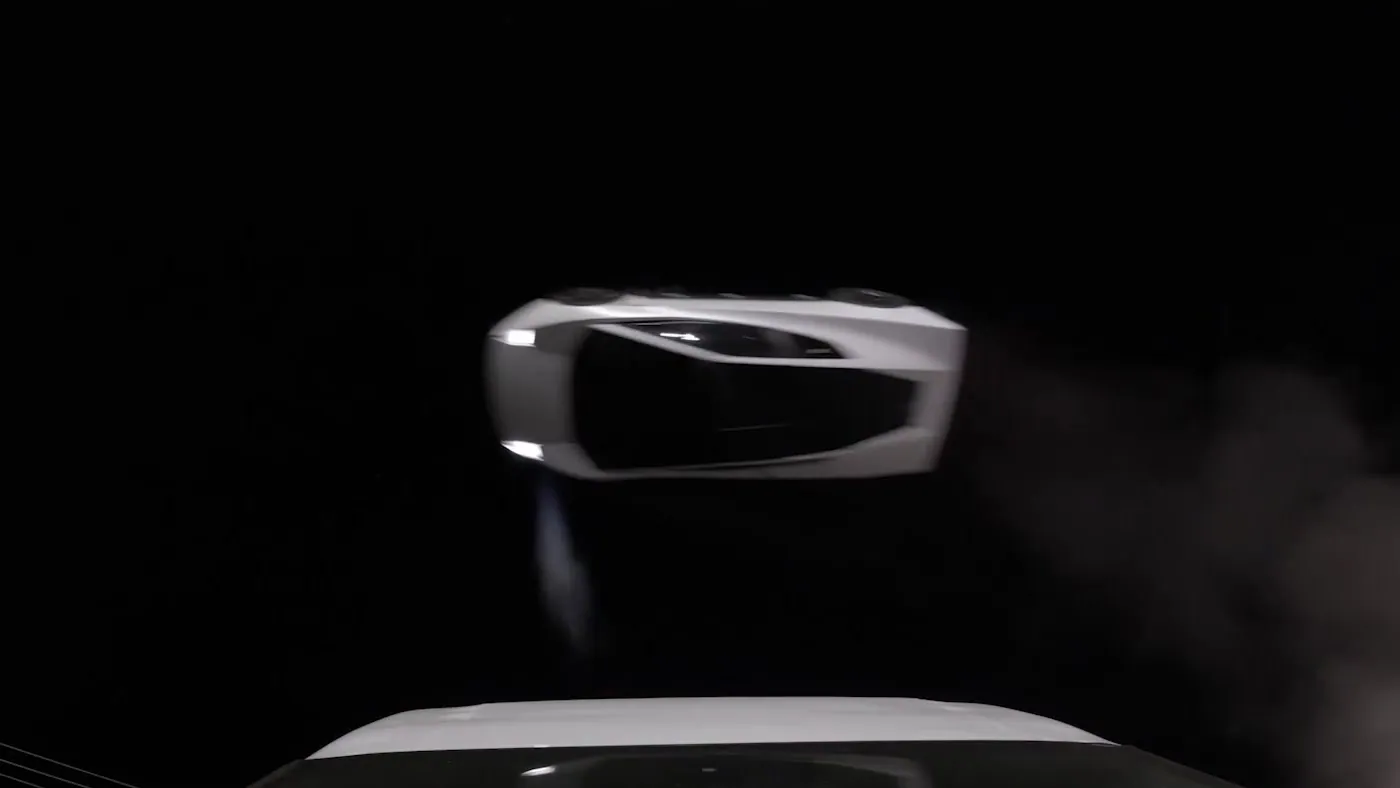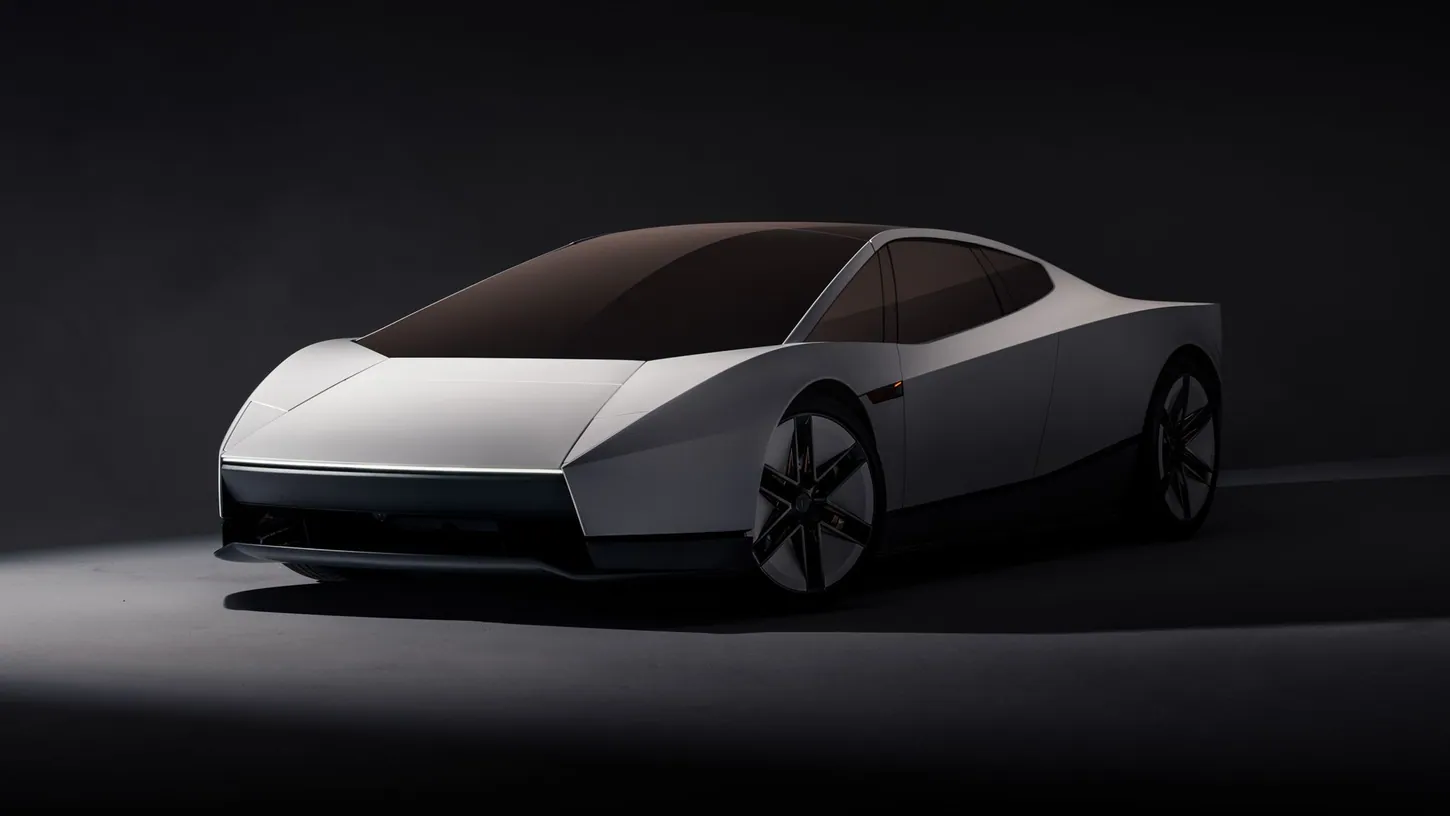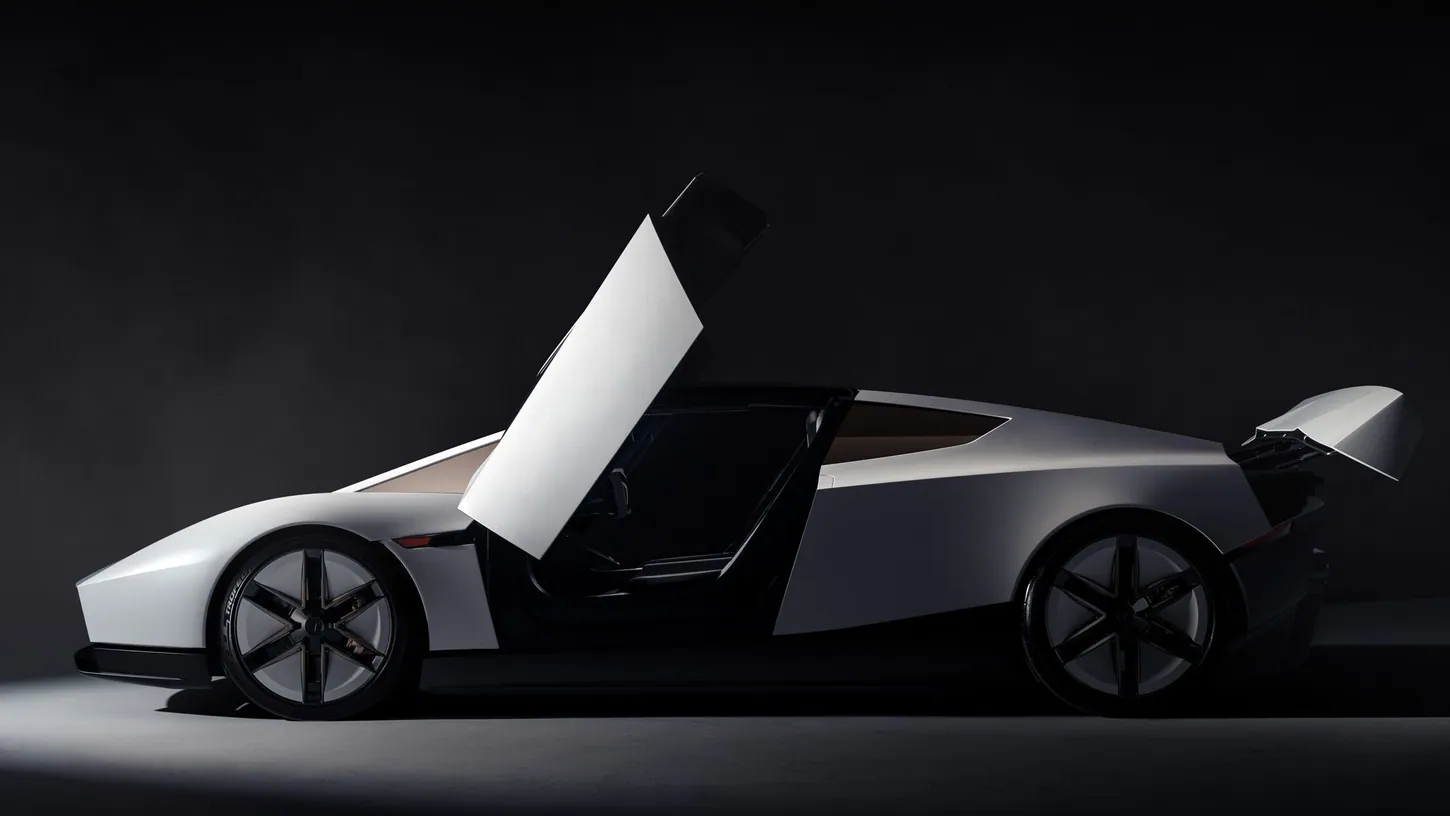
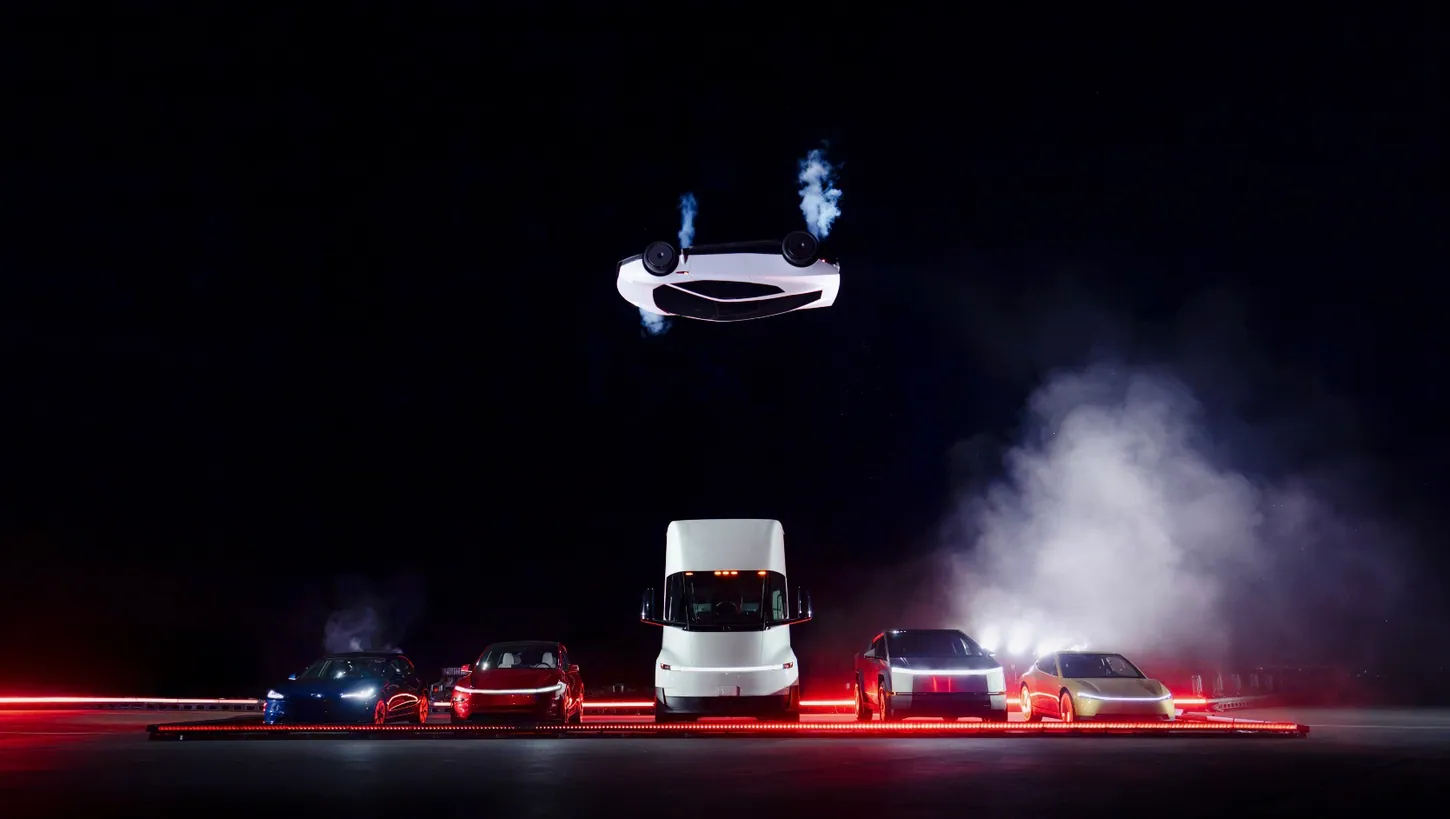
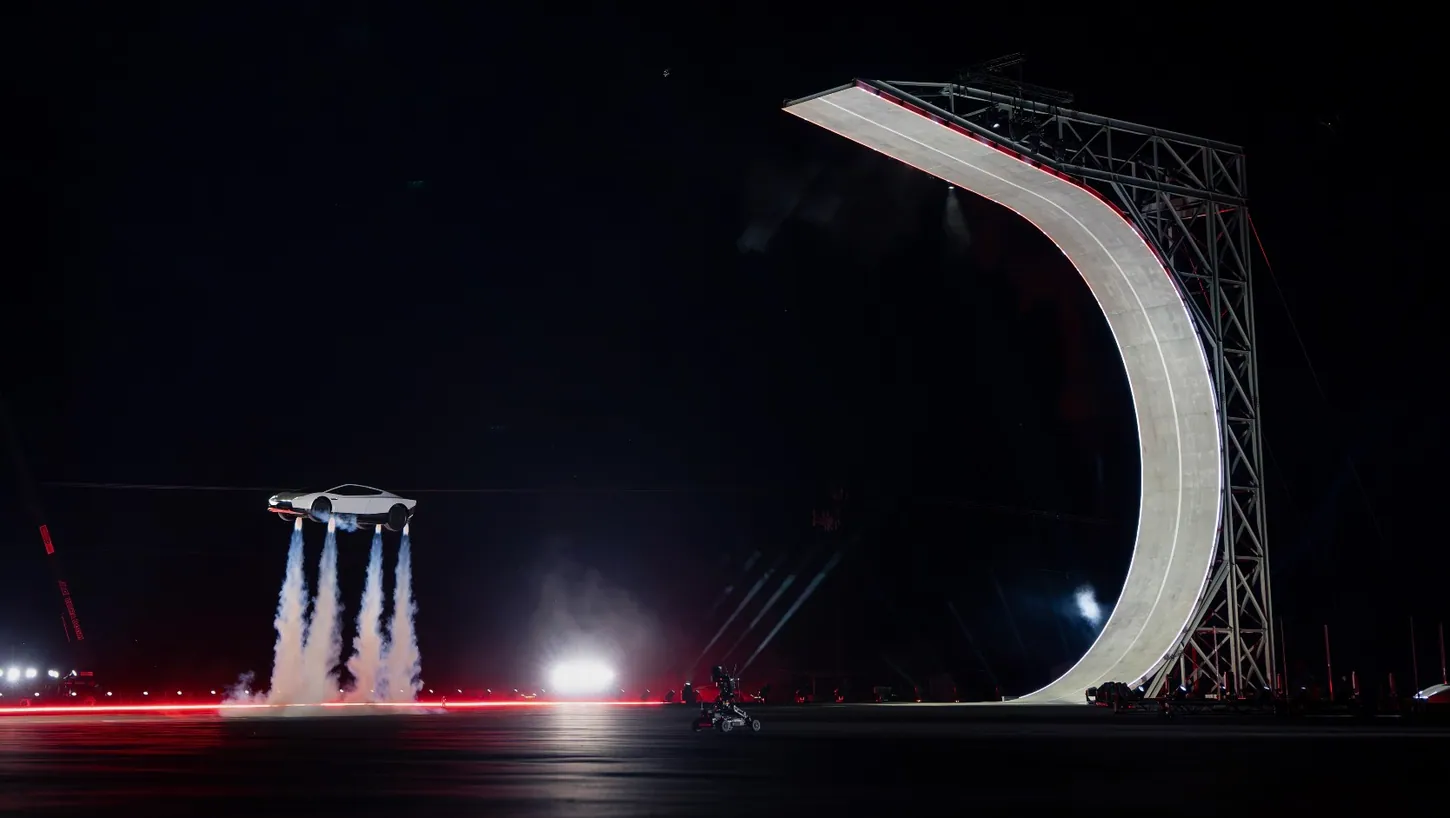
Jason Fenske of Engineering Explained ran the physics on all three stunts from the Tesla Roadster reveal and called each one legit: the drive up a curved ramp to hang upside down, the kickflip over a Semi, and the 0.81-second run to 60 mph. His 18-minute video went up on Friday morning and passed 240,000 views by the afternoon.
The one claim he labeled nonsense came from an interview, not the stage. Fenske says Tesla design chief Franz von Holzhausen told MotorTrend that a base Roadster, the version with no fans, reaches 60 mph in just over a second. MotorTrend’s written story doesn’t carry that line. Tesla’s slowest listed trim, the fan-equipped Performance, claims under 1.6 seconds.
Fenske Puts a Fan-Free Roadster’s Limit at 2.1 Seconds
A rear-drive Roadster without fans can launch at about 0.99 g, Fenske calculates, or 0 to 60 mph in 2.76 seconds. With every pound on the rear tires, a 1.3 friction coefficient caps it at 2.1 seconds. Allowing for more grip than he assumed, he expects 2.5 to 2.7.
His inputs in the video are a 111-inch (2,825 mm) wheelbase, a 40/60 front-to-rear weight split, and a center of gravity 18 inches (460 mm) high, the height Car and Driver measured on a Model S. Only the rear tires push. Grip sets the ceiling, so more power doesn’t change the answer, and EVXL reran the weight-transfer formula with his inputs and got the same 0.99 g. A base Roadster with 800 kW (1,073 hp), as Top Gear and InsideEVs described it in EVXL’s Roadster rundown, still can’t put more through two tires than they can hold.
Fenske thinks von Holzhausen misspoke and meant the Performance trim. Its fans add about 2 g of downforce, and with 60% of that on the rear axle and a little less grip per pound as the tires load up, his napkin math gives about 2.3 g, or 1.2 seconds to 60 mph. That fits Tesla’s under-1.6 claim. Hagerty says the base car is still in development, and Fenske expects a Model S Plaid, with all-wheel drive, to beat it off the line.
Tesla’s 10,362 Pounds of Fan Downforce Needs Only an 11.5% Vacuum
The 10,362 pounds (4,700 kg) of fan downforce Tesla credited at the event needs a pressure difference of only about 1.7 psi (11.5 kPa) across a 43-square-foot (4 m²) sealed floor, Fenske calculates. That leaves 88.5% of normal air pressure under the car, a modest vacuum.
Electrek called the 4,700 kg figure potentially unreal. Fenske’s math puts the ceiling far higher. With a perfect vacuum underneath, air pressure on the Roadster’s roughly 97-square-foot (9 m²) top would press down with about 200,000 pounds of force (900 kN). Four fans of about 20 kW each only have to pull a fraction of the air from under the car.
Upkeep is the price. Hagerty reported that the skirts sealing the floor, which the Tesla suction patent gives a flexible ground edge, are replaceable wear parts, and Fenske adds the fans to that list. He cites McMurtry, whose Speirling fan car filters out 92% of the debris its fans swallow by mass, which still sends the finest 8% through the fans. Tesla ran the stunt on a prepared surface, and suction grip depends on what the skirts seal against.
One Fill of Gas Hovers the Roadster for About 7 Seconds
Holding a 4,400-pound (2,000 kg) Roadster aloft takes about 4,500 pounds of force (20 kN), a quarter of the 80-plus kN Tesla’s Lars Moravy quotes. At that thrust Fenske works out 82 pounds (37 kg) of gas per second, so 551 pounds (250 kg) lasts 6.75 seconds.
Moravy, Tesla’s vice president of vehicle engineering, puts the car at just under 1,700 kg (about 3,700 pounds), which would stretch the hover to about eight seconds. The thruster stunts each lasted about four seconds and needed more than hover thrust, which Fenske says still fits inside one fill. He credits Tesla for doing the kickflip with no ramp, on thrusters for both takeoff and landing.
Yann LeCun, the Turing Award winner, put useful thrust at about five seconds on X last weekend and called the car “cute demo, but totally impractical,” and Elon Musk answered him with a fart joke. Fenske’s flow rate implies a specific impulse of about 55 seconds, by EVXL’s arithmetic, against LeCun’s under 50. Fenske reaches nearly the same hover time and calls the stunts possible.
The 0.81-Second Run Implies 3.37 g, and 0.55 Needs 5.5 g
Tesla’s live 0.81-second run averages 3.37 g, and Fenske says its clock started at zero with no rollout. Four rear thrusters on top of the fan car’s roughly 2.3 g cover it, he says, since a 1 g push for one second takes about 88 pounds (40 kg) of gas.
The Rocket adds a 106-gallon (400-liter) tank and six more thrusters. Fenske divides the 80 kN by a vehicle weight he puts at about 22.5 kN, which gives roughly 3.5 g from thrust alone, then adds 2 g from the fans for 5.5 g and a run to 60 mph in about half a second. Moravy told Hagerty the Rocket will do 0.55 seconds, and Fenske calls that legit.
His sum treats all of that thrust as pushing the car forward. Six of the Rocket’s ten nozzles point down or to the sides, according to MotorTrend. Hagerty’s Henry Catchpole calls the 0.55 a rollout figure, which would start the clock after the car has rolled about a foot.
EVXL’s Take
A week ago I wrote that I’d trust Moravy’s interviews over Tesla’s launch post, and Fenske’s video is a reason to narrow that. Every stunt Tesla actually performed survived an engineer working the numbers on camera. The claim that failed came from a walkaround, where by Fenske’s account Tesla’s chief designer gave a fan-free car a time that two rear tires can’t deliver. This is the same Roadster that promised four seats and 620 miles in 2017 and now offers two seats and over 300. For a $50,000 deposit, I’d hold Tesla to the three times on its own configuration post and ask it to state the timing method for each. A number said in a walkaround doesn’t count.
Sources: Engineering Explained on YouTube, MotorTrend on YouTube, MotorTrend, Hagerty on YouTube, Electrek, Yann LeCun on X, Tesla on X
EVXL uses automated tools to support research and source retrieval. All reporting and editorial perspectives are by Haye Kesteloo.