
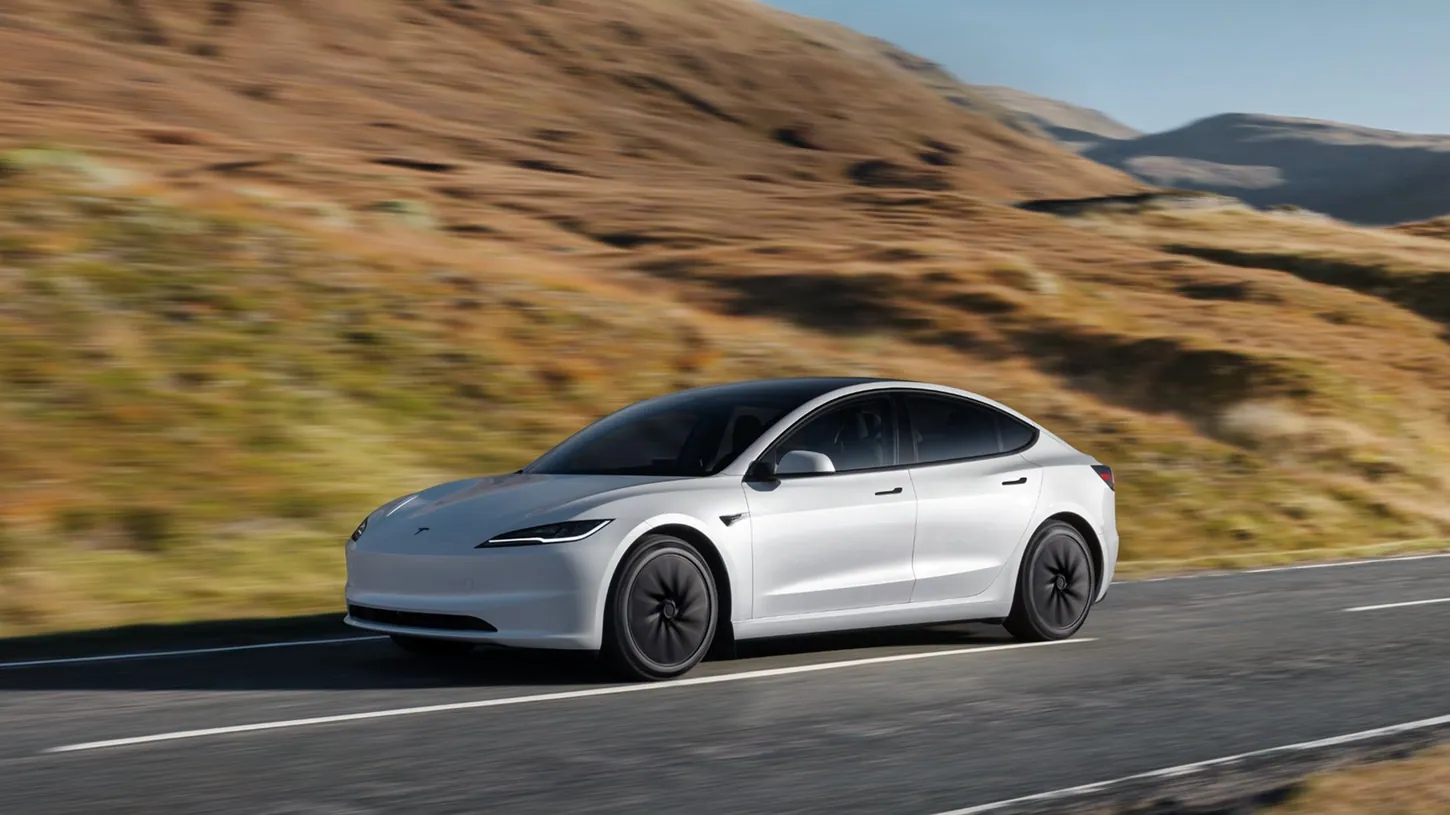
A Tesla Model 3 driven at 56 mph (90 km/h) with the climate control off used 37% less energy per mile than the same car at 87 mph (140 km/h), in a highway test the S3XY Buttons maker Enhance published on October 14. EVXL ran both results across the 2,816-mile Cannonball Run from Manhattan to Redondo Beach, charging only at Tesla Superchargers.
The fast car needs six more charging stops than the efficient one, 16 against 10. It still reaches the Portofino Hotel 15 hours sooner.
Enhance’s Model 3 Used 58% More Energy at 87 MPH
Enhance drove a European Model 3 Highland with 60 kWh of usable battery twice over one 62-mile (100-kilometer) route at 68°F (20°C). At 56 mph it averaged 157 Wh per mile (97.7 Wh/km). At 87 mph it used 249 Wh per mile (154.8 Wh/km).
About 90% of the route was highway, and the fast run added firmer acceleration and the climate control. Scaled to a full battery, Enhance’s numbers work out to about 382 miles (614 km) of range at the slow pace and 241 miles (388 km) at the fast one. The slow figure beats the car’s own 572 km (355-mile) WLTP rating. The efficient run took 1 hour 16 minutes and the fast one took 54, so the extra range cost 22 minutes over 62 miles.
EVXL’s Model Gives Both Cars the Same Supercharger Routine
EVXL used the 2,816 miles Arne Toman logged for the overall record, from the Red Ball Garage on East 31st Street in Manhattan. Both cars leave at 100%, never drop below 10%, charge from 10% to 80% at every stop, and hold their test speed and consumption throughout.
Leaving at 100% is normal for this car. Tesla tells owners of its LFP (lithium iron phosphate) packs to keep the charge limit at 100%, as InsideEVs reported from the owner’s manual.
A 10% to 80% session adds 42 kWh. Green Car Reports saw the LFP Model 3 peak at 168 kW and timed 15% to 80% at 23 minutes, so EVXL used 24 minutes for 10% to 80%, an average near 105 kW. Each stop also gets 5 minutes to get on and off the charger.
The Fast Model 3 Stops Six More Times and Arrives 15 Hours Sooner
The efficient Model 3 finishes in 54 hours 53 minutes: 50 hours 21 minutes of driving and 4 hours 32 minutes at Superchargers. The fast car drives 32 hours 22 minutes and charges for 7 hours 30 minutes, finishing in 39 hours 52 minutes.
The fast car burns 702 kWh against the efficient car’s 443 kWh, and every 10% to 80% session only carries it 169 miles instead of 267. It spends just under three hours more at chargers and 18 hours less on the road.
The break-even point is low. Using Enhance’s two consumption figures, the slow car only wins if charging averages less than about 14 kW across the whole stop, which is home wall-box speed, not DC fast charging. Even if every Supercharger delivered half the modeled rate, the fast car would still arrive more than 12 hours sooner.
Enhance’s video carries one wrinkle. The battery percentages it shows (60% to 42%, and 60% to 29%) imply more energy than the car’s kWh readout, especially on the fast run. Run on those percentages instead, the fast car needs 19 stops, finishes in 41 hours 15 minutes and still wins by 14 hours.
The 87 MPH Model 3 Lands Near the EV Cannonball Record, on Paper Only
The electric Cannonball record is 39 hours 29 minutes, set in October 2024 in a Porsche Taycan by Kyle Conner, Tijmen Schreur and Drew Peterson. The fast Model 3 lands 23 minutes to 1 hour 46 minutes behind it, depending on which of the video’s figures you use.
The model includes no meals, traffic, charger queues or broken stalls, and a real team hits all of them. It also breaks the law the whole way. Interstate limits on the usual routes run from 65 mph in New York and New Jersey to 80 mph in parts of the West, per the Insurance Institute for Highway Safety. The overall record of 25 hours 39 minutes, set in 2020 in an Audi S6, averaged about 110 mph.
Tesla drivers chasing the record on Full Self-Driving run slower. Dan Burkland’s team claimed 49 hours 55 minutes in May, as EVXL reported at the time. David Moss, Spencer Scott and Owen Sparks then posted 47 hours 15 minutes in July in Moss’s Model 3 on FSD v14.3.6, Drive Tesla Canada reported. Both times come from the teams themselves. The efficient Model 3 would finish about five hours behind Burkland and more than seven behind Moss.
EVXL’s Take
Hypermiling is a range tool, and on a road trip with DC fast chargers it costs you time. Enhance’s test shows a gentle right foot really does buy range, 382 miles against 241. On a Supercharger route that extra range saves six stops of about half an hour each, and the slow pace costs 18 hours of driving. My read is that the same holds at legal speeds, because even the higher 19 kW break-even from the battery percentages sits far below what a Supercharger delivers. So drive the limit with the climate control on, and slow down when the next working charger is farther away than your battery. If you want a faster road trip, shop for a car that charges faster. That is also why I keep an eye on hardware like EVgo’s 750-kW charger, even though it has slipped to 2027 and no US EV can take its full output yet.
Sources: Enhance on YouTube, Arne Toman, Green Car Reports, InsideEVs, Insurance Institute for Highway Safety, Tijmen Schreur on X, Drive Tesla Canada.
EVXL uses automated tools to support research and source retrieval. All reporting and editorial perspectives are by Haye Kesteloo.


