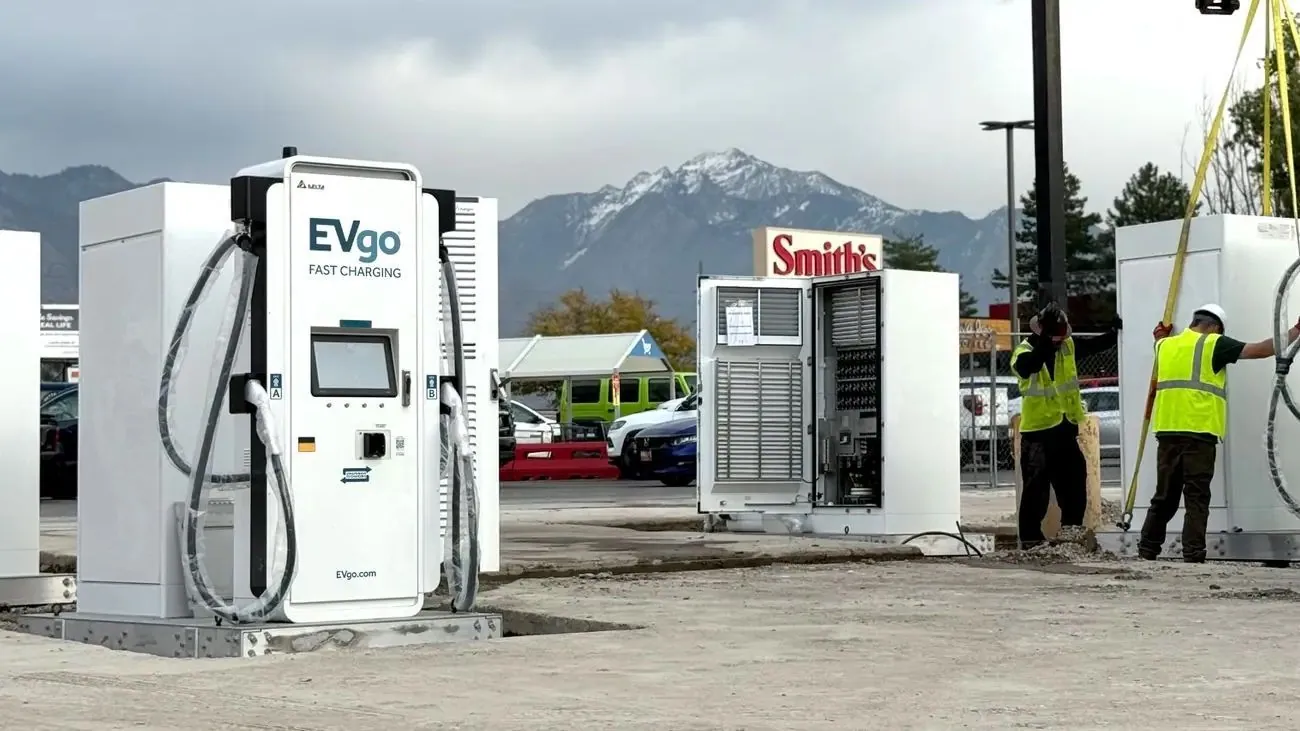
EVgo previewed a charging system on September 29 that can deliver up to 750 kW, more than twice the 350 kW its fastest stalls put out today. The company says the system should charge the fastest-charging EVs sold in the US in around 10 minutes, and that the final design will be unveiled in 2027 as deployment begins.
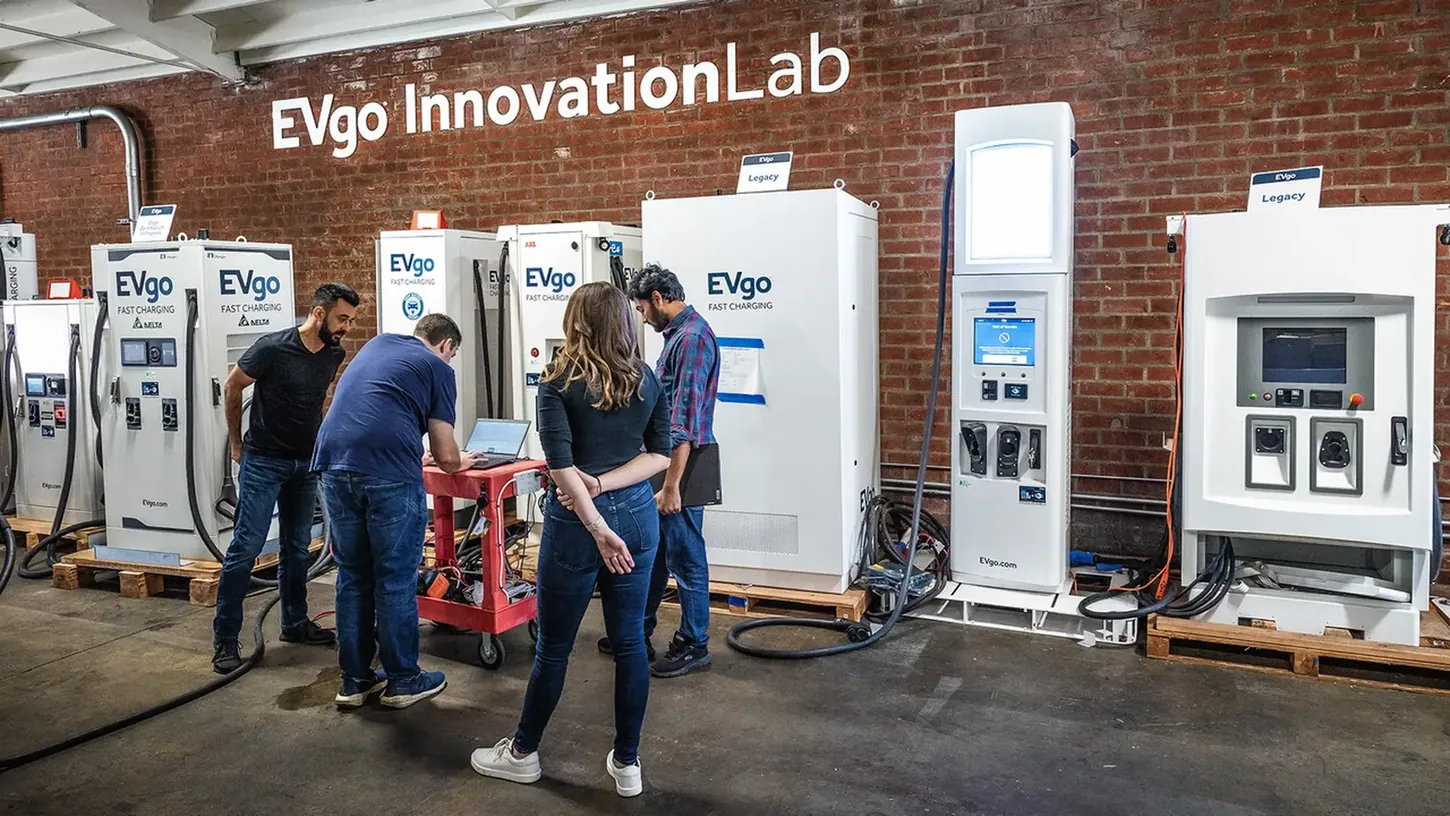
The hardware is being built with longtime supplier Delta Electronics at EVgo’s Innovation Lab in El Segundo, California. Every stall will carry a North American Charging Standard, or NACS, connector, and the system will split its power between the cars plugged into it rather than giving one car a fixed rating.
EVgo’s own August 5 press release said the first units of this architecture were expected to be installed by the end of this year.
EVgo Has Not Named the Car Behind Its 10-Minute Claim
EVgo’s 10-minute figure comes with no vehicle, no battery size and no starting or ending charge level. A footnote on its announcement says actual charging time depends on the vehicle’s charging speed and settings, battery condition, outside temperature and starting charge level.
A car that accepts 400 kW will not charge at 750 kW because it is plugged into one of these stations. EVgo’s own guide to EV charging speed explains that the vehicle controls how much power it takes, and that many cars slow their rate as the battery fills.
No EV sold in the US accepts 750 kW. The fastest on the road today top out near 400 kW, and most sit between 150 and 200 kW, according to Telemetry’s Sam Abuelsamid. BMW’s new i3, which peaks at 400 kW, does not reach US customers until early 2027. China is already past this number: BYD is deploying 1,000-kW Megawatt Flash Chargers for cars that can take a full charge in about six minutes.
EVgo CEO Badar Khan said charge rates on the EVgo network are “up nearly 20% in the last two years” and that the new architecture is built to absorb further increases. The system is an investment in cars that do not exist in the US yet.
EVgo Will Split 750 kW Between Cars Rather Than Give It to One
The 750 kW is the system’s total, not a per-car rating. Dynamic power sharing routes electricity between the vehicles plugged in, and EVgo says each dispenser adjusts its output in real time as a car’s limit changes, so drivers stop hunting for the stall with the right number.
The architecture dates to an October 2024 agreement with Delta that promised sharing across as many as six stalls at a time, with dispensers rated at 400 kW. EVgo also promises easier-to-handle cables, touchless payment and reworked hardware and firmware aimed at reliability, drawing on data from 1.8 million customer accounts and more than 10 million sessions a year.
The release does not mention CCS, so what a CCS-equipped car does at one of these stalls is a question EVgo has not answered.
Those changes address problems that have nothing to do with peak power. EVXL has previously covered how heavy cables and awkward payment steps make a public charging stop frustrating even when a charger is free, and its reporting on charger reliability shows why a higher rating matters little if the session never starts.
EVgo Also Has 500-kW Tesla V4 Superchargers Coming First
The 750-kW system is separate from the Tesla V4 Superchargers EVgo announced in August. Those are rated at up to 500 kW and 1,000 volts, use Tesla’s Magic Dock so NACS and CCS cars connect without an adapter, and add up to 200 miles in 15 minutes, EVgo says.
Deployment of the Superchargers starts this fall, with the first EVgo Supercharger sites expected to be operational in the second half of 2026. They will show up in Tesla’s in-car navigation and Trip Planner.
EVgo Gave a 2026 Date Twice Before It Said 2027
EVgo’s October 2024 agreement with Delta set deployment for the second half of 2026, and its August 5 release repeated a 2026 date with the first units due by year end. The September 29 release puts the final design and deployment in 2027, nearly eight weeks after the August statement.
EVgo has not called this a delay, and the September 29 release does not explain the change. “First units installed” in August could also describe pilot hardware rather than public stalls, and EVgo did not say which.
EVXL’s Take
The number on the press release is the least useful thing in it. Nothing you can buy in the US today draws 750 kW, and until EVgo names the car and the battery window behind its 10-minute figure, that claim can’t be compared with the 10 to 80 percent times automakers publish.
The parts that will change a charging stop sooner are the ones EVgo buried further down its release: the cable, the payment screen and the power sharing. Charge rates on its network really are climbing, so building for cars that aren’t here yet is the right call.
My read is that the 2027 date deserves the same scrutiny as the 10-minute claim, because EVgo gave a 2026 date twice in its own releases before this one. Build the charger, name the car, and hold the date.
Sources: EVgo press release, September 29, 2026, EVgo Supercharger deployment announcement, August 5, 2026, EVgo and Delta Electronics MOU, October 10, 2024, EVgo guide to EV charging speed
EVXL uses automated tools to support research and source retrieval. All reporting is by Damien Kesteloo, edited by Haye Kesteloo.