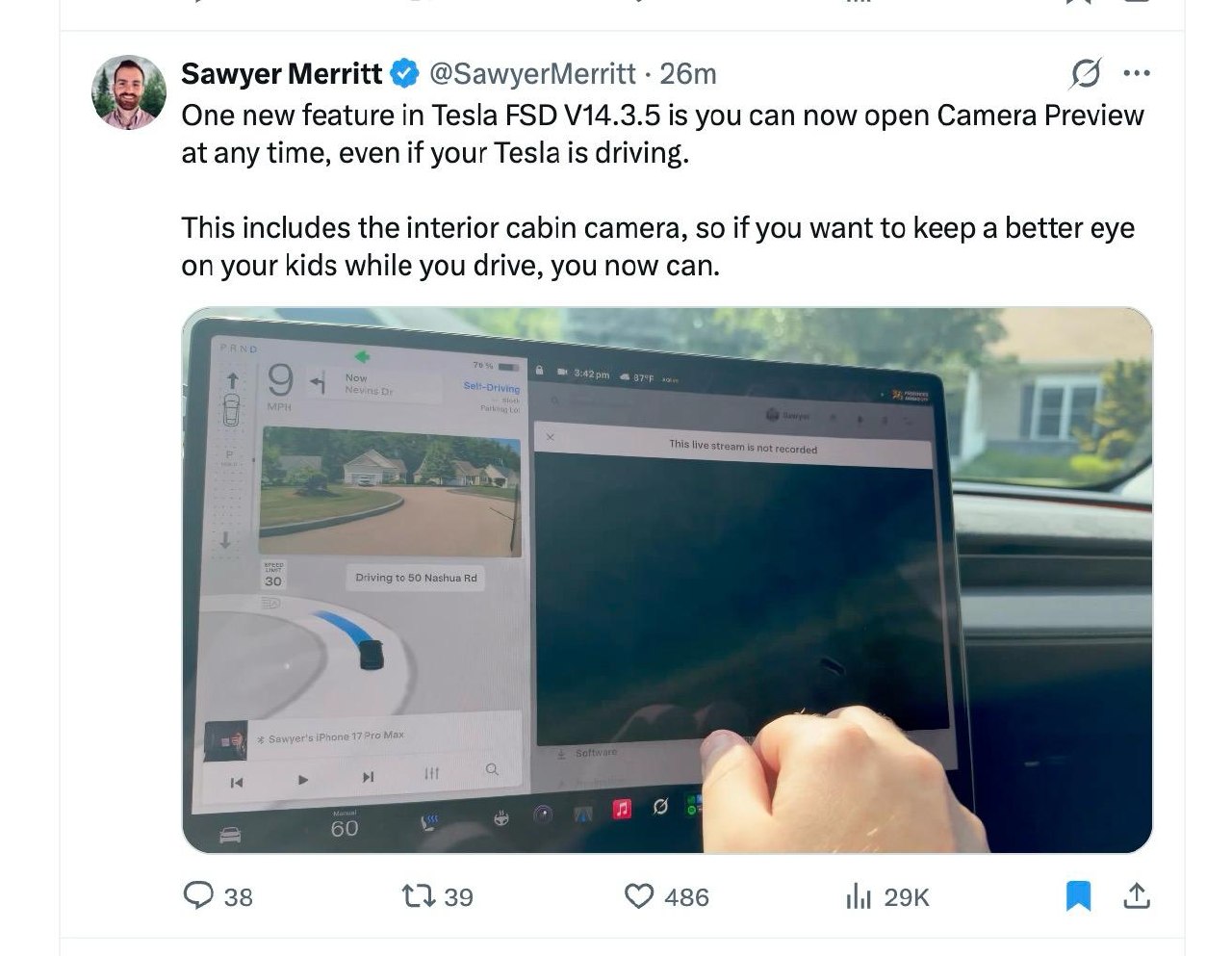
Tesla pushed FSD V14.3.5 to the fleet this week, and buried in the changelog is a small interface tweak that Tesla watcher Sawyer Merritt flagged as one of the update’s most useful additions: drivers can now open Camera Preview at any time, even while the car is actively driving. Previously, the feature only worked when the vehicle was parked, according to Merritt’s post on X, which included a screenshot of the split-screen view, navigation on one side, a live camera feed on the other, running while the car was in motion.
Cabin Camera Access Is the Real Story
The update covers every camera Tesla vehicles carry, including the interior cabin camera that watches the driver. That detail matters more than a simple UI unlock. Parents driving with kids in the back seat can now pull up the cabin view mid-trip to check on them without pulling over. Tesla’s cabin camera has mostly lived in the background, quietly feeding the driver-monitoring system that watches for attentiveness. Making it accessible on demand, while driving, turns a passive safety sensor into something drivers can actually use.
Merritt’s screenshot shows the feed with a small disclaimer overlay, “This live stream is not recorded,” a reminder that Camera Preview is a live monitoring tool, not a way to pull saved footage. For that, drivers still need TeslaCam and the vehicle’s onboard storage.
What Else Shipped in V14.3.5
Camera Preview wasn’t the only change. Per official notes tracked by Not a Tesla App, V14.3.5 rewrote Tesla’s AI compiler using MLIR, delivering what Tesla says is a 20 percent faster FSD reaction time. The update also upgraded the vision encoder, improving how the car reads rare, low-visibility scenes and expanding traffic sign recognition.
Tesla says the release reduces unnecessary lane biasing and tailgating, increases decisiveness picking parking spots, and improves responses to emergency vehicles, school buses, and right-of-way violators, with added training for small-animal safety.
The same branch brought Actually Smart Summon to the Cybertruck for the first time, plus dashcam clip encryption, expanded parental controls, and better eye-gaze tracking.
EVXL’s Take
None of this is a headline leap for autonomy, and Tesla isn’t pitching it as one. It’s the kind of incremental usability fix that matters more in daily life than a marquee announcement. Letting a parent glance at the back seat without stopping, or letting any driver spot-check a blind-spot camera mid-drive, is the sort of change that gets used constantly once people know it exists.
It’s also a reminder of how Tesla ships software now. Big swings like the MLIR compiler rewrite land in the same point release as something as mundane as unlocking a camera button, and the small stuff is often what drivers notice first. Merritt’s post pulling nearly 30,000 views in under half an hour says as much about Tesla owners’ appetite for these details as it does about the feature itself.