

Tesla published a guide for Supercharger for Business customers on October 1 that explains how a commercial utility bill works, and it puts the lesson in one sentence: moving a stall from one charging session a day to five “could reduce average energy cost by more than half.” Tesla Charging posted the guide on X on Monday afternoon, and Max de Zegher, Tesla’s charging director for North America, followed with the chart behind it.
The reason is demand charges. A commercial utility bills a site for the highest power it draws in a month, on top of the energy it uses. A Supercharger site sets its peak when several cars charge at once, and the charge is fixed for the rest of the billing period whether the stalls sit empty or full.
Tesla started selling Supercharger sites to outside owners in 2025, and it has published the price: about $940,000 for an eight-stall V4 site before a single kilowatt-hour is sold.
Demand Charges Make an Empty Supercharger the Expensive Kind
Tesla’s guide, dated October 1 and posted to tesla.com/learn, lists six parts of a Supercharger utility bill: fixed costs, supply, delivery, demand charges, other fees and taxes. Supply and delivery scale with kilowatt-hours. Demand charges do not, and Tesla tells owners to budget them separately for that reason.
The guide also explains why demand charges are hard to avoid. A single high moment sets the cost for the entire month. Charging load is unpredictable: one vehicle can draw a large share of a cabinet’s capacity, and cars arrive in clusters rather than staggered. Every one of those is a property of a Supercharger site. None of them is something the owner controls.
Tesla’s answer is volume. Every extra session within the same peak spreads the fixed charge across more energy, which the guide calls demand charge dilution. The chart Tesla built for it plots average cost per kilowatt-hour against sessions per stall per day. The curve starts far above the revenue line, crosses it, and flattens toward the floor set by the energy charge alone. Tesla labels it a screening example, not a quote for any specific utility, and cites the U.S. Energy Information Administration, the State of Massachusetts and a Department of Energy-hosted survey of U.S. demand charges as its references.
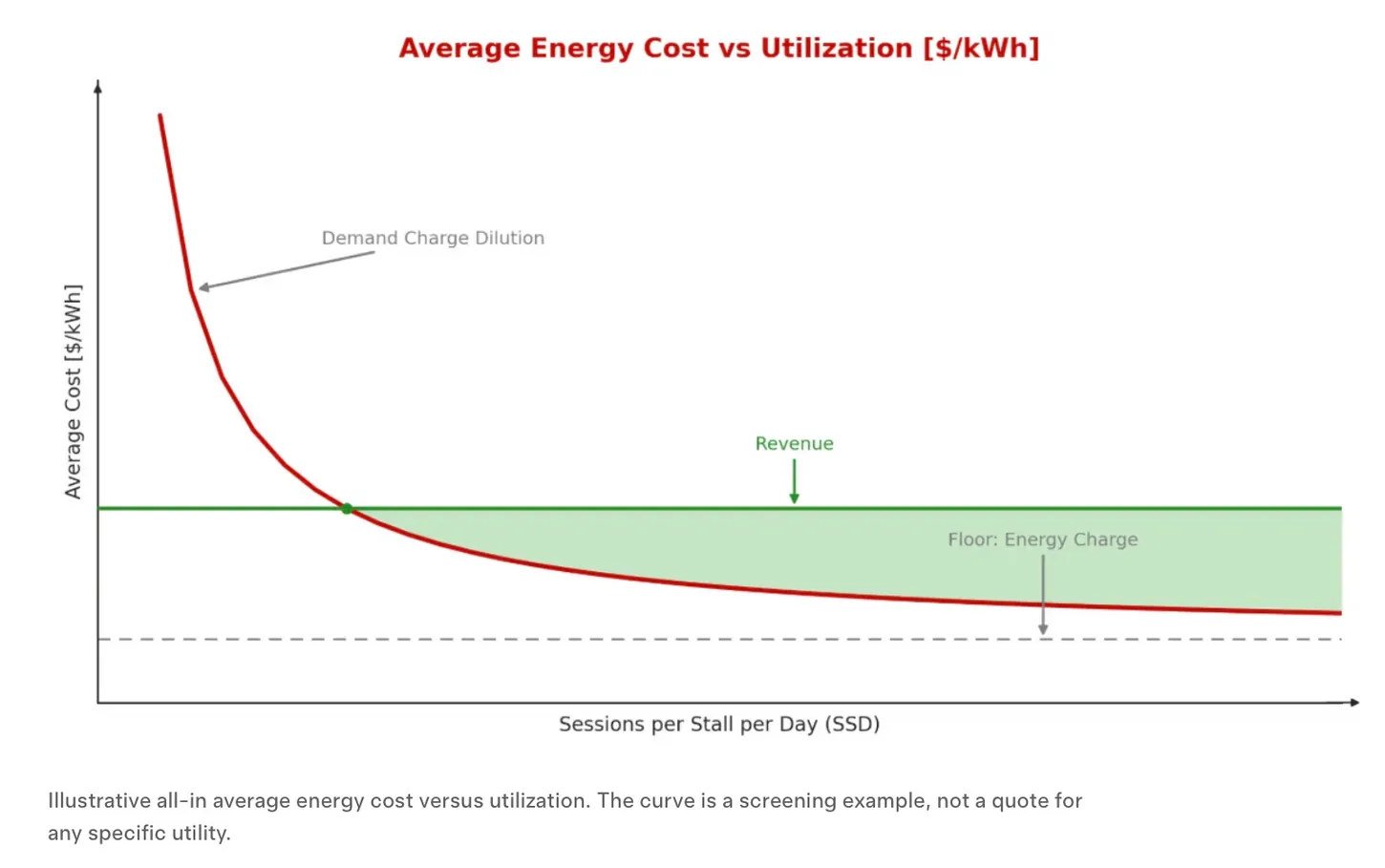
De Zegher’s post on X compressed the guide to three sentences, ending with “healthy utilization is the biggest lever in Supercharger economics.” He has been building Superchargers since 2014, by his own description, and the last time EVXL quoted him was on Tesla’s charging data going to Google Maps, where the same forecasting of demand was the point.
The Guide Arrives Six Months After Tesla Priced the Hardware
Tesla has sold Supercharger hardware to outside owners since 2025 and put out pricing and a calculator on April 8, 2026. Electrek’s reading of the configurator put an eight-post V4 site at $500,000 for hardware and $940,000 all in, plus a $0.10 per kWh fee to Tesla on every session.
That April calculator assumed between 302 and 453 kWh per post per day across its sample locations, which Electrek worked out to about seven cars per post per day at an average 35 kWh session, with 7% annual growth in utilization. On those assumptions a San Francisco gas station site paid back in about four years and a Manhattan site in about seven. The October guide spells out what happens to the per-kWh cost when a site runs well below that.
The program’s first owners are not charging networks. Alpharetta, Georgia, put four city-owned stalls at its public safety building in March to charge police Model Y patrol cars, with the public paying $0.35 per kWh. Tesla pitched the same white-label hardware to European operators at Power2Drive in Munich in 2025. A city fleet and a parking operator read a demand charge the same way a convenience store does: as a fixed monthly bill that only shrinks when strangers show up to charge.
The pushback on Tesla’s post came from where the curve is steepest. Don Burke, replying on X, wrote that off-the-beaten-path sites “will struggle to have the charging volume needed to dilute the demand charges” and need a way around them. Tesla’s guide names no such way. It ends by telling buyers to contact the Supercharger for Business team for help estimating a realistic utilization range for their location, which is the number the whole curve depends on and the one the guide does not supply.
EVXL’s Take
This is the most useful page Tesla has put in front of a prospective Supercharger owner, and it is also a warning dressed as a tutorial. Tesla is telling buyers, before they wire $940,000, that the site’s biggest cost is set by its busiest ten minutes and only comes down if cars keep arriving all month. That is honest in a way the charging industry rarely is, and it is the same thing the April calculator said in reverse: the payback math worked because it assumed roughly seven cars a stall a day. I’d treat that chart as a question to answer before buying, not after. If you cannot name where your first five sessions a day come from, the curve says you are the one paying the utility’s demand charge, not the drivers. Remote sites, the ones Don Burke asked about, are where that bites hardest, and the guide’s only answer to them is a link to the sales team. The page that explains how a battery behind the meter trims that peak would be the next guide worth writing, and Tesla sells the battery.
Sources: Tesla, How Higher Supercharger Site Utilization Increases Your Profits, October 1, 2026, Tesla Charging on X, October 5, 2026, Max de Zegher on X, October 5, 2026, Electrek, April 8, 2026
EVXL uses automated tools to support research and source retrieval. All reporting and editorial perspectives are by Haye Kesteloo.