QuantumScape unveiled its Osprey all-solid-state battery platform on November 11th, reporting that an experimental cell retained about 80% of its capacity after 1,000 full charging cycles. The cell operated under one atmosphere of pressure, which is roughly normal atmospheric pressure, without the heavy compression some solid-state batteries require.
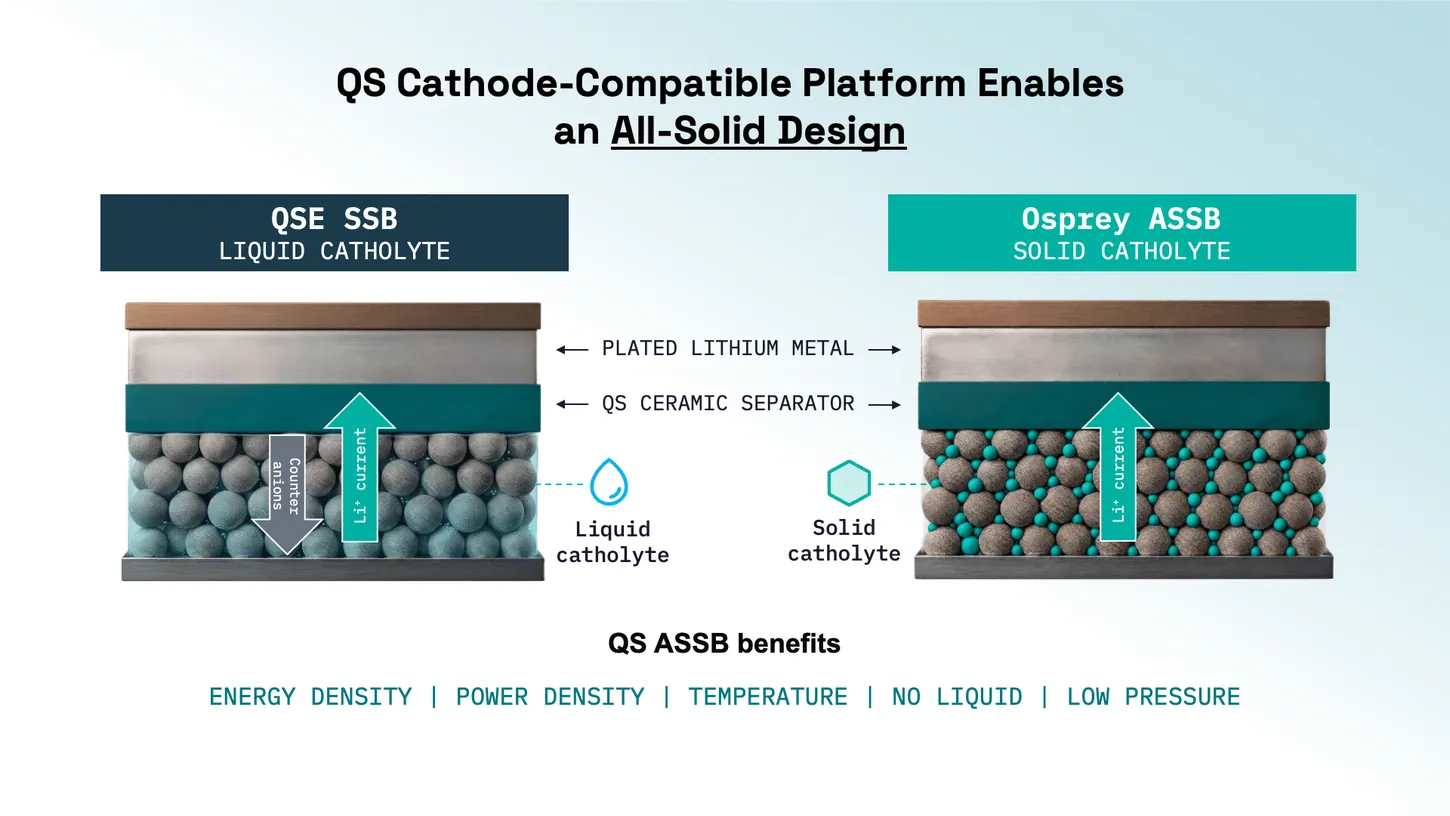
Osprey replaces the liquid electrolyte (catholyte) inside QuantumScape’s existing battery design with a solid material, making the new battery fully solid-state. However, the results come from small laboratory cells, not production-ready EV batteries, and the company has not announced when Osprey could produce EV-size all-solid-state batteries.
Osprey Replaces the Last Liquid Component
QuantumScape’s existing QSE-5 cell uses a ceramic separator and a liquid electrolyte within its positive electrode, called the cathode. Osprey replaces that liquid with a solid sulfide-based material, creating a fully solid-state design, according to the company’s announcement.
The new cell retains QuantumScape’s anode-free design, in which a lithium-metal layer forms during the first charge rather than being installed during manufacturing.
Osprey is also designed to work with cathode materials developed by other companies. QuantumScape has already tested materials supplied by automotive customers and plans to offer the technology through licensing and co-development agreements.
Its existing QSE-5 cells are being supplied to customers as samples. Osprey remains a separate, earlier-stage technology.
Fast Charging and Battery Life Depend on Test Conditions
The strongest result is the 1,000-cycle test. According to QuantumScape, a small two-layer battery cell retained about 80% of its original capacity after 1,000 full charging cycles at 86°F (30°C) and normal atmospheric pressure.
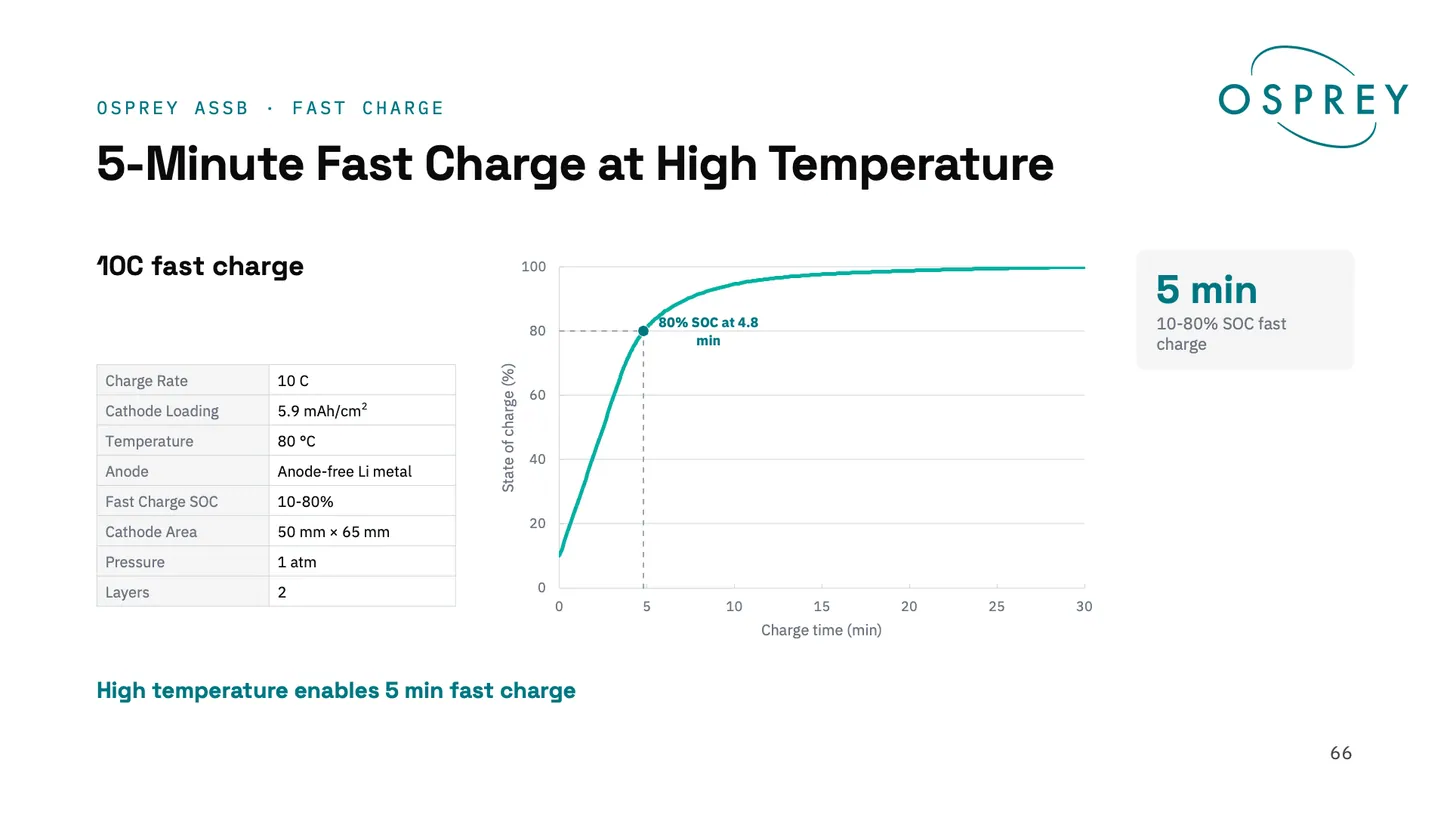
QuantumScape also reported charging from 10% to 80% in five minutes. However, that result was achieved at 176°F (80°C), far hotter than a typical EV battery would get during fast charging. QuantumScape’s own chart is titled “5-Minute Fast Charge at High Temperature.”
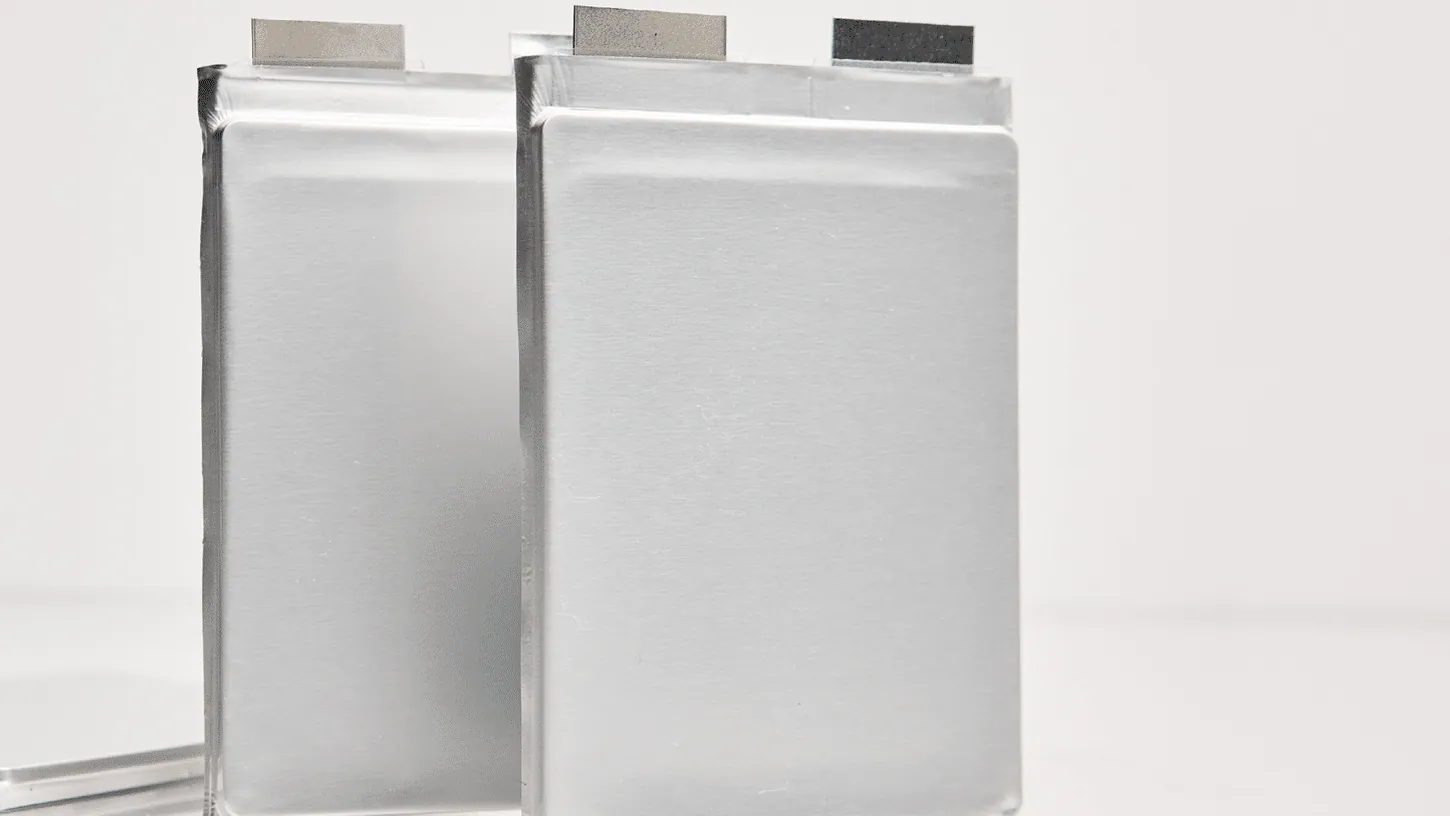
QuantumScape estimates its batteries could reach an energy density of approximately 1,100 watt-hours per liter (Wh/L). However, the thick cathodes behind that estimate have only been tested in a much smaller, coin-sized cell under three times normal atmospheric pressure. QuantumScape’s current QSE-5 cell, by comparison, already achieves 844 Wh/L and 301 Wh/kg.
In cold-weather testing at -4°F (-20°C), a small, single-layer battery cell delivered 68% of the capacity it could provide at room temperature. The test was conducted at a relatively low discharge rate.
EVXL previously covered a separate lithium-metal battery experiment reaching 700 Wh/kg. Another EVXL article examined Rimac’s expectation of solid-state batteries reaching production vehicles around 2030 and matching conventional battery costs around 2035.
For EV customers, Osprey changes nothing immediately. QuantumScape must still demonstrate larger cells suitable for electric vehicles.
EVXL’s Take
Osprey’s biggest achievement is combining a fully solid-state design with up to 1,000 charging cycles under low pressure. That addresses two longstanding obstacles for solid-state batteries. But the five-minute charging claim comes from an unusually hot laboratory test, and the energy-density figure remains an estimate. A full-size cell delivering similar performance under normal EV operating conditions would be much stronger evidence that Osprey is ready for cars.
Sources: QuantumScape, QuantumScape Osprey white paper
EVXL uses automated tools to support research and source retrieval. All reporting is by Damien Kesteloo, edited by Haye Kesteloo.