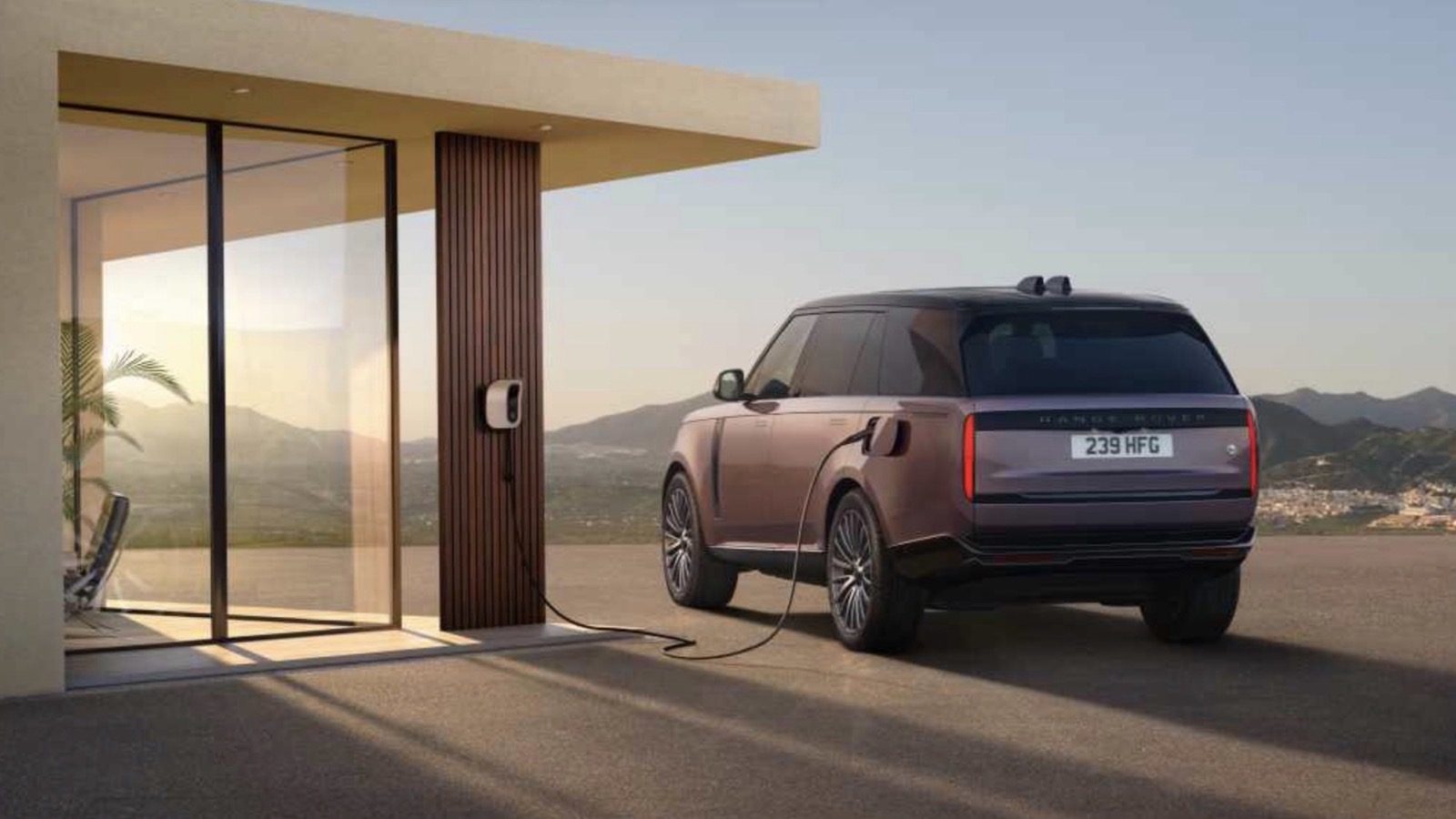
Land Rover opened order books on September 2 for the first fully electric Range Rover in the nameplate’s 56-year history, and in the United States the switch to batteries costs real money: $140,550 delivered, $24,800 more than the equivalent gas model.
Two motors produce 542 horsepower and 627 pound-feet (850 newton-meters) of torque, more twist than any Range Rover before it, enough for 0 to 60 mph in 4.3 seconds. Land Rover claims up to 333 miles (535 kilometers) of real-world range from the 118.5 kWh battery.
The design is untouched, and that is the entire strategy. The company redesigned nothing a customer can see, swapped the engine for motors, and priced the difference at $24,800. Whether Range Rover buyers pay it is now the most interesting question in luxury EVs.
The Electric Range Rover Keeps the Gas Car’s Body
Land Rover builds the Range Rover Electric on the same production line as the gas and hybrid versions at Solihull, the plant JLR spent years converting, as EVXL reported when JLR posted decade-high profits in May 2025. The visible changes are aerodynamic: a slipperier grille and a tailored underbody. New wheel designs round out the package, which together adds up to 10 miles (16 kilometers) of highway range.
The company describes the principle in its launch announcement as building “a Range Rover first and Electric second.” The cabin follows the same logic. A curated First Edition comes in Belgravia Green, Santorini Black or Varesine Blue with a Light Cloud Ultrafabrics and Kvadrat interior, and the Range Rover Bespoke program handles anything beyond that. Short and long wheelbase bodies are available across SE, HSE, Autobiography and SV grades.
Land Rover Claims 333 Miles of Real-World Range
Land Rover estimates up to 333 miles (535 kilometers) of real-world driving from the 118.5 kWh pack. The WLTP figure is 372 miles (600 kilometers). The EPA has published nothing yet, so every range number attached to this SUV is the manufacturer’s own.
That distinction matters at this price. Cold weather, speed, and payload will pull the real number down for some owners, and the certification test will settle where the official rating lands. Land Rover’s ThermAssist heat pump system is designed to protect range in extreme temperatures, adding up to 25 miles by the company’s measure. The propulsion hardware carries an eight-year, 100,000-mile warranty.
The 800-Volt Battery Charges From 10 to 80 Percent in 22 Minutes
Plugged into a 350 kW DC fast charger, the 800-volt system takes the battery from 10 to 80 percent in about 22 minutes, or adds 137 miles (220 kilometers) in 10 minutes under WLTP conditions. US cars get a NACS port with Tesla Supercharger access.
That port is the quiet win for American buyers. No adapter, no second app, just the network that pushed Volkswagen and nearly every other automaker toward Tesla’s connector. At home, a 22 kW AC charger fills the pack in about seven hours by Land Rover’s estimate.
Electric Motors React to Wheel Slip in 50 Milliseconds, Land Rover Says
Off-road hardware carries over: height-adjustable air suspension and a wading depth of 35 inches (900 millimeters), matching the gas model. What changes is control. Land Rover says its Integrated Traction Management adjusts motor speed within 50 milliseconds, up to 100 times quicker than a combustion equivalent.
The 100-times figure is the company’s own; nobody independent has timed it. The underlying physics is real, though. Electric motors meter torque far faster than any engine and gearbox, and a new Single Pedal mode uses that precision to crawl up 33-degree slopes or complete rolling climbs of up to 45 degrees on the accelerator alone.
Pricing Lands $9,200 Above Land Rover’s Own Plug-In Hybrid
Kelley Blue Book puts the US price at $140,550 including a $2,550 destination fee, from a $138,000 MSRP. A delivered P400 SE gas model runs $115,750, a gap of $24,800, and the P550e plug-in hybrid at $131,350 sits just $9,200 below the EV.
The 2027 model year SUV ships from the United Kingdom, which makes trade policy part of the sticker. UK-built vehicles enter the US under the 10 percent tariff rate negotiated in May 2025, the deal that let JLR restart its US EV exports after a month-long pause. In the UK, the EV starts at £154,070 on the road.
EVXL’s Take
Land Rover just built the least adventurous first EV in the luxury segment, and I think that’s the smartest thing about it. The company whose sister brand Jaguar burned its identity down for an electric rebrand chose the opposite play: change nothing the customer can see, and let the badge do the convincing.
The pricing tells you who this is for. At $9,200 over Land Rover’s own P550e, the EV is a rounding error for a Range Rover buyer. Against actual electric rivals it’s a harder sell, because the Lucid Gravity and Porsche Cayenne Electric both clear 400 miles (644 kilometers) while Land Rover claims 333. Credit where due: publishing a real-world figure below the WLTP number is more honest than this industry usually manages, and I’d rather have a straight 333 than an inflated 400. Honesty doesn’t add miles, though.
Demand looks real. The waitlist had passed 61,000 sign-ups when EVXL covered JLR’s Defender Sport plans in June 2025. Two numbers will tell the story from here: how many of those names convert at $140,550, and what the EPA certification says when it lands. If the official rating comes in under Land Rover’s own claim, the one straight-talking range number in this class gets tested in public.
Sources: JLR, Kelley Blue Book
EVXL uses automated tools to support research and source retrieval. All reporting is by Damien Kesteloo, edited by Haye Kesteloo.