Tesla cut its 2026 capital spending forecast to about $20 billion from more than $25 billion on Wednesday, after spending $4.7 billion in the third quarter against the $7.5 billion analysts expected. Free cash flow came in at $1.53 billion against an expected $4.92 billion burn. The shares slipped about 2% on Thursday.
Tesla reported a day after Elon Musk said on SpaceX’s earnings call that both companies have formed special committees to discuss a merger. SpaceX spent $19.6 billion on capital expenditures in the same three months, more than four times Tesla’s figure.
Last Friday, in EVXL’s preview of the two reports, I named Tesla’s automotive gross margin and its capex guidance as the two numbers to watch on this call.
Tesla’s Car Margin Beat As Revenue Held Flat
Tesla’s automotive gross margin excluding regulatory credits was 18.1% in the third quarter, up from 16.3% in the second and above the 16.7% analysts expected, per Visible Alpha data cited by Reuters. Revenue was $28.05 billion, flat on a year ago, and GAAP net income fell 43% to $787 million.
The 486,532 deliveries were already public. Tesla’s Q3 update says it ended the quarter with its largest passenger-vehicle backlog in four years, and that battery availability was the limiting factor on car volumes. Musk told analysts demand is running ahead of production by a wide margin, and Tesla now aims to build 5 million vehicles a year by about 2030, up from an expected 2.5 million this year.
The FSD (Supervised) attach rate passed 75% of new deliveries in North America, nearly 20 points higher than in the second quarter. Active FSD subscriptions, a count that includes upfront purchases, reached 1.74 million.
Tesla Hasn’t Said Where The Roughly $5 Billion Cut Lands
Tesla gave no breakdown of the cut. Executives on Wednesday’s call described it as managing capital deployment efficiently, Reuters reported. The update’s outlook says Tesla will make the most of its existing production capacity before building new factories and production lines.
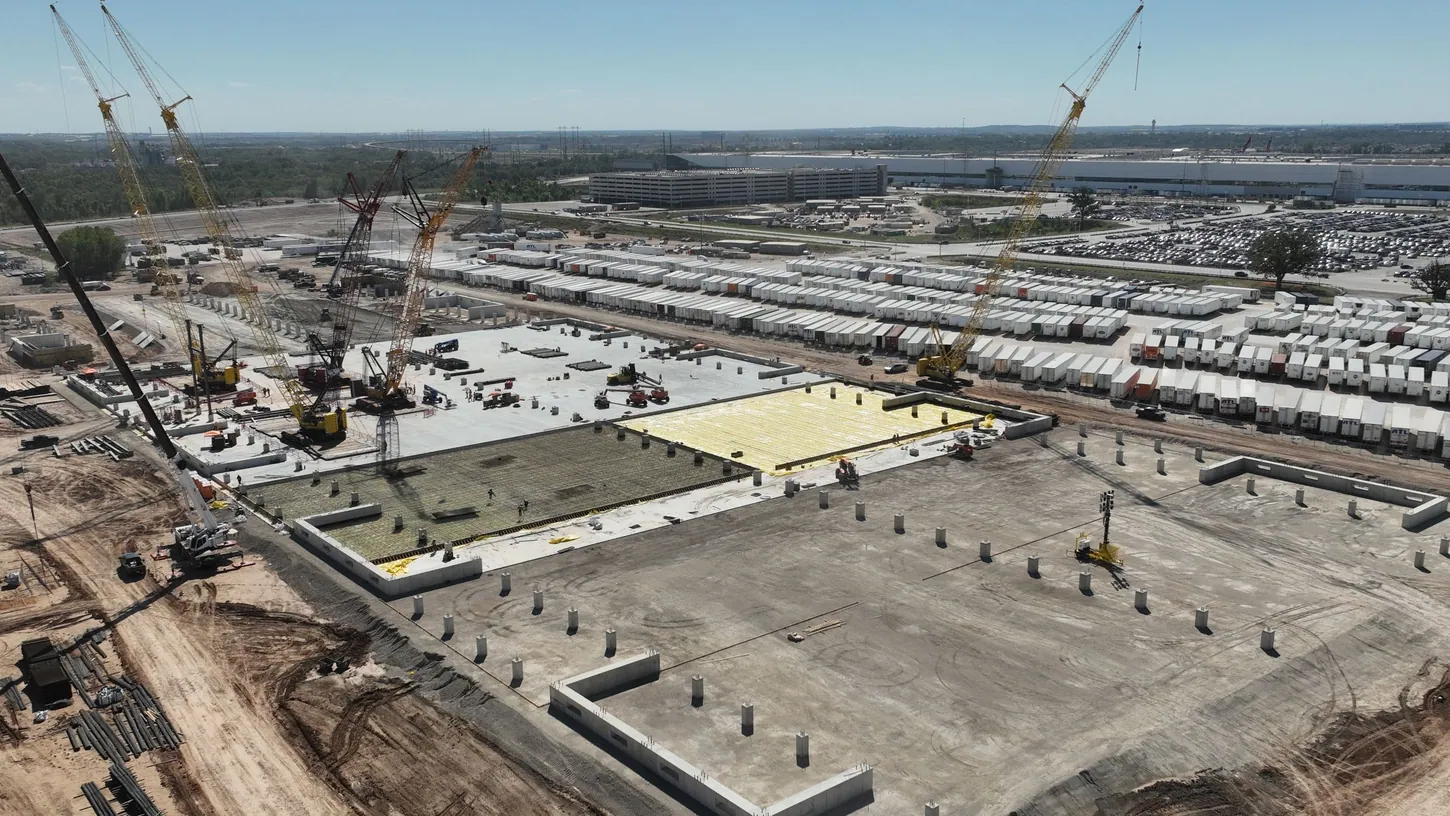
The 10-Q Tesla filed with the SEC puts the forecast above $20 billion, driven by compute infrastructure and data centers, manufacturing and R&D production lines, and its company-operated fleet. Tesla has spent $13.0 billion through September, so the lower number still needs about $7 billion in the fourth quarter, more than any quarter so far this year. Third-quarter capex of $4.73 billion was more than double the $2.25 billion of a year earlier.
Tesla also added borrowing room before the quarter closed. On September 29 it signed three credit agreements with $30 billion of commitments, which the 10-Q says give it flexibility to support planned investments.
Ryan Lee of Direxion, which runs Tesla-linked ETFs, told Reuters the lower spending suggests “less of an ‘all-in’ approach to the AI arms race” than he would expect from Musk.
Tesla’s Committee Can Weigh Deals Short Of A Merger
The 10-Q says Tesla’s board formed a special committee of disinterested directors to explore “deepening Tesla’s relationship with SpaceX,” which could include a business combination but is not limited to one. Any transaction needs that committee’s recommendation and any required shareholder vote.
Musk told SpaceX analysts on Tuesday that he can’t sit in either committee’s talks because he is a conflicted party, and that a merger is not certain. He still sees “a lot of merit to combining the companies,” citing AI software, chip design, robotics and the Terafab chip project the two companies announced in March. On Tesla’s call a day later he said he had nothing more to add. A combined company would be worth about $3.5 trillion.
Tesla already owns part of SpaceX. It paid $2.0 billion for its stake in March and valued it at $2.87 billion on September 30, after a $142 million loss in the third quarter, according to the 10-Q. Those shares stay locked up under the IPO sale restrictions until December.
SpaceX reported $4.4 billion of net income for the quarter, but its earnings release shows $48.1 billion of capex in the first nine months against $13.1 billion of operating cash flow. Of the $19.6 billion it spent in the third quarter, $16.4 billion went to its Super Intelligence segment. Tesla ended September with $45.4 billion in cash and investments.
Musk said a Tesla vote would need half of all outstanding shares, not just the shares voted, TechCrunch reported. Tesla’s proxy cites low retail turnout as one reason for its new retail voting program. The December 3 annual meeting ballot carries no merger proposal.
EVXL’s Take
The car business gave a partial answer to the question I asked in July, when I said the third-quarter margin would show whether Tesla had real pricing power. The 18.1% margin recovered most of the second-quarter slide, but it’s still below the 19.2% Tesla posted in the first quarter.
The capex cut is harder to read as good news. Tesla sells its valuation on Cybercab and Optimus, and it cut this year’s spending plan by about $5 billion without naming what moves out. My read is that the cash Tesla isn’t spending looks most useful to the company it may merge with, whose capex ran at more than three times its operating cash flow through September. Shareholders who bought Tesla as a car and energy company should know what got slowed down before anyone asks them to vote their shares into a business built around SpaceX’s spending.
Sources: Tesla Q3 2026 Update, Tesla Form 10-Q (SEC), SpaceX Q3 2026 earnings release (SEC), Reuters, Reuters, Reuters, TechCrunch
EVXL uses automated tools to support research and source retrieval. All reporting and editorial perspectives are by Haye Kesteloo.