

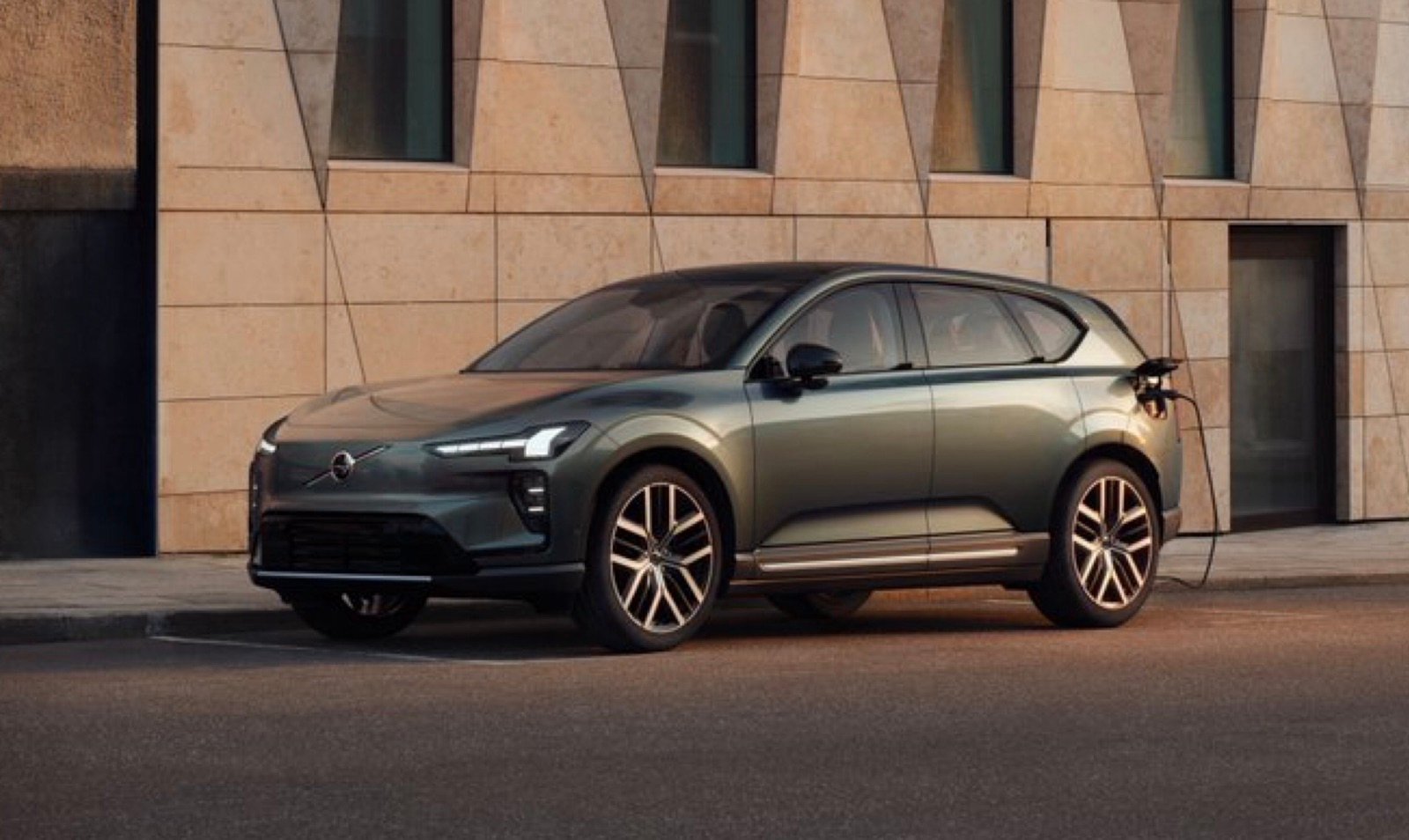
Volvo has officially unveiled its all-electric EX60 mid-size SUV, and the specifications tell a story the Swedish automaker desperately needed to tell. After months of declining EV sales and workforce cuts, today’s reveal in Stockholm delivers a vehicle that directly challenges everything BMW y Mercedes are bringing to market this year.
The numbers speak for themselves: up to 400 miles of EPA-estimated range, 400 kW peak charging speeds, and a native NACS port that connects directly to Tesla’s 75,000+ Supercharger network without adapters.
Here is the TL;DR of what you need to know:
- The Development: Volvo unveiled the EX60 on January 21, 2026, introducing its all-new SPA3 platform with 800-volt architecture and megacasting construction technology.
- The “So What?”: With 400 miles of range and 173 miles added in just 10 minutes of charging, the EX60 eliminates the primary objection consumers cite when avoiding EVs.
- The Price: The mid-range P10 AWD Plus model starts around $60,000, positioning it directly against the BMW iX3 and upcoming Mercedes GLC Electric.
- The Source: Volvo Cars official press release.
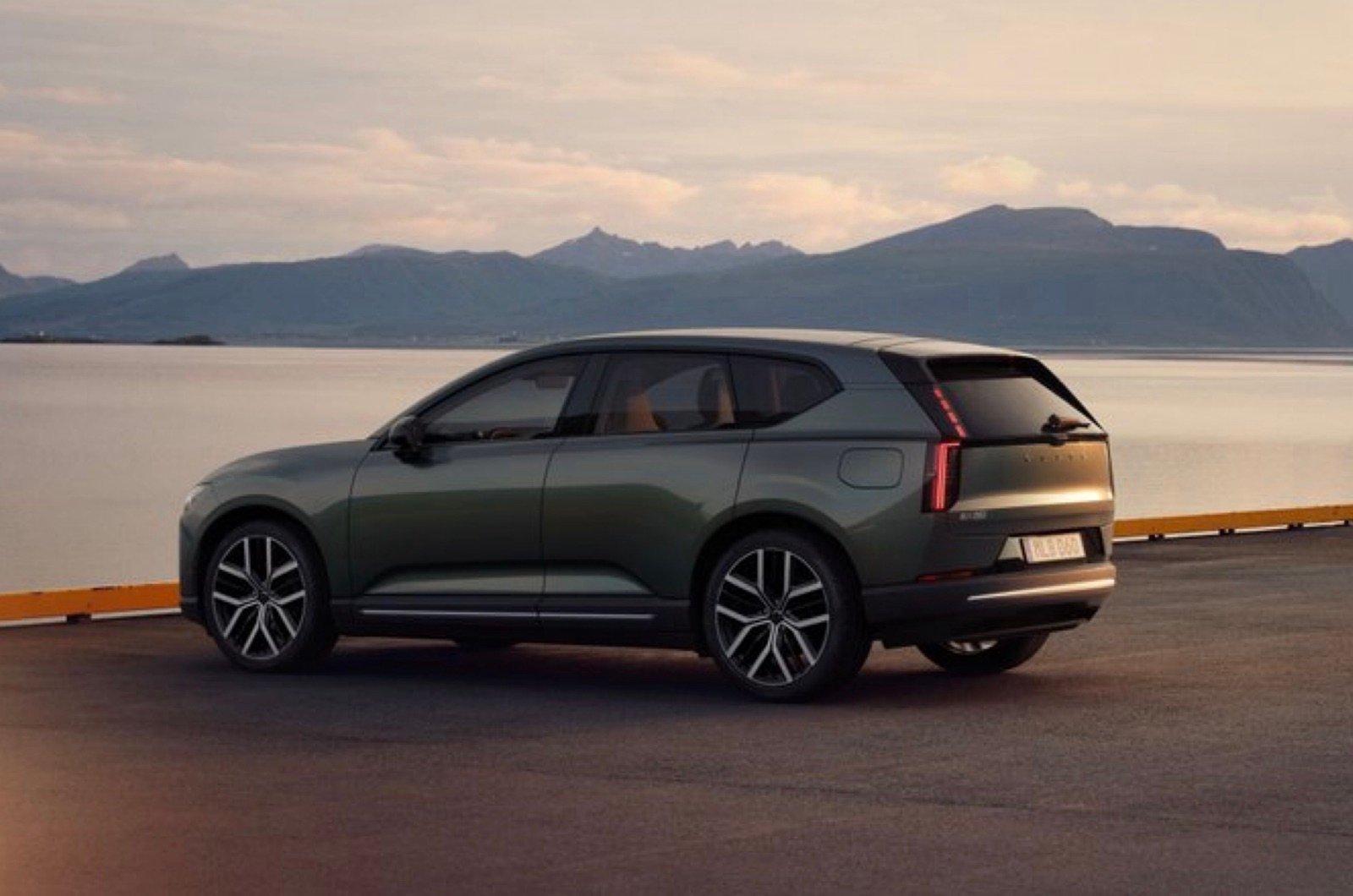
The SPA3 platform marks Volvo’s complete break from combustion heritage
En Volvo EX60 debuts the company’s third-generation Scalable Product Architecture (SPA3), a platform designed exclusively for electric vehicles with no accommodation for internal combustion engines. Unlike the SPA2 platform underpinning the EX90 and ES90, which evolved from hybrid-capable predecessors, SPA3 started with a blank sheet of paper and a single requirement: pure electric performance./
“By 2026, there’s no question that electric cars are the superior product,” said Anders Bell, Volvo’s Chief Technology Officer, during the Stockholm reveal event.
The platform introduces several manufacturing firsts for Volvo. Megacasting technology replaces hundreds of smaller aluminum parts with single high-precision castings, reducing vehicle weight and production complexity. Cell-to-body battery integration builds the battery pack directly into the vehicle structure, improving energy density by 20 percent while cutting weight.
Volvo developed its third-generation electric motors in-house, claiming 93 percent efficiency compared to 91 percent in previous units. The company expects these motors to cost 40 percent less to manufacture than their predecessors.
Three powertrain configurations deliver 310 to 400 miles of range
En EX60 P6 rear-wheel-drive variant produces 369 horsepower from a single electric motor paired with an 80 kWh battery pack, delivering an estimated 310 miles of EPA range. The P10 AWD adds a front motor for 503 combined horsepower and extends range to 320 miles with its 91 kWh pack. The flagship P12 AWD pushes output to 670 horsepower with a 112 kWh battery, achieving the headline 400-mile range figure.
Acceleration times reflect the power hierarchy. The P12 sprints from 0-60 mph in 3.8 seconds, making it one of the quickest mid-size SUVs available regardless of powertrain type. All variants are electronically limited to 112 mph, continuing Volvo’s 2020 decision to cap speeds across its entire lineup.
| Variant | Power | Battery | Range (EPA Est.) | 0-60 mph |
|---|---|---|---|---|
| P6 RWD | 369 hp | 80 kWh | 310 miles | TBD |
| P10 AWD | 503 hp | 91 kWh | 320 miles | TBD |
| P12 AWD | 670 hp | 112 kWh | 400 millas | 3.8 sec |
Native NACS port eliminates Tesla Supercharger adapter hassle
En Volvo EX60 becomes the first Volvo to ship with a native North American Charging Standard (NACS) port, granting direct access to Tesla’s Supercharger network without requiring the $175 adapters that BMW, Mercedes, and even Volvo’s own EX90 owners currently need. This integration connects EX60 drivers to over 25,000 Tesla Supercharger stalls across North America.
The 800-volt electrical architecture enables charging speeds up to 400 kW on the P10 and P12 models, dropping to 350 kW on the entry-level P6. In practical terms, all variants charge from 10 to 80 percent in under 20 minutes when connected to appropriate DC fast chargers. Volvo claims a 10-minute charging session adds up to 173 miles of range.
Bidirectional charging arrives as standard equipment, allowing the EX60 to function as a mobile power source with up to 22 kW output. A 19.2 kW onboard charger handles Level 2 AC connections for home charging.
Every EX60 includes a 10-year battery warranty, addressing long-term ownership concerns that continue to affect EV resale values.
Google Gemini integration makes the EX60 Volvo’s first conversational vehicle
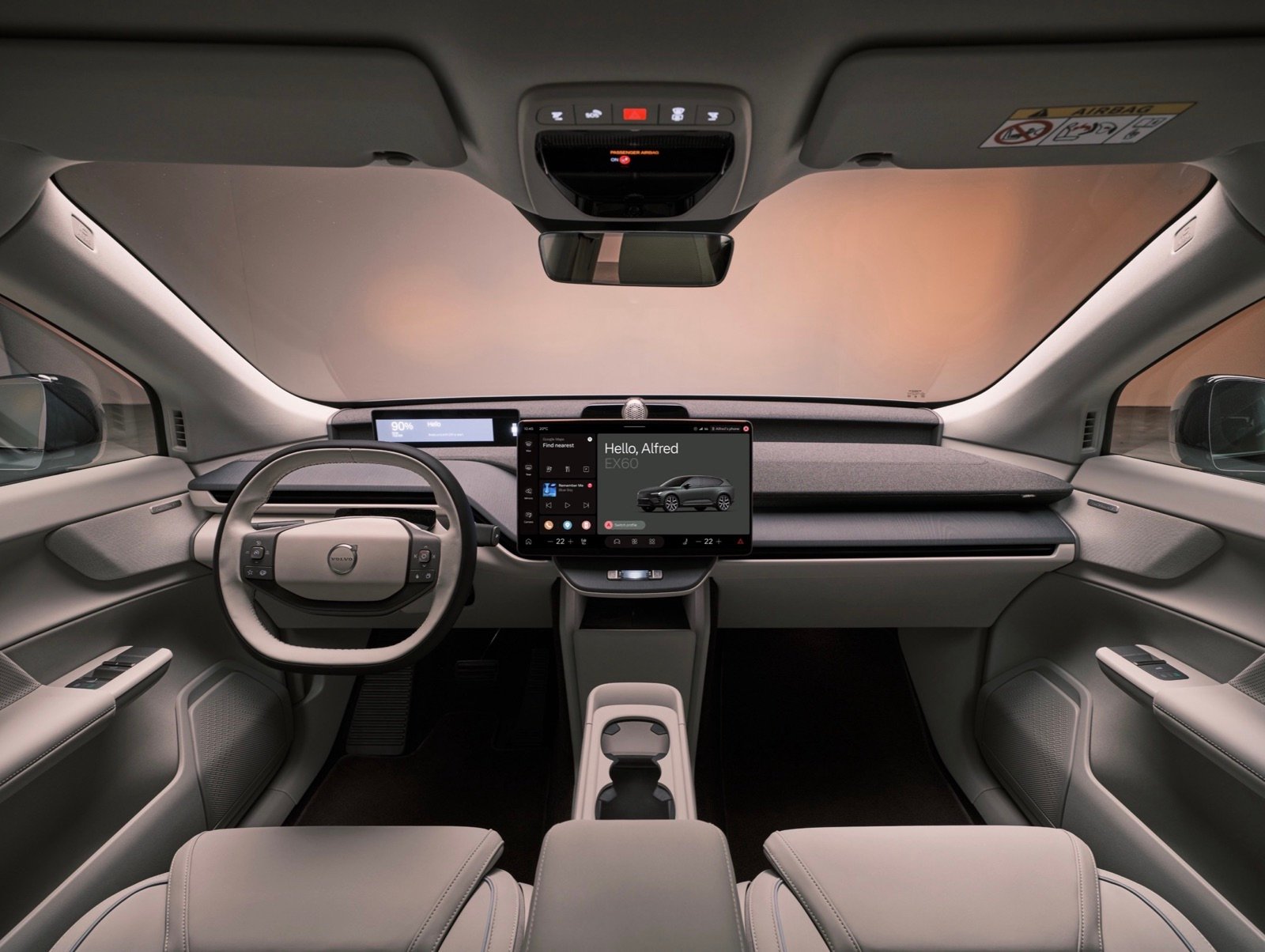
En EX60 debuts as the first Volvo with Google Gemini AI assistant integration, enabling natural language conversations that extend far beyond typical voice commands. Drivers can ask Gemini to search their email for hotel booking addresses, check if recently purchased items fit in the trunk, or brainstorm road trip destinations.
This builds on Volvo’s decade-long partnership with Google and Android Automotive OS. The infotainment system runs on a curved 15-inch OLED display with the highest pixel density in any Volvo to date. Qualcomm’s Snapdragon 8255 chipset provides processing power that Volvo claims delivers the most responsive user experience in any of its vehicles.
Volvo calls its core computing architecture HuginCore, named after the raven in Norse mythology that represents Odin’s mind and senses. The system combines Nvidia DRIVE AGX Orin chips for autonomous driving functions with Qualcomm silicon for infotainment, delivering over 250 trillion operations per second.
Apple Music arrives built into a Volvo for the first time, complete with Dolby Atmos spatial audio support through the available 28-speaker Bowers & Wilkins sound system.
The EX60 Cross Country adds rugged capability without off-road pretense
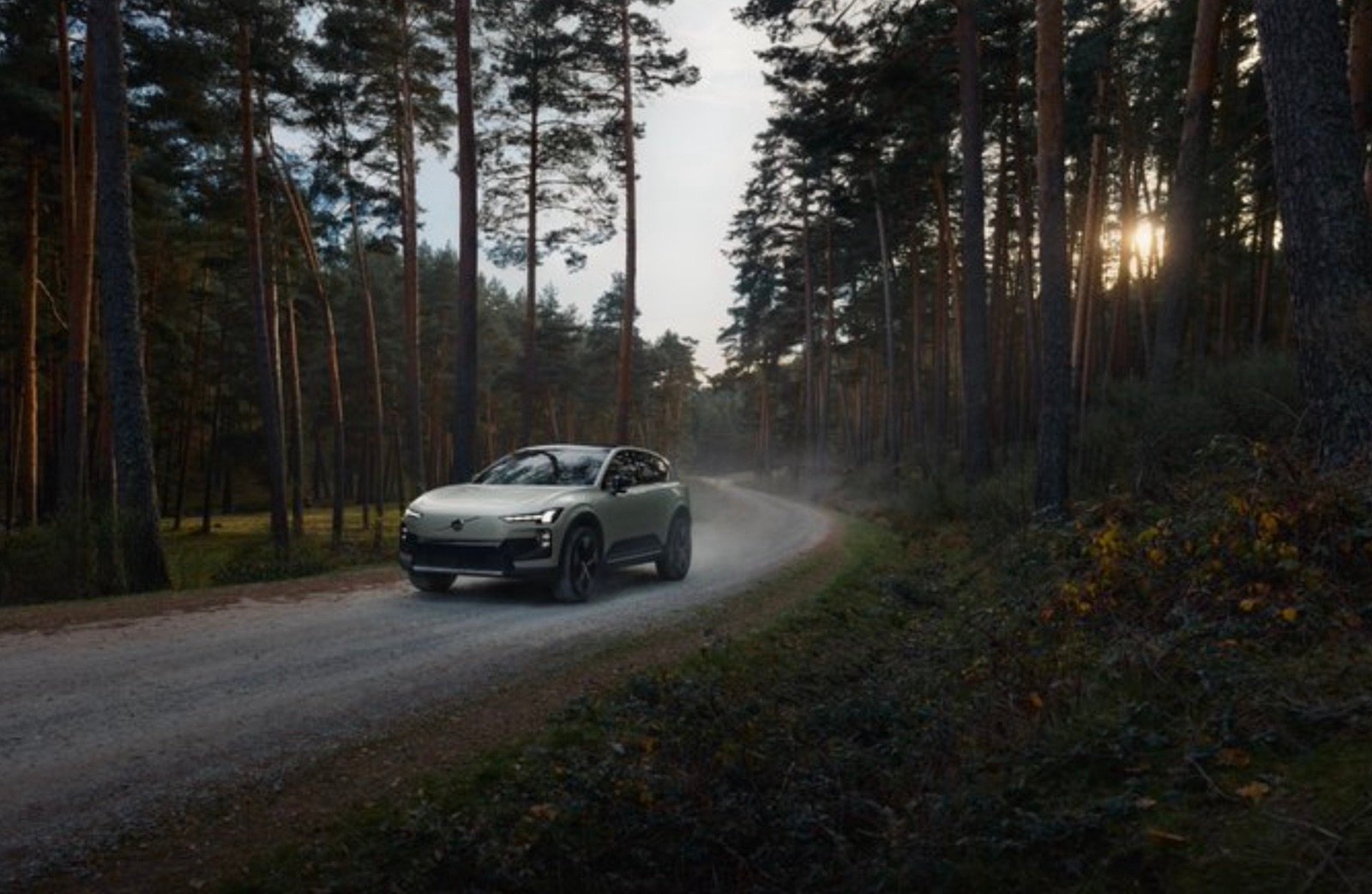
Volvo revealed the EX60 Cross Country alongside the standard model, featuring 20mm (0.8 inches) of additional ride height, air suspension with another 20mm of adjustable lift, stainless steel skid plates, and wider wheel arches with black cladding. The Cross Country comes exclusively in P10 AWD and P12 AWD configurations.
The air suspension automatically lowers the vehicle at highway speeds to reduce drag and improve efficiency, then raises it when conditions warrant additional ground clearance. A unique Forest Lake green exterior color option distinguishes the Cross Country variant.
This approach mirrors Volvo’s traditional Cross Country philosophy: enhanced capability without the aggressive off-road styling that dominates many crossover SUV designs.
Multi-adaptive seat belts represent another Volvo safety innovation
En EX60 introduces multi-adaptive safety belts, a world-first technology that uses real-time sensor data to adjust belt tension and restraint behavior based on the specific crash scenario and the person wearing it. Volvo’s core computing platform processes this data continuously, making split-second adjustments that the company claims will improve front-row passenger protection in real-world collisions.
Unlike the EX90, the EX60 does not include LiDAR sensors for its driver assistance systems. Volvo CTO Anders Bell addressed this directly, noting that advances in camera and radar technology now enable many autonomous functions that previously required LiDAR. The timing proves fortuitous given the recent bankruptcy of Luminar, Volvo’s former LiDAR partner.
The Nvidia DRIVE AGX Orin chip powers Volvo’s Pilot Assist system, which includes adaptive cruise control, lane centering, and traffic jam assist. However, no hands-free driving capability is currently available.
U.S. deliveries begin Summer 2026 with P10 Plus around $60,000
Volvo will begin EX60 production at its Torslanda plant in Gothenburg, Sweden during the first half of 2026. U.S. orders open this spring, with deliveries expected to commence in Summer 2026. The P6 and P10 variants enter production first, with the range-topping P12 following later in the year.
A well-equipped P10 AWD Plus with 21-speaker Bose audio and Pilot Assist will cost approximately $60,000, placing it directly against the BMW iX3 50 xDrive at roughly the same price point. The entry-level P6 should start closer to $55,000, while the P12 will likely approach $70,000 or higher.
This pricing positions the EX60 at rough parity with the gas-powered XC60 T6 plug-in hybrid in European markets, a strategic decision that Volvo believes will ease the transition for customers moving from hybrid to pure electric vehicles.
EVXL’s Take
The Volvo EX60 arrives at a critical moment for the Swedish automaker. After reporting 32% EV sales declines y announcing 3,000 job cuts in 2025, Volvo needed a vehicle that could reverse its trajectory. The EX60’s specifications suggest they understood the assignment.
The native NACS port is the most significant feature for American buyers. While BMW owners are still fumbling with $175 adapters to access Tesla Superchargers, EX60 drivers will simply plug in. That convenience advantage compounds over years of ownership.
The competition is fierce. BMW’s iX3 demonstrated 626 miles in real-world testing and offers 400 kW charging as well. Mercedes is bringing its GLC Electric and 800V architecture to the segment. The German brands are not standing still.
But Volvo has something BMW and Mercedes lack: a coherent software story. The Google Gemini integration announced in May 2025 now comes to fruition in the EX60, making it arguably the most intelligent infotainment system available in any vehicle today. Whether buyers care about asking their car to search their email remains to be seen, but the underlying computing architecture positions Volvo for continuous improvement via over-the-air updates.
Expect the EX60 to become Volvo’s volume leader within 18 months of launch. The XC60 sold over 2.7 million units to become Volvo’s best-selling model ever. If the EX60 can capture even a fraction of that demand with electric propulsion, Volvo’s adjusted 90-100% electrification target suddenly looks achievable.
The real test comes this summer when customers can actually drive one. Volvo’s EX90 and EX30 launches were plagued by software issues and delays. If the EX60 delivers on its promises without the growing pains, it could be the vehicle that finally proves Volvo’s electric future is worth waiting for.
Editorial Note: This article was researched and drafted with the assistance of AI to ensure technical accuracy and archive retrieval. All insights, industry analysis, and perspectives were provided exclusively by Haye Kesteloo and our other EVXL authors, editors, and partners to ensure the “Human-First” perspective our readers expect.
Descubra más de EVXL.co
Subscribe to get the latest posts sent to your email.





 English
  Chinese
  Dutch
Dutch  French (Canada)
  French (France)
  German
  Norwegian
  Portuguese
  Spanish (Argentina)
  Spanish (Mexico)
  Spanish (Spain)